Act like a helpful tutor and exlain me :
Give step-by-step solution with explanation and final answer:
solve all sub parts clearlypr———y 6.10.6 Measuring Air Velocity
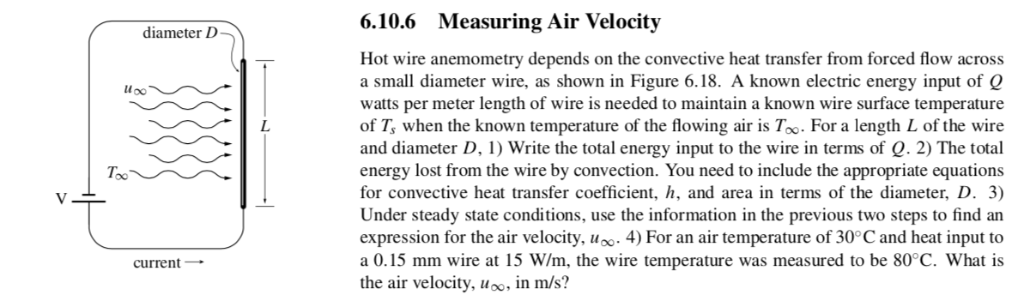
1 —- Hot wire anemometry depends on the convective heat transfer from forced flow across
PR | a small diameter wire, as shown in Figure 6.18. A known electric energy input of Q
= wats per meter length of wire is needed to maintain a known wire surface temperature
ha -al B3 of T; when the known temperature of the flowing air is 7. For a length L of the wire
= and diameter D, 1) Write the total energy input to the wire in terms of Q. 2) The total
Tone energy lost from the wire by convection. You need to include the appropriate equations
v for convective heat transfer coefficient, k, and area in terms of the diameter, D. 3)
= Under steady state conditions, use the information in the previous two steps to find an
expression for the air velocity, ux. 4) For an air temperature of 30°C and heat input to
current — 20.15 mm wire at 15 W/m, the wire temperature was measured to be 80°C. What is
the air velocity, ioc, in m/s?
DOL: xDL(Ts Too) 5B (*57) Pri;
3) ut, = Of (nT — TwkB (2)" Prt):
Question:
Act like a helpful tutor and exlain me :
Give step-by-step solution with explanation and final answer:
solve all sub parts clearlypr———y 6.10.6 Measuring Air Velocity
1 —- Hot wire anemometry depends on the convective heat transfer from forced flow across
PR | a small diameter wire, as shown in Figure 6.18. A known electric energy input of Q
= wats per meter length of wire is needed to maintain a known wire surface temperature
ha -al B3 of T; when the known temperature of the flowing air is 7. For a length L of the wire
= and diameter D, 1) Write the total energy input to the wire in terms of Q. 2) The total
Tone energy lost from the wire by convection. You need to include the appropriate equations
v for convective heat transfer coefficient, k, and area in terms of the diameter, D. 3)
= Under steady state conditions, use the information in the previous two steps to find an
expression for the air velocity, ux. 4) For an air temperature of 30°C and heat input to
current — 20.15 mm wire at 15 W/m, the wire temperature was measured to be 80°C. What is
the air velocity, ioc, in m/s?
DOL: xDL(Ts Too) 5B (*57) Pri;
3) ut, = Of (nT — TwkB (2)" Prt):
This is AI generated Response.
Asked by: manish kumar
Created at: 2025-10-13 06:46:01
Final Answer:
RenderedRaw Text
Did you like this answer?
# Step-by-Step Solution: Measuring Air Velocity
Let's solve each sub-part step by step:
---
## **1) Total Energy Input to the Wire (in terms of Q)**
- **Given:**
Electric energy input per unit length of wire = \( Q \) (W/m)
Length of the wire = \( L \) (m)
- **Total energy input to the wire:**
The total energy input, for the entire length, is:
\[
\text{Total energy input} = QL
\]
---
## **2) Total Energy Lost from the Wire by Convection**
- **Convective heat transfer equation:**
\[
\text{Heat loss by convection} = hA(T_s - T_\infty)
\]
Where:
- \( h \) = convective heat transfer coefficient (W/m²·K)
- \( A \) = surface area for heat transfer (for a wire: \( A = \pi D L \))
- \( T_s \) = surface temperature of wire (°C or K)
- \( T_\infty \) = ambient air temperature (°C or K)
- **For a cylinder in cross flow, \( h \) can be found using the Nusselt number, \( Nu \):**
\[
Nu = \frac{hD}{k}
\]
Where \( k \) is the thermal conductivity of air.
- **Empirical correlation for Nusselt number:**
\[
Nu = B \left( \frac{u_\infty D}{\nu} \right)^n Pr^{1/3}
\]
Where:
- \( B, n \) = empirical constants (from literature)
- \( u_\infty \) = air velocity
- \( D \) = wire diameter
- \( \nu \) = kinematic viscosity of air
- \( Pr \) = Prandtl number of air
- **So,**
\[
h = \frac{Nu \cdot k}{D} = \frac{k}{D} B \left( \frac{u_\infty D}{\nu} \right)^n Pr^{1/3}
\]
- **Total heat loss by convection:**
\[
QL = h \cdot \pi D L (T_s - T_\infty)
\]
Substitute for \( h \):
\[
QL = \left[ \frac{k}{D} B \left( \frac{u_\infty D}{\nu} \right)^n Pr^{1/3} \right] \pi D L (T_s - T_\infty)
\]
Simplify:
\[
QL = \pi D L (T_s - T_\infty) \frac{k}{D} B \left( \frac{u_\infty D}{\nu} \right)^n Pr^{1/3}
\]
\[
QL = \pi L (T_s - T_\infty) k B \left( \frac{u_\infty D}{\nu} \right)^n Pr^{1/3}
\]
---
## **3) Expression for Air Velocity \( u_\infty \) (Steady State)**
- **From the above, for unit length (\( L = 1 \)):**
\[
Q = \pi (T_s - T_\infty) k B \left( \frac{u_\infty D}{\nu} \right)^n Pr^{1/3}
\]
- **Solve for \( u_\infty \):**
\[
Q = \pi (T_s - T_\infty) k B D^n u_\infty^n \nu^{-n} Pr^{1/3}
\]
\[
u_\infty^n = \frac{Q}{\pi (T_s - T_\infty) k B (D/\nu)^n Pr^{1/3}}
\]
\[
u_\infty^n = \frac{Q}{\pi (T_s - T_\infty) k B} \cdot \frac{\nu^n}{D^n Pr^{1/3}}
\]
\[
u_\infty^n = \frac{Q}{\pi (T_s - T_\infty) k B (D/\nu)^n Pr^{1/3}}
\]
---
## **4) Numerical Example**
- **Given:**
- Air temperature, \( T_\infty = 30^\circ C \)
- Wire temperature, \( T_s = 80^\circ C \)
- Heat input per length, \( Q = 5 \) W/m
- Wire diameter, \( D = .15 \) mm \( = .00015 \) m
- **Find:**
Air velocity, \( u_\infty \) (in m/s)
**Assume (for air at 30°C):**
- \( k \approx .026 \) W/m·K
- \( \nu \approx 1.6 \times 10^{-5} \) m²/s
- \( Pr \approx .7 \)
- Use typical empirical values for a cylinder:
- \( B \approx .47 \)
- \( n \approx .5 \) (for turbulent flow)
Now, plug values into the derived formula:
\[
u_\infty^n = \frac{Q}{\pi (T_s - T_\infty) k B (D/\nu)^n Pr^{1/3}}
\]
Substitute:
- \( Q = 5 \) W/m
- \( T_s - T_\infty = 80 - 30 = 50 \) K
- \( k = .026 \) W/m·K
- \( B = .47 \)
- \( D = .00015 \) m
- \( \nu = 1.6 \times 10^{-5} \) m²/s
- \( Pr = .7 \)
- \( n = .5 \)
Calculate \( (D/\nu)^n \):
\[
\frac{D}{\nu} = \frac{.00015}{1.6 \times 10^{-5}} = 9.375
\]
\[
(D/\nu)^n = (9.375)^{.5} = \sqrt{9.375} \approx 3.062
\]
\[
Pr^{1/3} = (.7)^{1/3} \approx .887
\]
Now, compute denominator:
\[
\pi (T_s - T_\infty) k B (D/\nu)^n Pr^{1/3}
\]
\[
= \pi \times 50 \times .026 \times .47 \times 3.062 \times .887
\]
Let's compute step by step:
- \( \pi \times 50 = 157.08 \)
- \( 157.08 \times .026 = 4.084 \)
- \( 4.084 \times .47 = 1.920 \)
- \( 1.920 \times 3.062 = 5.882 \)
- \( 5.882 \times .887 = 5.218 \)
So, denominator ≈ **5.22**
Now, solve for \( u_\infty^n \):
\[
u_\infty^{.5} = \frac{Q}{5.22} = \frac{5}{5.22} = .958
\]
\[
u_\infty = (.958)^2 = .918~\text{m/s}
\]
---
## **Final Answer**
### **Air velocity, \( u_\infty \), is approximately:**
\[
\boxed{.92~\text{m/s}}
\]
---
### **Summary Table**
| Subpart | Formula/Result |
|---------|------------------------------------------------------------------------------------|
| 1 | Total energy input: \( QL \) |
| 2 | Energy lost by convection: \( \pi D L (T_s - T_\infty) \frac{k}{D} B \left( \frac{u_\infty D}{\nu} \right)^n Pr^{1/3} \) |
| 3 | \( u_\infty^n = \frac{Q}{\pi (T_s - T_\infty) k B (D/\nu)^n Pr^{1/3}} \) |
| 4 | \( u_\infty \approx .92~\text{m/s} \) |
---
Let me know if you want to see the calculation with other values or further explanation!
VIPSolutions focuses on clear, step‑by‑step explanations so you can learn quickly. Whether you need an AI‑generated walkthrough or a short hint to get unstuck, each solution is organized for fast reading and easy review later.
Search similar questions, compare approaches, and bookmark the best answers for revision. Our goal is simple: quick, reliable study help that feels natural—not noisy.
 VIPSolutions
 pr———y 6.10.6 Measuring Air Velocity
1 —- Hot wire anemometry depends on the convective heat transfer from forced flow across
PR | a small diameter wire, as shown in Figure 6.18. A known electric energy input of Q
= wats per meter length of wire is needed to maintain a known wire surface temperature
ha -al B3 of T; when the known temperature of the flowing air is 7. For a length L of the wire
= and diameter D, 1) Write the total energy input to the wire in terms of Q. 2) The total
Tone energy lost from the wire by convection. You need to include the appropriate equations
v for convective heat transfer coefficient, k, and area in terms of the diameter, D. 3)
= Under steady state conditions, use the information in the previous two steps to find an
expression for the air velocity, ux. 4) For an air temperature of 30°C and heat input to
current — 20.15 mm wire at 15 W/m, the wire temperature was measured to be 80°C. What is
the air velocity, ioc, in m/s?
DOL: xDL(Ts Too) 5B (*57) Pri;
3) ut, = Of (nT — TwkB (2)" Prt):