VIPSolutions logo ✨ VIPSolutions

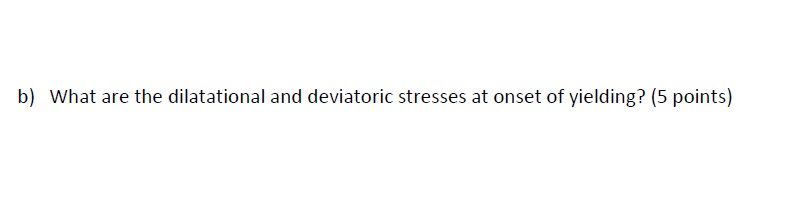
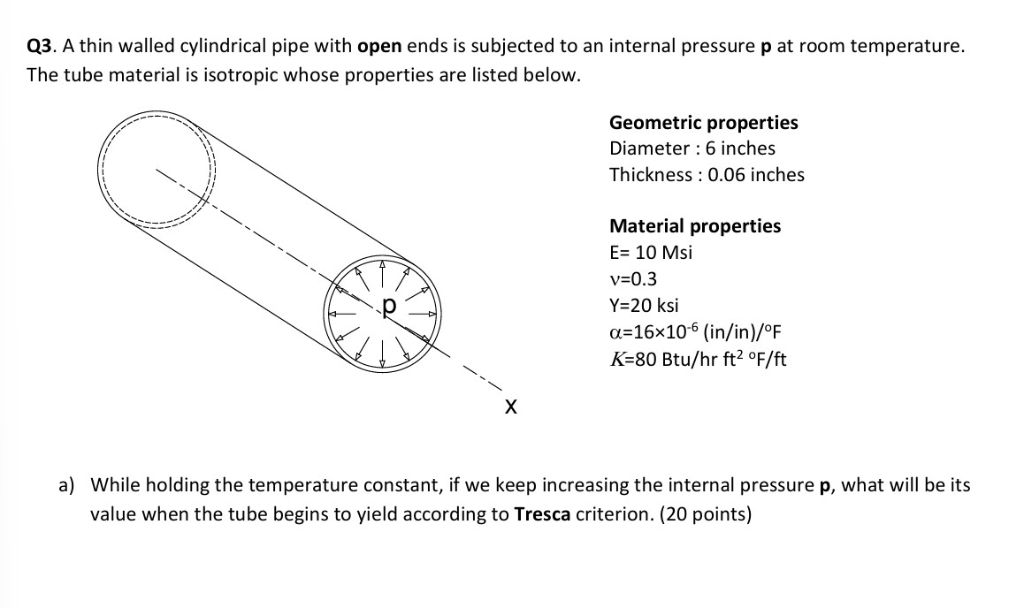
Act like a helpful tutor and exlain me : Give step-by-step solution with explanation and final answer: solve all sub parts clearlyQ3. A thin walled cylindrical pipe with open ends is subjected to an internal pressure p at room temperature. The tube material is isotropic whose properties are listed below. ZT Geometric properties 74 WN Diameter : 6 inches - Thickness : 0.06 inches Ne NL Material properties ~ § 8 = E=10 Msi SENT v=03 , p A Y=20 ksi 2 2 a=16x10"® (in/in)/°F Lay K=80 Btu/hr ft? °F/ft bd X a) While holding the temperature constant, if we keep increasing the internal pressure p, what will be its value when the tube begins to yield according to Tresca criterion. (20 points) b) What are the dilatational and deviatoric stresses at onset of yielding? (5 points)
Question:

Act like a helpful tutor and exlain me : Give step-by-step solution with explanation and final answer: solve all sub parts clearlyUploaded ImageUploaded ImageQ3. A thin walled cylindrical pipe with open ends is subjected to an internal pressure p at room temperature. The tube material is isotropic whose properties are listed below. ZT Geometric properties 74 WN Diameter : 6 inches - Thickness : 0.06 inches Ne NL Material properties ~ § 8 = E=10 Msi SENT v=03 , p A Y=20 ksi 2 2 a=16x10"® (in/in)/°F Lay K=80 Btu/hr ft? °F/ft bd X a) While holding the temperature constant, if we keep increasing the internal pressure p, what will be its value when the tube begins to yield according to Tresca criterion. (20 points) b) What are the dilatational and deviatoric stresses at onset of yielding? (5 points)

This is AI generated Response.
Asked by: manish kumar
Created at: 2025-10-12 18:14:51

Final Answer:

Rendered Raw Text
Did you like this answer?
# Step-by-Step Solution ## **Given Data** **Geometric Properties:** - Diameter (\(d\)) = 6 in - Thickness (\(t\)) = .06 in **Material Properties:** - Young's modulus (\(E\)) = 10 Msi - Poisson's ratio (\(\nu\)) = .3 - Yield strength (\(Y\)) = 20 ksi - Coefficient of thermal expansion (\(\alpha\)) = \(16 \times 10^{-6}\) (in/in)/°F - Thermal conductivity (\(K\)) = 80 Btu/hr ft² °F/ft --- ## a) **Find the value of internal pressure \(p\) when the tube begins to yield (Tresca Criterion)** ### **Step 1: Stresses in a Thin-Walled Cylinder** For a thin-walled cylinder under internal pressure \(p\): - **Hoop (circumferential) stress:** \[ \sigma_h = \frac{p r}{t} \] - **Longitudinal (axial) stress:** \[ \sigma_a = \frac{p r}{2t} \] Where \(r = \frac{d}{2}\) is the inner radius. ### **Step 2: Tresca Yield Criterion** The Tresca criterion says yielding starts when the maximum shear stress reaches half the yield strength: \[ \max |\sigma_i - \sigma_j| = Y \] For this cylinder: - Principal stresses: \(\sigma_1 = \sigma_h\), \(\sigma_2 = \sigma_a\), \(\sigma_3 = \) (assuming open ends) So, the differences are: - \(|\sigma_h - \sigma_a|\) - \(|\sigma_h - |\) - \(|\sigma_a - |\) The largest is \(|\sigma_h - | = \sigma_h\). ### **Step 3: Set Up the Yield Condition** At yield, \[ \sigma_h = Y \] Plug in the formula for hoop stress: \[ \frac{p r}{t} = Y \] \[ p = \frac{Y t}{r} \] --- ### **Step 4: Plug in the Numbers** - \(Y = 20\,\text{ksi} = 20,000\,\text{psi}\) - \(t = .06\,\text{in}\) - \(d = 6\,\text{in} \implies r = 3\,\text{in}\) Now, \[ p = \frac{20,000 \times .06}{3} \] \[ p = \frac{1,200}{3} = 400\,\text{psi} \] --- ### **Final Answer (Part a):** \[ \boxed{p = 400\,\text{psi}} \] --- ## b) **Dilatational and Deviatoric Stresses at Onset of Yielding** ### **Step 1: Stress Components at Yield** At yield: - \(\sigma_h = Y = 20,000\,\text{psi}\) - \(\sigma_a = \frac{Y}{2} = 10,000\,\text{psi}\) - \(\sigma_r = \) (thin wall assumption, neglect radial stress) --- ### **Step 2: Mean (Dilatational) Stress** Mean (hydrostatic or dilatational) stress: \[ \sigma_m = \frac{\sigma_1 + \sigma_2 + \sigma_3}{3} \] \[ \sigma_m = \frac{20,000 + 10,000 + }{3} = \frac{30,000}{3} = 10,000\,\text{psi} \] --- ### **Step 3: Deviatoric Stresses** Deviatoric stress for each principal direction: \[ s_i = \sigma_i - \sigma_m \] - \(s_1 = 20,000 - 10,000 = 10,000\,\text{psi}\) - \(s_2 = 10,000 - 10,000 = \,\text{psi}\) - \(s_3 = - 10,000 = -10,000\,\text{psi}\) --- ### **Final Answers (Part b):** - **Dilatational (mean) stress:** \(\boxed{10,000\,\text{psi}}\) - **Deviatoric stresses:** \(\boxed{10,000\,\text{psi},\, \,\text{psi},\, -10,000\,\text{psi}}\) --- ## **Summary Table** | Quantity | Value | |------------------------------|--------------------------| | Pressure at yield (Tresca) | \(400\,\text{psi}\) | | Dilatational Stress | \(10,000\,\text{psi}\) | | Deviatoric Stresses | \(10,000, , -10,000\) psi | If you have any questions or need a more detailed explanation of any step, let me know!

📢 Instructions:

  • Ask anything relatd to above question only.
  • For new Question goto :

Study Help, Fast Answers

VIPSolutions focuses on clear, step‑by‑step explanations so you can learn quickly. Whether you need an AI‑generated walkthrough or a short hint to get unstuck, each solution is organized for fast reading and easy review later.

Search similar questions, compare approaches, and bookmark the best answers for revision. Our goal is simple: quick, reliable study help that feels natural—not noisy.