 VIPSolutions
Act like a helpful tutor and exlain me : Give step-by-step solution with explanation and final answer: also check wheather reynolds number is high enough to take C_d as givenIn a district cooling plant’s primary chilled-water loop, accurate flow measurement is required to verify pump curves, balance distribution headers, and optimise chiller staging. A sharp-edged orifice plate is installed in a DN100 (10 cm ID) steel main with an orifice diameter of 4.6 cm. A mercury differential manometer across the orifice indicates a column difference of 18 cm. For high Reynolds number operation (Re>30,000), take the orifice discharge coefficient as C4=0.61. Task. Determine the volumetric flow rate of water in the pipe.
Question:
Act like a helpful tutor and exlain me :
Give step-by-step solution with explanation and final answer:
also check wheather reynolds number is high enough to take C_d as given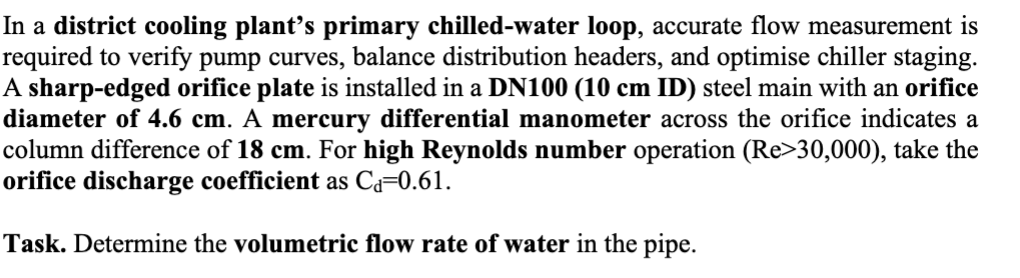 In a district cooling plant’s primary chilled-water loop, accurate flow measurement is
required to verify pump curves, balance distribution headers, and optimise chiller staging.
A sharp-edged orifice plate is installed in a DN100 (10 cm ID) steel main with an orifice
diameter of 4.6 cm. A mercury differential manometer across the orifice indicates a
column difference of 18 cm. For high Reynolds number operation (Re>30,000), take the
orifice discharge coefficient as C4=0.61.
Task. Determine the volumetric flow rate of water in the pipe.
This is AI generated Response.
Asked by: manish kumar
Created at: 2025-10-12 16:29:33
Asked by: manish kumar
Created at: 2025-10-12 16:29:33
Final Answer:
Rendered
Raw Text
Did you like this answer?
Let's **solve step-by-step** and check if the Reynolds number is high enough for the given \( C_d \).
---
## **Step 1: List Given Data**
- **Pipe diameter, \( D \) = 10 cm = .10 m**
- **Orifice diameter, \( d \) = 4.6 cm = .046 m**
- **Manometer reading, \( h_{Hg} \) = 18 cm = .18 m (Hg)**
- **Discharge coefficient, \( C_d = .61 \)**
- **High Reynolds number (Re > 30,000)**
- **Fluid: Water**
---
## **Step 2: Calculate Pressure Difference Across Orifice**
A mercury manometer measures the pressure difference as a height of mercury:
\[
\Delta P = \rho_{Hg} \cdot g \cdot h_{Hg}
\]
But the manometer is measuring water, so:
\[
\Delta P = (\rho_{Hg} - \rho_{water}) g h_{Hg}
\]
- \( \rho_{Hg} = 13,600 \) kg/m³
- \( \rho_{water} = 1,000 \) kg/m³
- \( g = 9.81 \) m/s²
- \( h_{Hg} = .18 \) m
\[
\Delta P = (13600 - 100) \cdot 9.81 \cdot .18 = 12600 \cdot 9.81 \cdot .18
\]
\[
= 12600 \cdot 1.7658 \approx 22,265 \text{ Pa}
\]
---
## **Step 3: Orifice Flow Equation**
The volumetric flow rate through an orifice:
\[
Q = C_d \cdot A_2 \cdot \sqrt{\frac{2 \Delta P}{\rho (1-\beta^4)}}
\]
Where:
- \( A_2 = \) area of orifice \( = \frac{\pi}{4} d^2 \)
- \( \beta = \frac{d}{D} \)
- \( \rho = \rho_{water} = 100 \) kg/m³
Calculate \( \beta \):
\[
\beta = \frac{.046}{.10} = .46
\]
Calculate \( 1 - \beta^4 \):
\[
\beta^4 = (.46)^4 \approx .0447
\]
\[
1 - \beta^4 = 1 - .0447 = .9553
\]
Calculate \( A_2 \):
\[
A_2 = \frac{\pi}{4} d^2 = \frac{\pi}{4} (.046)^2 \approx .00166 \text{ m}^2
\]
---
## **Step 4: Plug Values into the Orifice Equation**
\[
Q = .61 \cdot .00166 \cdot \sqrt{\frac{2 \cdot 22265}{100 \cdot .9553}}
\]
First, calculate the square root term:
\[
\frac{2 \cdot 22265}{100 \cdot .9553} = \frac{44530}{955.3} \approx 46.62
\]
\[
\sqrt{46.62} \approx 6.827
\]
Now, multiply:
\[
Q = .61 \cdot .00166 \cdot 6.827
\]
\[
= .61 \cdot .01134
\]
\[
= .00692 \text{ m}^3/\text{s}
\]
---
## **Step 5: Final Answer**
\[
\boxed{Q = .00692 \ \text{m}^3/\text{s} = 6.92 \ \text{L/s}}
\]
---
## **Step 6: Check Reynolds Number**
Find velocity at orifice:
\[
v_2 = \frac{Q}{A_2} = \frac{.00692}{.00166} \approx 4.17 \text{ m/s}
\]
\[
Re = \frac{v_2 \cdot d}{\nu}
\]
- Kinematic viscosity of water at room temp, \( \nu \approx 1 \times 10^{-6} \) m²/s
\[
Re = \frac{4.17 \cdot .046}{1 \times 10^{-6}} = .1918 \times 10^6 = 191,800
\]
**Since \( Re \gg 30,000 \), the flow is highly turbulent and using \( C_d = .61 \) is valid.**
---
## **Summary Table**
| Quantity | Value |
|---------------------------|--------------|
| Volumetric Flow Rate, Q | .00692 m³/s (6.92 L/s) |
| Orifice Velocity, \( v_2 \) | 4.17 m/s |
| Reynolds Number, Re | 191,800 |
| Is \( C_d \) valid? | **YES** |
---
## **Conclusion**
**The volumetric flow rate of water is:**
\[
\boxed{Q = .00692 \ \text{m}^3/\text{s} = 6.92 \ \text{L/s}}
\]
And \( C_d = .61 \) is valid since \( Re \gg 30,000 \).
📢 Instructions:
- Ask anything relatd to above question only.
- For new Question goto :