 VIPSolutions
Act like a helpful tutor and exlain me : Give step-by-step solution with explanation and final answer:4-4. A thin-walled tube with closed ends i ized i 5 is pressuri GF — 2 pertains, p ized internally and & = 22,000£09-25 (a) At what value of & will instability occur with respect to pressure? h (b) If the tube had an initial diameter of 4 in. and a wall thickness of {5 in, what is the pressure at instability ?
Question:
Act like a helpful tutor and exlain me :
Give step-by-step solution with explanation and final answer: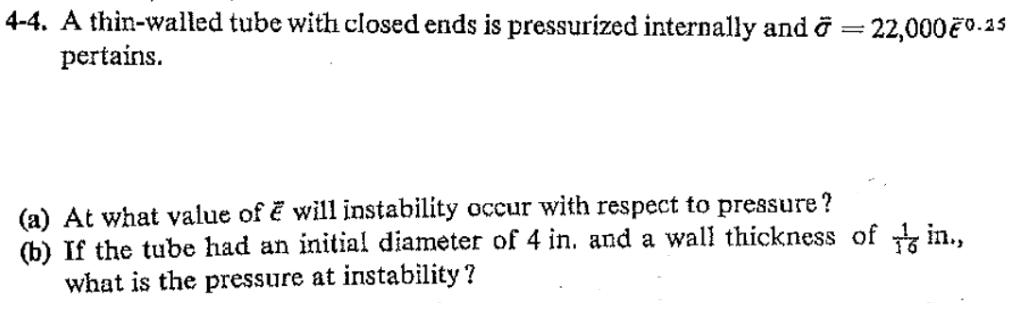 4-4. A thin-walled tube with closed ends i ized i
5 is pressuri GF — 2
pertains, p ized internally and & = 22,000£09-25
(a) At what value of & will instability occur with respect to pressure? h
(b) If the tube had an initial diameter of 4 in. and a wall thickness of {5 in,
what is the pressure at instability ?
This is AI generated Response.
Asked by: manish kumar
Created at: 2025-10-12 09:25:46
Asked by: manish kumar
Created at: 2025-10-12 09:25:46
Final Answer:
Rendered
Raw Text
Did you like this answer?
Let's break down the problem and solve it step by step:
---
## Given
- Stress-strain relation:
\(\bar{\sigma} = 22,000 \bar{\epsilon}^{.25}\)
Where:
- \(\bar{\sigma}\) = true (axial) stress (psi)
- \(\bar{\epsilon}\) = true (axial) strain
A thin-walled tube with closed ends is internally pressurized.
---
## (a) **At what value of \(\bar{\epsilon}\) will instability occur with respect to pressure?**
### **Step 1: Instability Condition**
For thin-walled tubes (cylinders) under internal pressure, **pressure instability** (maximum internal pressure) occurs at the **maximum point of the pressure-strain curve**, i.e., when:
\[
\frac{dP}{d\bar{\epsilon}} =
\]
For a thin-walled tube, the **hoop strain** (circumferential) is related to the **axial strain** for closed ends, but for instability with respect to pressure, we use the following:
The **internal pressure** can be expressed (thin wall) as:
\[
P = \frac{\sigma_{\theta} \, t}{r}
\]
where:
- \(P\): internal pressure
- \(\sigma_{\theta}\): hoop (circumferential) stress
- \(t\): wall thickness
- \(r\): radius
For closed ends, the **axial stress** is half the hoop stress:
\[
\sigma_{z} = \frac{\sigma_{\theta}}{2}
\]
But the instability criterion comes from the **maximum pressure**, which in turn is linked to the **maximum of \(P\) as a function of strain**.
### **Step 2: Express Pressure in Terms of \(\bar{\epsilon}\)**
Let’s relate pressure to strain.
For thin-walled cylinder:
\[
\sigma_{\theta} = \frac{P r}{t}
\]
\[
\sigma_{z} = \frac{P r}{2t}
\]
Given the constitutive relation for the material:
\[
\sigma_{z} = 22{,}000 \bar{\epsilon}^{.25}
\]
So,
\[
\frac{P r}{2t} = 22{,}000 \bar{\epsilon}^{.25}
\]
\[
P = \frac{2t}{r} \cdot 22{,}000 \bar{\epsilon}^{.25}
\]
But as the tube stretches, radius and thickness change:
- \(r = r_ (1 + \bar{\epsilon}_{\theta})\)
- \(t = t_/(1+\bar{\epsilon}_{\theta})\)
- For thin walls, the **hoop strain** relates to the **axial strain** for closed ends by incompressibility (volume constancy), but for instability, what matters is how \(P\) depends on \(\bar{\epsilon}\).
### **Step 3: Find Maximum \(P\) with Respect to \(\bar{\epsilon}\)**
The instability occurs at the **maximum pressure**, i.e., when:
\[
\frac{dP}{d\bar{\epsilon}} =
\]
From above,
\[
P = K \bar{\epsilon}^{.25}
\]
where \(K = \frac{2t}{r} \cdot 22{,}000\) (but \(t\) and \(r\) are functions of strain).
#### However, for power-law solids with closed-end thin-walled cylinders, the instability (maximum pressure) occurs at:
\[
\frac{d\sigma_{z}}{d\bar{\epsilon}} = \sigma_{z}
\]
Plug in the given constitutive relation:
\[
\sigma_{z} = 22,000 \bar{\epsilon}^{.25}
\]
\[
\frac{d\sigma_{z}}{d\bar{\epsilon}} = 22,000 \cdot .25 \bar{\epsilon}^{-.75}
\]
Set:
\[
\frac{d\sigma_{z}}{d\bar{\epsilon}} = \sigma_{z}
\]
So,
\[
22,000 \cdot .25 \bar{\epsilon}^{-.75} = 22,000 \bar{\epsilon}^{.25}
\]
\[
.25 \bar{\epsilon}^{-.75} = \bar{\epsilon}^{.25}
\]
Divide both sides by \(\bar{\epsilon}^{-.75}\):
\[
.25 = \bar{\epsilon}^{.25 + .75} = \bar{\epsilon}^{1}
\]
\[
\bar{\epsilon} = .25
\]
---
### **Final Answer (a):**
\[
\boxed{\bar{\epsilon} = .25}
\]
---
## (b) **If the tube had an initial diameter of 4 in. and wall thickness \(1/16\) in., what is the pressure at instability?**
### **Step 1: Initial Geometry**
- Initial diameter, \(d_ = 4\) in. ⇒ \(r_ = 2\) in.
- Wall thickness, \(t_ = 1/16\) in.
### **Step 2: Calculate \(\sigma_{z}\) at Instability**
From (a), instability at \(\bar{\epsilon} = .25\):
\[
\sigma_{z} = 22,000 \times (.25)^{.25}
\]
Calculate \(.25^{.25}\):
\[
.25^{.25} = e^{.25 \ln .25}
= e^{.25 \times (-1.3863)}
= e^{-.3466}
\approx .7071
\]
So,
\[
\sigma_{z} = 22,000 \times .7071 \approx 15,556 \text{ psi}
\]
### **Step 3: Relate Pressure to Axial Stress**
\[
\sigma_{z} = \frac{P r}{2t}
\implies P = \frac{2 t \sigma_{z}}{r}
\]
But after strain, the final radius and thickness change:
- Axial strain \(\bar{\epsilon}\) = .25
- In thin-walled approximation and small strains, we can use initial geometry for a rough estimate.
\[
P = \frac{2 t_ \sigma_{z}}{r_}
\]
Plug in the numbers:
- \(t_ = \frac{1}{16}\) in. = .0625 in.
- \(r_ = 2\) in.
- \(\sigma_{z} \approx 15,556\) psi
\[
P = \frac{2 \times .0625 \times 15,556}{2}
= .0625 \times 15,556
\approx 972 \text{ psi}
\]
---
### **Final Answer (b):**
\[
\boxed{P \approx 972 \text{ psi}}
\]
---
## **Summary Table**
| Part | Answer |
|------|--------|
| (a) | \(\bar{\epsilon} = .25\) |
| (b) | \(P \approx 972 \text{ psi}\) |
---
Let me know if you'd like to see more detailed derivations or explanations for any step!
📢 Instructions:
- Ask anything relatd to above question only.
- For new Question goto :