 VIPSolutions
Act like a helpful tutor and exlain me : Give step-by-step solution with explanation and final answer:3. You are designing new buckle for car seat harness. You are going to make it out of a polymer material. What material do you choose and why? Think through how many cycles this material needs to last. For reference, it would be reasonable to use a car seat 2-3 times a day, with each time requiring a buckle and an unbuckle, both putting stresses on the structure. Nowadays, car seats are made so that they can adapt and last for at least the first few years of a child's life. They do not require a large amount of force to buckle and unbuckle, likely around 5 MPa.
Question:
Act like a helpful tutor and exlain me :
Give step-by-step solution with explanation and final answer: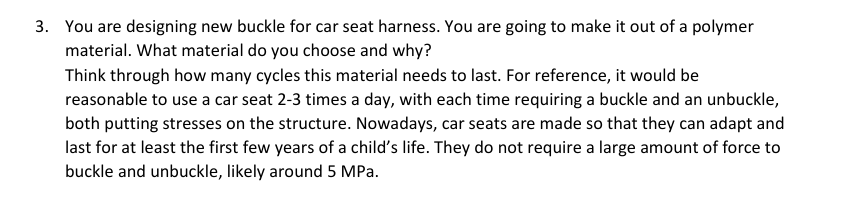 3. You are designing new buckle for car seat harness. You are going to make it out of a polymer
material. What material do you choose and why?
Think through how many cycles this material needs to last. For reference, it would be
reasonable to use a car seat 2-3 times a day, with each time requiring a buckle and an unbuckle,
both putting stresses on the structure. Nowadays, car seats are made so that they can adapt and
last for at least the first few years of a child's life. They do not require a large amount of force to
buckle and unbuckle, likely around 5 MPa.
This is AI generated Response.
Asked by: manish kumar
Created at: 2025-10-11 23:33:25
Asked by: manish kumar
Created at: 2025-10-11 23:33:25
Final Answer:
Rendered
Raw Text
Did you like this answer?
# Step-by-Step Solution
## 1. **Understanding Requirements**
- **Material:** Polymer (plastic)
- **Cycles:** 2-3 uses/day × 365 days/year × 4 years ≈ **300-400 cycles**
- **Force:** Needs to handle **~5 MPa** stress (force to buckle/unbuckle)
- **Durability:** Must last several years, resist wear, not degrade in sunlight/heat, safe for children
---
## 2. **Key Polymer Properties Needed**
- **High fatigue resistance:** Survive repeated loading (buckle/unbuckle)
- **Good impact strength:** Withstand drops/accidents
- **Non-toxic:** Safe for children
- **UV and chemical resistance:** Won’t degrade from sunlight/saliva/cleaning agents
- **Manufacturability:** Can be molded into complex shapes
---
## 3. **Common Polymers for Buckles**
Let’s compare some options:
| Polymer | Pros | Cons |
|--------------|----------------------------------------------|-----------------------------------|
| **Polycarbonate (PC)** | Very high impact and fatigue strength, transparent, safe | Expensive, can scratch |
| **Acetal (POM/Delrin)** | High fatigue strength, self-lubricating, easy to mold, good dimensional stability | Can be brittle in cold, less UV resistant than PC |
| **Nylon (PA 6/6)** | Good strength, flexible, chemical resistance, easy to dye | Absorbs moisture, can warp |
| **Polypropylene (PP)** | Good fatigue resistance, cheap, chemical resistant | Lower strength, less rigid |
---
## 4. **Material Choice and Justification**
### **Best Choice: Acetal (POM, e.g. Delrin)**
- **Why?**
- **High fatigue strength:** Excellent for repeated flexing and snapping.
- **Good dimensional stability:** Shape holds over years, critical for buckle fit.
- **Self-lubricating:** Smooth operation for easy buckling/unbuckling.
- **Safe and widely used:** Common in child safety buckles.
### **Alternative: Polycarbonate (PC)**
- **Why?**
- Even higher impact strength, very tough, but more expensive.
- Used if transparency or extra toughness is needed.
---
## 5. **Cycle Life Calculation**
- **Estimated cycles needed:**
- **3 cycles/day × 365 days/year × 4 years = 438 cycles**
- **Acetal (POM) fatigue life:**
- Survives **tens of thousands** of cycles at moderate stress, well above requirement.
---
## 6. **Stress Check**
- **Required strength:** 5 MPa
- **Yield strength of Acetal:** 60-70 MPa
- **Much higher than required**, so it's safe.
---
## 7. **Final Answer**
### **Material:**
**Acetal (POM, e.g. Delrin)**
### **Why?**
- High fatigue and impact strength, safe for children, easy to mold, self-lubricating, and widely used in buckles. It comfortably exceeds the required cycle life and strength for a car seat harness buckle.
---
## **Summary Table**
| Criteria | Requirement | POM (Acetal) Performance |
|-----------------------|----------------------|-------------------------|
| Fatigue resistance | 400+ cycles | 10,000+ cycles |
| Maximum stress | 5 MPa | 60-70 MPa |
| Impact resistance | High | High |
| Child safety | Non-toxic | Non-toxic |
| Manufacturability | Moldable | Easily molded |
---
### **Conclusion**
**Choose Acetal (POM/Delrin) for the car seat buckle due to its excellent fatigue resistance, high strength, safety, and proven use in similar applications.**
📢 Instructions:
- Ask anything relatd to above question only.
- For new Question goto :