 VIPSolutions
Act like a helpful tutor and exlain me : Give step-by-step solution with explanation and final answer:1) A system consists of 2 kg of carbon dioxide gas initially at state 1, where pi = 1 bar, T1 = 300 K. The system undergoes a power cycle consisting of the following processes: - Process 1-2: Constant volume to p> = 4 bar. - Process 2-3: Expansion with pv!2$= constant. - Process 3-1: Constant-pressure compression. Assuming the ideal gas model and neglecting kinetic and potential energy effects, sketch the cycle on a p—V diagram and calculate the work and heat transfer for each process. Finally, calculate the thermal efficiency of the cycle.
Question:
Act like a helpful tutor and exlain me :
Give step-by-step solution with explanation and final answer: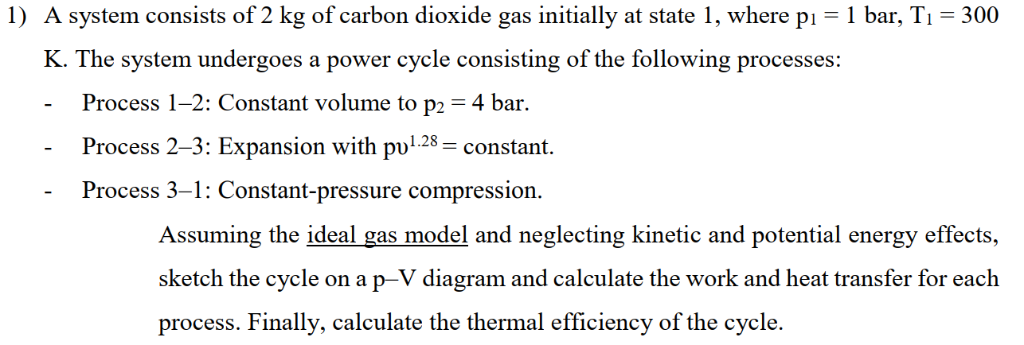 1) A system consists of 2 kg of carbon dioxide gas initially at state 1, where pi = 1 bar, T1 = 300
K. The system undergoes a power cycle consisting of the following processes:
- Process 1-2: Constant volume to p> = 4 bar.
- Process 2-3: Expansion with pv!2$= constant.
- Process 3-1: Constant-pressure compression.
Assuming the ideal gas model and neglecting kinetic and potential energy effects,
sketch the cycle on a p—V diagram and calculate the work and heat transfer for each
process. Finally, calculate the thermal efficiency of the cycle.
This is AI generated Response.
Asked by: manish kumar
Created at: 2025-10-11 20:57:58
Asked by: manish kumar
Created at: 2025-10-11 20:57:58
Final Answer:
Rendered
Raw Text
Did you like this answer?
Let's solve the problem step by step.
---
# **Step 1: Given Data**
- Mass, \( m = 2 \) kg
- Gas: CO\(_2\) (ideal gas assumption)
- State 1: \( p_1 = 1 \) bar \( = 100 \) kPa, \( T_1 = 300 \) K
- Process 1–2: Isochoric (constant volume), \( p_2 = 4 \) bar \( = 400 \) kPa
- Process 2–3: \( p v^{1.28} = \text{constant} \) (polytropic expansion)
- Process 3–1: Isobaric (constant pressure) compression
The specific gas constant for CO\(_2\):
\( R = .1889 \) kJ/kg·K
---
# **Step 2: Find State Properties**
## **At State 1:**
Use the ideal gas law:
\[
p_1 V_1 = m R T_1
\]
\[
V_1 = \frac{m R T_1}{p_1}
\]
\[
V_1 = \frac{2 \times .1889 \times 300}{100} = \frac{113.34}{100} = 1.1334 \text{ m}^3
\]
## **At State 2:**
- \( V_2 = V_1 \) (isochoric)
- \( p_2 = 400 \) kPa
\[
T_2 = \frac{p_2 V_2}{m R}
\]
\[
T_2 = \frac{400 \times 1.1334}{2 \times .1889} = \frac{453.36}{.3778} \approx 120 \text{ K}
\]
---
# **Step 3: Find State 3 Properties**
## **Polytropic Expansion (\( p v^{1.28} = \text{constant} \))**
Let \( V_3 \) be the volume at 3, \( p_3 \) the pressure at 3.
\[
p_2 V_2^{1.28} = p_3 V_3^{1.28}
\implies \left(\frac{V_3}{V_2}\right)^{1.28} = \frac{p_2}{p_3}
\]
### **But Process 3–1 is Constant Pressure (\( p_3 = p_1 \))**
\[
p_3 = p_1 = 100 \text{ kPa}
\]
\[
\left(\frac{V_3}{V_2}\right)^{1.28} = \frac{400}{100} = 4
\implies \frac{V_3}{V_2} = 4^{1/1.28}
\]
Calculate \( 1/1.28 \approx .78125 \):
\[
\frac{V_3}{V_2} = 4^{.78125} \approx e^{.78125 \ln 4} \approx e^{.78125 \times 1.3863} \approx e^{1.083} \approx 2.953
\]
\[
V_3 = 2.953 \times V_2 \approx 2.953 \times 1.1334 = 3.349 \text{ m}^3
\]
Now, find \( T_3 \):
\[
T_3 = \frac{p_3 V_3}{m R}
= \frac{100 \times 3.349}{2 \times .1889}
= \frac{334.9}{.3778} \approx 886 \text{ K}
\]
---
# **Step 4: Sketch p-V Diagram**
```
Y-axis: Pressure (p)
X-axis: Volume (V)
1: (1 bar, 1.13 m³)
2: (4 bar, 1.13 m³) [vertical up: process 1-2]
3: (1 bar, 3.35 m³) [curve down/right: process 2-3]
Back to 1: (horizontal left: process 3-1)
```
---
# **Step 5: Work and Heat Calculations**
## **Process 1–2: Isochoric (ΔV = )**
\[
W_{1-2} =
\]
\[
Q_{1-2} = m c_v (T_2 - T_1)
\]
For CO\(_2\) (ideal): \( c_v \approx .655 \) kJ/kg·K
\[
Q_{1-2} = 2 \times .655 \times (120 - 300) = 2 \times .655 \times 900 = 2 \times 589.5 = 1179 \text{ kJ}
\]
## **Process 2–3: Polytropic Expansion (\( n = 1.28 \))**
\[
W_{2-3} = \frac{p_3 V_3 - p_2 V_2}{1 - n}
\]
\[
= \frac{100 \times 3.349 - 400 \times 1.1334}{1 - 1.28}
\]
\[
= \frac{334.9 - 453.36}{-.28}
= \frac{-118.46}{-.28} = 423.8 \text{ kJ}
\]
\[
Q_{2-3} = m c_v (T_3 - T_2) + W_{2-3}
\]
\[
= 2 \times .655 \times (886 - 120) + 423.8
= 2 \times .655 \times (-314) + 423.8
= 2 \times (-205.57) + 423.8
= -411.14 + 423.8 = 12.7 \text{ kJ}
\]
## **Process 3–1: Isobaric Compression**
\[
W_{3-1} = p_1 (V_1 - V_3)
= 100 \times (1.1334 - 3.349) = 100 \times (-2.2156) = -221.56 \text{ kJ}
\]
\[
Q_{3-1} = m c_p (T_1 - T_3)
\]
For CO\(_2\) (ideal): \( c_p \approx .844 \) kJ/kg·K
\[
Q_{3-1} = 2 \times .844 \times (300 - 886)
= 2 \times .844 \times (-586)
= 2 \times (-494.78) = -989.56 \text{ kJ}
\]
---
# **Step 6: Cycle Summary**
| Process | \( W \) (kJ) | \( Q \) (kJ) |
|---------|--------------|--------------|
| 1–2 | | 1179 |
| 2–3 | 423.8 | 12.7 |
| 3–1 | -221.56 | -989.56 |
### **Net Work Done**
\[
W_\text{cycle} = + 423.8 - 221.56 = 202.24 \text{ kJ}
\]
### **Net Heat Added**
\[
Q_\text{in} = Q_{1-2} + Q_{2-3} = 1179 + 12.7 = 1191.7 \text{ kJ}
\]
(Only heat input during 1-2 and 2-3.)
---
# **Step 7: Thermal Efficiency**
\[
\eta = \frac{W_\text{cycle}}{Q_\text{in}} = \frac{202.24}{1191.7} = .1697 = 16.97\%
\]
---
# **# Final Answers**
### **a) Work and Heat for Each Process**
- **Process 1–2:** \( W = \) kJ, \( Q = 1179 \) kJ
- **Process 2–3:** \( W = 423.8 \) kJ, \( Q = 12.7 \) kJ
- **Process 3–1:** \( W = -221.56 \) kJ, \( Q = -989.56 \) kJ
### **b) Net Work Output:**
**202 kJ**
### **c) Thermal Efficiency:**
**16.97%**
---
### **d) p-V Diagram Sketch**
```
|
p | 2
| |
| |
| |
| /
| /
|___/__________
1 3
V
```
- 1→2: vertical (constant V, up)
- 2→3: curve down/right (polytropic)
- 3→1: horizontal (constant p, left)
---
**Let me know if you need clarifications or further steps!**
📢 Instructions:
- Ask anything relatd to above question only.
- For new Question goto :