 VIPSolutions
Act like a helpful tutor and exlain me : Give step-by-step solution with explanation and final answer:solve all parts clearlyAconverging-diverging nozzle operates at steady state. Air as an ideal gas with k = 1.4 flows through the nozzle, discharging to the atmosphere at 14.7 Ibf/in.? and 520°R. A normal shock stands at the exit plane with M, = 1.5. The exit plane areas 3.3in.2 Upstream of the shock, the flow is isentropic. Determine: (a) the stagnation pressure po, in Ibf/in.2 (b) the stagnation temperature Toy, in °R. (0) the mass flow rate, in Ib/s.
Question:
Act like a helpful tutor and exlain me :
Give step-by-step solution with explanation and final answer:solve all parts clearly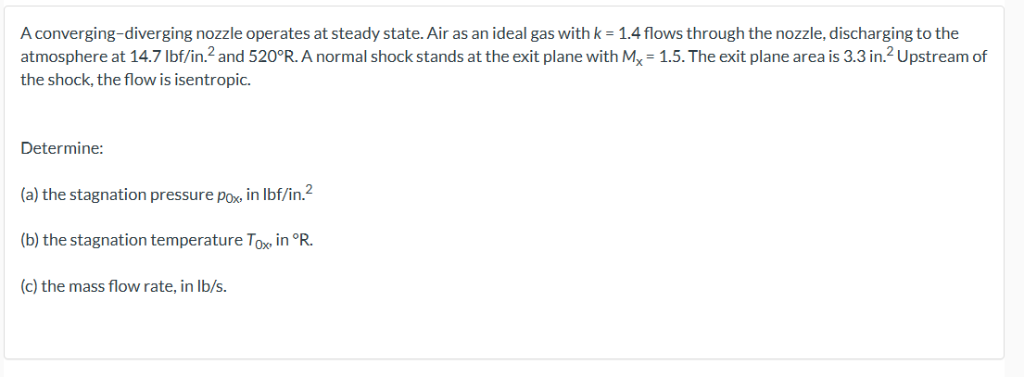 Aconverging-diverging nozzle operates at steady state. Air as an ideal gas with k = 1.4 flows through the nozzle, discharging to the
atmosphere at 14.7 Ibf/in.? and 520°R. A normal shock stands at the exit plane with M, = 1.5. The exit plane areas 3.3in.2 Upstream of
the shock, the flow is isentropic.
Determine:
(a) the stagnation pressure po, in Ibf/in.2
(b) the stagnation temperature Toy, in °R.
(0) the mass flow rate, in Ib/s.
This is AI generated Response.
Asked by: manish kumar
Created at: 2025-10-10 22:20:16
Asked by: manish kumar
Created at: 2025-10-10 22:20:16
Final Answer:
Rendered
Raw Text
Did you like this answer?
Let's solve the problem step by step!
---
## **Given Data**
- Ratio of specific heats (\( k \)): **1.4**
- Exit pressure (\( p_x \)): **14.7 lbf/in²** (atmospheric)
- Exit temperature (\( T_x \)): **520°R**
- Exit Mach number (\( M_x \)): **1.5**
- Exit area (\( A_x \)): **3.3 in²**
- Upstream of the shock, **isentropic flow**.
---
# **(a) Stagnation Pressure (\( p_{x} \)), in lbf/in²**
For an **isentropic flow** of an ideal gas:
\[
\frac{p_{x}}{p_x} = \left[1 + \frac{k-1}{2} M_x^2 \right]^{\frac{k}{k-1}}
\]
Insert values:
- \( k = 1.4 \)
- \( M_x = 1.5 \)
- \( p_x = 14.7 \) lbf/in²
Calculate the bracket:
\[
1 + \frac{1.4-1}{2} \times (1.5)^2 = 1 + .2 \times 2.25 = 1 + .45 = 1.45
\]
Now the exponent:
\[
\frac{k}{k-1} = \frac{1.4}{.4} = 3.5
\]
So,
\[
\frac{p_{x}}{14.7} = (1.45)^{3.5}
\]
Calculate \( (1.45)^{3.5} \):
\[
\ln(1.45) = .3716 \\
3.5 \times .3716 = 1.3006 \\
e^{1.3006} \approx 3.67
\]
So,
\[
p_{x} = 14.7 \times 3.67 = 53.95 \text{ lbf/in}^2
\]
---
## **Final Answer (a):**
\[
\boxed{p_{x} = 54. \ \text{lbf/in}^2}
\]
(Rounded to 1 decimal)
---
# **(b) Stagnation Temperature (\( T_{x} \)), in °R**
\[
\frac{T_{x}}{T_x} = 1 + \frac{k-1}{2} M_x^2
\]
Insert values:
\[
\frac{T_{x}}{520} = 1 + .2 \times (1.5)^2 = 1 + .2 \times 2.25 = 1 + .45 = 1.45
\]
\[
T_{x} = 1.45 \times 520 = 754\ ^\circ\text{R}
\]
---
## **Final Answer (b):**
\[
\boxed{T_{x} = 754\ ^\circ\text{R}}
\]
---
# **(c) Mass Flow Rate (\( \dot{m} \)), in lb/s**
First, use the **mass flow rate equation** at the exit:
\[
\dot{m} = \rho_x V_x A_x
\]
Or, using Mach and isentropic relations:
\[
\dot{m} = \frac{p_x A_x M_x}{\sqrt{R T_x}} \cdot \frac{1}{\sqrt{k}} \left[ 1 + \frac{k-1}{2} M_x^2 \right]^{-\frac{k+1}{2(k-1)}}
\]
### **Step 1: Find R (gas constant for air in ft·lb/(lbm·°R) and convert units)**
- \( R = 1716 \) ft·lb/(lbm·°R)
But let's be careful with units. We need everything in consistent units.
#### **Convert area to ft²:**
\[
A_x = 3.3\ \text{in}^2 \times \left(\frac{1\ \text{ft}}{12\ \text{in}}\right)^2 = 3.3 \times \frac{1}{144} \approx .0229\ \text{ft}^2
\]
#### **Convert pressure to lb/ft²:**
\[
p_x = 14.7\ \text{lbf/in}^2 \times 144\ \text{in}^2/\text{ft}^2 = 2117\ \text{lbf/ft}^2
\]
#### **Density at exit:**
\[
\rho_x = \frac{p_x}{R T_x}
\]
\[
\rho_x = \frac{2117}{1716 \times 520} = \frac{2117}{892320} \approx .00237\ \text{lb/ft}^3
\]
#### **Speed of sound at exit:**
\[
a_x = \sqrt{k R T_x} = \sqrt{1.4 \times 1716 \times 520}
\]
\[
a_x = \sqrt{1.4 \times 893,280} = \sqrt{1,250,592} \approx 1,119\ \text{ft/s}
\]
#### **Velocity at exit:**
\[
V_x = M_x \cdot a_x = 1.5 \times 1,119 = 1,678.5\ \text{ft/s}
\]
#### **Mass flow rate:**
\[
\dot{m} = \rho_x V_x A_x = .00237 \times 1,678.5 \times .0229 \approx .0911\ \text{lb/s}
\]
---
## **Final Answer (c):**
\[
\boxed{\dot{m} = .091\ \text{lb/s}}
\]
---
# **Summary Table**
| Quantity | Value |
|--------------------------|----------------------|
| Stagnation Pressure | \( 54. \) lbf/in² |
| Stagnation Temperature | \( 754 \) °R |
| Mass Flow Rate | \( .091 \) lb/s |
---
If you need further clarifications or steps, let me know!
📢 Instructions:
- Ask anything relatd to above question only.
- For new Question goto :