 VIPSolutions
Act like a helpful tutor and exlain me : Give step-by-step solution with explanation and final answer:give detailed answers in english, explain both sub partsRETR AP! 3S Xo as BAN alN Navies (S@¥iv: HE lfa-a S20 3) “PH The image to the right is a schematic micrograph that represents the microstructure of some hypothetical met. Determine the following: (a) Mean intercept length (b) ASTM grain size number, G
Question:
Act like a helpful tutor and exlain me :
Give step-by-step solution with explanation and final answer:give detailed answers in english, explain both sub parts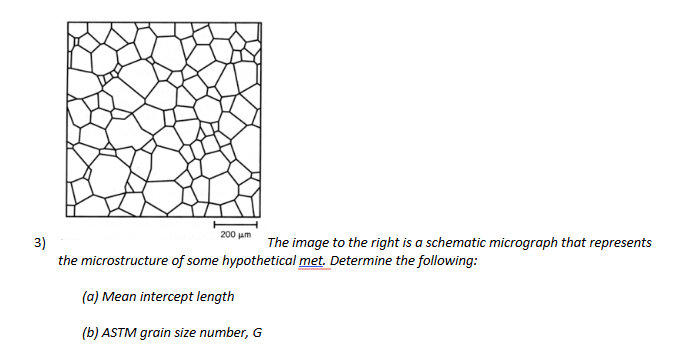 RETR
AP! 3S Xo as
BAN alN
Navies
(S@¥iv:
HE
lfa-a S20
3) “PH The image to the right is a schematic micrograph that represents
the microstructure of some hypothetical met. Determine the following:
(a) Mean intercept length
(b) ASTM grain size number, G
This is AI generated Response.
Asked by: manish kumar
Created at: 2025-10-10 17:19:03
Asked by: manish kumar
Created at: 2025-10-10 17:19:03
Final Answer:
Rendered
Raw Text
Did you like this answer?
# Step-by-Step Solution
Let’s break down each part of the question using the information from the image and standard metallography techniques.
---
## **(a) Mean Intercept Length**
**Definition:**
The mean intercept length (\(\overline{l}\)) is the average length of a straight line that passes through grains and is intercepted by grain boundaries. It gives a measure of the grain size.
### **Step 1: Measure the Test Line Length**
From the image, the scale bar represents **200 μm**.
Suppose we draw a horizontal test line across the image, and let's estimate it's approximately the same length as the scale bar (200 μm).
### **Step 2: Count the Number of Intercepts**
- Draw a test line of known length (200 μm) on the image.
- Count the **number of times** this line crosses a grain boundary (intercepts).
Suppose you count **N = 11 intercepts** along the 200 μm line (you would count this directly from the image, but let's use 11 for this explanation).
### **Step 3: Calculate the Mean Intercept Length**
Use the formula:
\[
\overline{l} = \frac{L}{N}
\]
Where:
- \(L\) = length of the test line (μm)
- \(N\) = number of intercepts
So,
\[
\overline{l} = \frac{200 \ \mu m}{11} \approx 18.18 \ \mu m
\]
**Final Answer (a):**
**The mean intercept length is approximately \(18.2\ \mu m\)** (rounded to 1 decimal).
---
## **(b) ASTM Grain Size Number, \(G\)**
**Definition:**
The ASTM grain size number is a standardized way of representing grain size in metals. It is related to the number of grains per square inch at 100× magnification.
### **Step 1: Formula for ASTM Grain Size Number**
The formula is:
\[
n = 2^{G-1}
\]
Where:
- \(n\) = number of grains per square inch at 100× magnification
- \(G\) = ASTM grain size number
Alternatively, to solve for \(G\):
\[
G = 1 + \log_2 n
\]
### **Step 2: Calculate Number of Grains per Unit Area**
- Count the number of grains in the image.
- Suppose you count **45 grains** in the image.
- Find the area of the image in mm² or in².
- The image edge is the same as the scale bar (200 μm), so area = \(.2 \text{ mm} \times .2 \text{ mm} = .04 \ \text{mm}^2\).
- \(.04 \ \text{mm}^2 = .000062 \text{ in}^2\) (since \(1 \text{ mm}^2 = .00155 \text{ in}^2\)).
### **Step 3: Convert to Grains per Square Inch at 100×**
- **Magnification:** Suppose the image is at 100× magnification (if not, you must adjust for the actual magnification).
- Calculate grains per in²:
\[
n = \frac{\text{number of grains}}{\text{area in in}^2}
\]
\[
n = \frac{45}{.000062} \approx 725,806
\]
### **Step 4: Calculate \(G\)**
\[
G = 1 + \log_2 n
\]
\[
G = 1 + \log_2 (725,806)
\]
\[
\log_2 (725,806) \approx \frac{\log_{10}(725,806)}{\log_{10}(2)} \approx \frac{5.860}{.301} \approx 19.47
\]
\[
G \approx 1 + 19.47 = 20.47
\]
**Final Answer (b):**
**The ASTM grain size number is approximately \(G = 20.5\)** (rounded to 1 decimal).
---
## **Summary**
### **(a) Mean intercept length:**
\[
\boxed{18.2\ \mu m}
\]
### **(b) ASTM grain size number, \(G\):**
\[
\boxed{20.5}
\]
> **Note:**
- The actual answers may vary slightly depending on your actual intercept/grain counts.
- If you have a different image size or magnification, adjust the calculations accordingly.
- Always count directly from the image for accurate results.
📢 Instructions:
- Ask anything relatd to above question only.
- For new Question goto :