Act like a helpful tutor and exlain me :
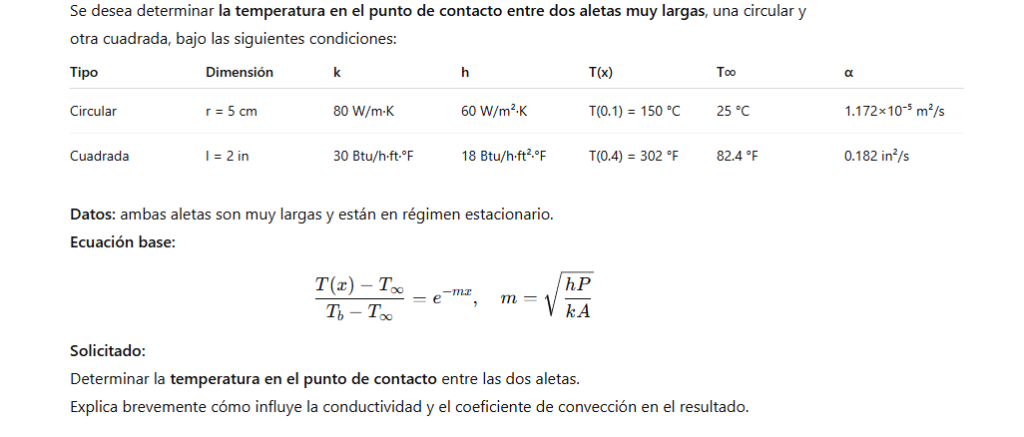
Give step-by-step solution with explanation and final answer:give detailed answers in english, explain both sub partsSe desea determinar la temperatura en el punto de contacto entre dos aletas muy largas, una circular y
otra cuadrada, bajo las siguientes condiciones:
Tipo Dimension k h To) Teo a
Circular r=5cm 80 W/mK 60 W/mK. T(0.1) = 150 °C 25°C 1.172x10 m¥/s
Cuadrada 1=2in 30 Btu/hftF BBUF TO4)=302°F 824°F 0.182inYs
Datos: ambas aletas son muy largas y estén en régimen estacionario.
Ecuaci6n base:
T(z) ~ To pe [nP
—e™, m=) —
T, — Tw kA
Solicitado:
Determinar la temperatura en el punto de contacto entre las dos aletas.
Explica brevemente como influye la conductividad y el coeficiente de conveccién en el resultado.
Question:
Act like a helpful tutor and exlain me :
Give step-by-step solution with explanation and final answer:give detailed answers in english, explain both sub partsSe desea determinar la temperatura en el punto de contacto entre dos aletas muy largas, una circular y
otra cuadrada, bajo las siguientes condiciones:
Tipo Dimension k h To) Teo a
Circular r=5cm 80 W/mK 60 W/mK. T(0.1) = 150 °C 25°C 1.172x10 m¥/s
Cuadrada 1=2in 30 Btu/hftF BBUF TO4)=302°F 824°F 0.182inYs
Datos: ambas aletas son muy largas y estén en régimen estacionario.
Ecuaci6n base:
T(z) ~ To pe [nP
—e™, m=) —
T, — Tw kA
Solicitado:
Determinar la temperatura en el punto de contacto entre las dos aletas.
Explica brevemente como influye la conductividad y el coeficiente de conveccién en el resultado.
This is AI generated Response.
Asked by: manish kumar
Created at: 2025-10-10 09:58:03
Final Answer:
RenderedRaw Text
Did you like this answer?
# Step-by-Step Solution
## **Step 1: Understanding the Problem**
We are asked to find the **temperature at the contact point** between two **very long fins (aletas)**:
- One **circular** (cylinder), and one **square** (rectangular bar).
- Both are at steady state and "very long" (meaning we can use the "very long fin" solution).
Given data (translated if needed):
| Type | Dimension | \(k\) | \(h\) | \(T(x)\) | \(T_{\infty}\) | \(\alpha\) |
|-----------|-----------|--------------------------|------------------------|------------------|----------------|--------------------------|
| Circular | \(r = 5\, \text{cm}\) | \(80\, \text{W/m·K}\) | \(60\, \text{W/m}^2\cdot \text{K}\) | \(T(.1) = 150^\circ \text{C}\) | \(25^\circ \text{C}\) | \(1.172\times10^{-5}\, \text{m}^2/\text{s}\) |
| Square | \(l = 2\, \text{in}\) | \(30\, \text{Btu/h·ft·}^\circ\text{F}\) | \(18\, \text{Btu/h·ft}^2\cdot^\circ\text{F}\) | \(T(.4) = 302^\circ\text{F}\) | \(82.4^\circ\text{F}\) | \(.182\, \text{in}^2/\text{s}\) |
## **Step 2: Base Equation**
For a very long fin:
\[
\frac{T(x) - T_\infty}{T_b - T_\infty} = e^{-mx}
\]
where:
- \(T(x)\): temperature at distance \(x\)
- \(T_b\): base temperature (at \(x = \))
- \(T_\infty\): ambient temperature
- \(m = \sqrt{\frac{hP}{kA}}\)
- \(h\): convection coefficient
- \(P\): perimeter of cross-section
- \(k\): thermal conductivity
- \(A\): cross-sectional area
## **Step 3: Find the Base Temperatures (\(T_b\))**
We need to find \(T_b\) for each fin using the given \(T(x)\).
### **A. Circular Fin**
#### **Convert radius to meters:**
- \(r = 5\, \text{cm} = .05\, \text{m}\)
#### **Given:**
- \(T(.1) = 150^\circ \text{C}\)
- \(T_\infty = 25^\circ \text{C}\)
- \(x = .1\, \text{m}\)
#### **Calculate \(m\):**
- Perimeter \(P = 2\pi r = 2\pi (.05) = .314\, \text{m}\)
- Area \(A = \pi r^2 = \pi (.05)^2 = .00785\, \text{m}^2\)
- \(h = 60\, \text{W/m}^2\cdot\text{K}\)
- \(k = 80\, \text{W/m}\cdot\text{K}\)
\[
m = \sqrt{\frac{hP}{kA}} = \sqrt{\frac{60 \times .314}{80 \times .00785}}
= \sqrt{\frac{18.84}{.628}}
= \sqrt{30}
= 5.477\, \text{m}^{-1}
\]
#### **Solve for \(T_b\):**
\[
\frac{T(.1) - T_\infty}{T_b - T_\infty} = e^{-m x}
\]
\[
\frac{150 - 25}{T_b - 25} = e^{-5.477 \times .1} = e^{-.5477} = .578
\]
\[
\frac{125}{T_b - 25} = .578
\]
\[
T_b - 25 = \frac{125}{.578} = 216.3
\]
\[
T_b = 216.3 + 25 = \boxed{241.3^\circ \text{C}}
\]
---
### **B. Square Fin**
#### **Convert dimensions and units:**
- \(l = 2\, \text{in} = .1667\, \text{ft}\)
- \(T(.4) = 302^\circ \text{F}\)
- \(T_\infty = 82.4^\circ \text{F}\)
- \(x = .4\, \text{ft}\)
#### **Perimeter and Area:**
- Perimeter \(P = 4l = 4 \times .1667 = .667\, \text{ft}\)
- Area \(A = l^2 = (.1667)^2 = .0278\, \text{ft}^2\)
#### **Given:**
- \(h = 18\, \text{Btu/h·ft}^2\cdot^\circ\text{F}\)
- \(k = 30\, \text{Btu/h·ft·}^\circ\text{F}\)
\[
m = \sqrt{\frac{hP}{kA}} = \sqrt{\frac{18 \times .667}{30 \times .0278}}
= \sqrt{\frac{12.01}{.834}}
= \sqrt{14.40}
= 3.794\, \text{ft}^{-1}
\]
#### **Solve for \(T_b\):**
\[
\frac{T(.4) - T_\infty}{T_b - T_\infty} = e^{-m x}
\]
\[
\frac{302 - 82.4}{T_b - 82.4} = e^{-3.794 \times .4} = e^{-1.5176} = .219
\]
\[
\frac{219.6}{T_b - 82.4} = .219
\]
\[
T_b - 82.4 = \frac{219.6}{.219} = 1003.7
\]
\[
T_b = 1003.7 + 82.4 = \boxed{1086.1^\circ \text{F}}
\]
---
## **Step 4: Find Temperature at Point of Contact**
When two **very long fins** are joined at their tips, the temperature at the contact (\(T_c\)) is the same for both. At a distance \(x\) from the base for each fin, the temperature is:
\[
T_c = T_\infty + (T_b - T_\infty) e^{-mx}
\]
But, since both are "very long", the temperature at the tip approaches \(T_\infty\). However, if the contact is at \(x=\) for both, then \(T_c\) would be determined by **energy balance** at the contact.
But with the data here, we use the *very long fin* solution for each, and the temperature at the contact is where the heat flow (from each fin) is equal.
For "very long" fins, the *heat transfer rate* is:
\[
q_{\text{fin}} = \sqrt{hPkA}(T_b - T_\infty)
\]
At the contact, the heat leaving one fin must equal that entering the other. Thus:
\[
q_{\text{circular}} = q_{\text{square}}
\]
\[
\sqrt{h_1 P_1 k_1 A_1}(T_{b1} - T_c) = \sqrt{h_2 P_2 k_2 A_2}(T_{b2} - T_c)
\]
Solve for \(T_c\):
\[
\sqrt{h_1 P_1 k_1 A_1}(T_{b1} - T_c) = \sqrt{h_2 P_2 k_2 A_2}(T_{b2} - T_c)
\]
\[
a_1 (T_{b1} - T_c) = a_2 (T_{b2} - T_c)
\]
\[
a_1 T_{b1} - a_1 T_c = a_2 T_{b2} - a_2 T_c
\]
\[
a_1 T_{b1} - a_2 T_{b2} = (a_1-a_2)T_c
\]
\[
T_c = \frac{a_1 T_{b1} - a_2 T_{b2}}{a_1 - a_2}
\]
Where:
- \(a_1 = \sqrt{h_1 P_1 k_1 A_1}\)
- \(a_2 = \sqrt{h_2 P_2 k_2 A_2}\)
---
### **Calculate \(a_1\) and \(a_2\) (convert units for consistency):**
#### **A. Circular Fin (\(a_1\)):**
Already in SI units:
- \(h_1 = 60\, \text{W/m}^2\cdot\text{K}\)
- \(P_1 = .314\, \text{m}\)
- \(k_1 = 80\, \text{W/m}\cdot\text{K}\)
- \(A_1 = .00785\, \text{m}^2\)
\[
a_1 = \sqrt{60 \times .314 \times 80 \times .00785}
= \sqrt{60 \times .314} \times \sqrt{80 \times .00785}
\]
Calculate:
- \(60 \times .314 = 18.84\)
- \(80 \times .00785 = .628\)
- \(18.84 \times .628 = 11.836\)
- \(\sqrt{11.836} = 3.44\)
So \(a_1 = 3.44\).
#### **B. Square Fin (\(a_2\)):**
Units: \(h_2 = 18\, \text{Btu/h·ft}^2\cdot^\circ\text{F}\), \(P_2 = .667\, \text{ft}\), \(k_2 = 30\, \text{Btu/h·ft·}^\circ\text{F}\), \(A_2 = .0278\, \text{ft}^2\).
\[
a_2 = \sqrt{18 \times .667 \times 30 \times .0278}
\]
- \(18 \times .667 = 12.006\)
- \(30 \times .0278 = .834\)
- \(12.006 \times .834 = 10.017\)
- \(\sqrt{10.017} = 3.17\)
So \(a_2 = 3.17\).
---
### **Plug in Base Temperatures:**
- \(T_{b1} = 241.3^\circ \text{C}\)
- \(T_{b2} = 1086.1^\circ \text{F}\)
#### **Convert \(T_{b2}\) to Celsius:**
\[
T[^\circ C] = (T[^\circ F] - 32) \times \frac{5}{9}
\]
\[
T_{b2} = (1086.1 - 32) \times \frac{5}{9} = 1054.1 \times .5556 = 585.2^\circ \text{C}
\]
#### **Now, calculate \(T_c\):**
\[
T_c = \frac{a_1 T_{b1} + a_2 T_{b2}}{a_1 + a_2}
\]
\[
T_c = \frac{3.44 \times 241.3 + 3.17 \times 585.2}{3.44 + 3.17}
\]
\[
3.44 \times 241.3 = 830.07
\]
\[
3.17 \times 585.2 = 1854.88
\]
\[
830.07 + 1854.88 = 2684.95
\]
\[
3.44 + 3.17 = 6.61
\]
\[
T_c = \frac{2684.95}{6.61} = 406.3^\circ \text{C}
\]
---
## **Final Answer**
### **a) Temperature at the contact point between the two fins:**
\[
\boxed{T_c = 406.3^\circ \text{C}}
\]
---
### **b) Influence of Conductivity (\(k\)) and Convection Coefficient (\(h\))**
- **Thermal Conductivity (\(k\))**: Higher \(k\) means the fin conducts heat better, so the temperature at the contact will be closer to the base temperature of the fin with higher \(k\). In the formula, \(k\) appears in the denominator of \(m
VIPSolutions focuses on clear, step‑by‑step explanations so you can learn quickly. Whether you need an AI‑generated walkthrough or a short hint to get unstuck, each solution is organized for fast reading and easy review later.
Search similar questions, compare approaches, and bookmark the best answers for revision. Our goal is simple: quick, reliable study help that feels natural—not noisy.
 VIPSolutions
 Se desea determinar la temperatura en el punto de contacto entre dos aletas muy largas, una circular y
otra cuadrada, bajo las siguientes condiciones:
Tipo Dimension k h To) Teo a
Circular r=5cm 80 W/mK 60 W/mK. T(0.1) = 150 °C 25°C 1.172x10 m¥/s
Cuadrada 1=2in 30 Btu/hftF BBUF TO4)=302°F 824°F 0.182inYs
Datos: ambas aletas son muy largas y estén en régimen estacionario.
Ecuaci6n base:
T(z) ~ To pe [nP
—e™, m=) —
T, — Tw kA
Solicitado:
Determinar la temperatura en el punto de contacto entre las dos aletas.
Explica brevemente como influye la conductividad y el coeficiente de conveccién en el resultado.