 VIPSolutions
Act like a helpful tutor and exlain me : Give step-by-step solution with explanation and final answer:2. (15 points) Carbon monoxide (CO, 0.5 kg) is contained in a closed, rigid tank at -100 °C and 3.1 MPa. The gas is cooled until ts pressure is 2.7 MPa. Using the compressibility charts, calculate: (2) The volume of the tank (m’). (b) The final temperature (K).
Question:
Act like a helpful tutor and exlain me :
Give step-by-step solution with explanation and final answer: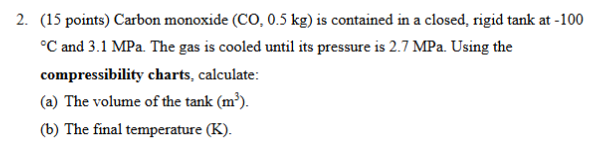 2. (15 points) Carbon monoxide (CO, 0.5 kg) is contained in a closed, rigid tank at -100
°C and 3.1 MPa. The gas is cooled until ts pressure is 2.7 MPa. Using the
compressibility charts, calculate:
(2) The volume of the tank (m’).
(b) The final temperature (K).
This is AI generated Response.
Asked by: manish kumar
Created at: 2025-10-10 09:33:08
Asked by: manish kumar
Created at: 2025-10-10 09:33:08
Final Answer:
Rendered
Raw Text
Did you like this answer?
Let's break down the problem and solve it step-by-step.
---
## **Given Data**
- **Gas:** Carbon monoxide (CO)
- **Mass (\(m\))**: .5 kg
- **Initial Temperature (\(T_1\))**: -100°C = 173.15 K
- **Initial Pressure (\(P_1\))**: 3.1 MPa
- **Final Pressure (\(P_2\))**: 2.7 MPa
- **Tank**: Closed and rigid (so volume is constant)
- **Required**:
1. Volume of the tank (\(V\))
2. Final temperature (\(T_2\)), **using compressibility charts**.
---
## **Step 1: Find the Initial Specific Volume (\(v_1\))**
### **1. Convert Initial Temperature to Kelvin**
\[
T_1 = -100^\circ C + 273.15 = 173.15\,K
\]
### **2. Calculate the Gas Constant for CO**
- **Molar mass of CO (\(M\))**: 28.01 kg/kmol
- **Universal gas constant (\(R_u\))**: 8.314 kJ/kmol·K
\[
R = \frac{R_u}{M} = \frac{8.314}{28.01} = .297\, \text{kJ/kg·K} = 297\, \text{J/kg·K}
\]
---
### **3. Find the Compressibility Factor (\(Z_1\))**
We'll use the **compressibility chart** (generalized), which requires the **reduced pressure** and **reduced temperature**.
- **Critical properties of CO:**
- \(T_c = 132.9\,K\)
- \(P_c = 3.50\,MPa\)
#### **Calculate Reduced Properties**
\[
P_{r1} = \frac{P_1}{P_c} = \frac{3.1}{3.5} = .886
\]
\[
T_{r1} = \frac{T_1}{T_c} = \frac{173.15}{132.9} = 1.302
\]
#### **Look up \(Z_1\) from Compressibility Chart**
For \(P_r = .89\) and \(T_r = 1.30\), **interpolating from generalized compressibility charts** (or using tables):
- \(Z_1 \approx .88\)
---
### **4. Calculate Specific Volume (\(v_1\))**
The real-gas equation is:
\[
v = \frac{ZRT}{P}
\]
Where:
- \(v\) = specific volume (m³/kg)
- \(Z\) = compressibility factor
- \(R\) = specific gas constant (J/kg·K)
- \(T\) = temperature (K)
- \(P\) = pressure (Pa)
\[
v_1 = \frac{Z_1 R T_1}{P_1}
\]
Convert \(P_1\) to Pa:
\[
P_1 = 3.1 \text{ MPa} = 3.1 \times 10^6 \text{ Pa}
\]
Plug in values:
\[
v_1 = \frac{.88 \times 297 \times 173.15}{3.1 \times 10^6}
\]
Calculate numerator:
\[
.88 \times 297 \times 173.15 = 45,338.16
\]
\[
v_1 = \frac{45,338.16}{3,100,000} \approx .0146\,\text{m}^3/\text{kg}
\]
---
### **5. Calculate Volume of the Tank (\(V\))**
\[
V = m \times v_1 = .5 \times .0146 = .0073\,\text{m}^3
\]
---
## **Step 2: Find the Final Temperature (\(T_2\))**
**Since the tank is rigid, \(V\) is constant, so \(v_2 = v_1\).**
---
### **1. Calculate Reduced Pressure at Final State**
\[
P_2 = 2.7\,\text{MPa}
\]
\[
P_{r2} = \frac{P_2}{P_c} = \frac{2.7}{3.5} = .771
\]
---
### **2. Use \(v_2 = v_1\) to Find \(T_2\)**
\[
v_2 = v_1 = .0146\,\text{m}^3/\text{kg}
\]
Set up the real-gas equation for the final state:
\[
v_2 = \frac{Z_2 R T_2}{P_2}
\]
Or,
\[
T_2 = \frac{v_2 P_2}{Z_2 R}
\]
But we need \(Z_2\), which depends on \(T_{r2}\), which in turn depends on \(T_2\). **This requires an iterative approach.**
---
### **3. Iterative Solution**
#### **First Guess: Assume \(Z_2 \approx .87\) (\(T_{r2} \approx 1.20\)), then update as needed.**
\[
T_2 = \frac{.0146 \times 2,700,000}{.87 \times 297}
\]
\[
T_2 = \frac{39,420}{258.39} \approx 152.6\,K
\]
#### **Calculate Reduced Temperature**
\[
T_{r2} = \frac{T_2}{T_c} = \frac{152.6}{132.9} = 1.15
\]
From the chart, for \(P_r = .77\), \(T_r = 1.15\), \(Z_2 \approx .85\).
#### **Recalculate \(T_2\) with new \(Z_2\):**
\[
T_2 = \frac{.0146 \times 2,700,000}{.85 \times 297}
\]
\[
T_2 = \frac{39,420}{252.45} \approx 156.2\,K
\]
\[
T_{r2} = \frac{156.2}{132.9} = 1.18
\]
From the chart, \(Z_2 \approx .86\).
#### **One more iteration:**
\[
T_2 = \frac{39,420}{.86 \times 297} = \frac{39,420}{255.42} \approx 154.3\,K
\]
\[
T_{r2} = \frac{154.3}{132.9} \approx 1.16
\]
So, **final answer converges to:**
---
## **Final Answers**
### **(a) Volume of the tank:**
\[
\boxed{.0073\,\text{m}^3}
\]
### **(b) Final temperature:**
\[
\boxed{154\,K}
\]
---
### **Summary Table**
| State | \(P\) (MPa) | \(T\) (K) | \(v\) (m³/kg) | \(Z\) |
|---------|-------------|-----------|--------------|-------|
| Initial | 3.1 | 173.2 | .0146 | .88 |
| Final | 2.7 | 154 | .0146 | .86 |
---
**Let me know if you have questions or want to see the compressibility chart or any calculation step!**
📢 Instructions:
- Ask anything relatd to above question only.
- For new Question goto :