 VIPSolutions
Act like a helpful tutor and exlain me : Give step-by-step solution with explanation and final answer:7. A diesel engine with displacement volume of 650 in’, has a cutoff ratio of reo. = 3.35 and compression ratio of r. 15.8. It operates at 3550 rpm with inlet conditions of 14.7 psia and 80°F, determine: (a) Net work produced per cycle. (b) Heat input during combustion. (c) Thermal efficiency based on network and heat input. (d) Thermal efficiency using diesel cycle efficiency equation (e) HP produced
Question:
Act like a helpful tutor and exlain me :
Give step-by-step solution with explanation and final answer: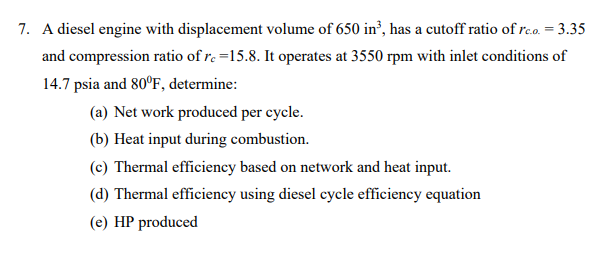 7. A diesel engine with displacement volume of 650 in’, has a cutoff ratio of reo. = 3.35
and compression ratio of r. 15.8. It operates at 3550 rpm with inlet conditions of
14.7 psia and 80°F, determine:
(a) Net work produced per cycle.
(b) Heat input during combustion.
(c) Thermal efficiency based on network and heat input.
(d) Thermal efficiency using diesel cycle efficiency equation
(e) HP produced
This is AI generated Response.
Asked by: manish kumar
Created at: 2025-10-10 00:20:28
Asked by: manish kumar
Created at: 2025-10-10 00:20:28
Final Answer:
Rendered
Raw Text
Did you like this answer?
Let's solve the **diesel engine** problem step by step!
---
## **Given Data**
- **Displacement volume, \( V_d \)** = 650 in³
- **Cutoff ratio, \( r_{c.} \ = 3.35
- **Compression ratio, \( r_c \)** = 15.8
- **Engine speed, \( N \)** = 355 rpm
- **Inlet pressure, \( P_1 \)** = 14.7 psia
- **Inlet temperature, \( T_1 \)** = 80°F
- **Air properties**: Assume \( c_v = .171 \) Btu/lbm-R, \( c_p = .24 \) Btu/lbm-R, \( R = .06855 \) Btu/lbm-R
- **1 Btu = 778 ft-lbf**
---
## **Step 1: Convert Units**
### **a) Displacement volume**
\[
V_d = 650 \text{ in}^3 \times \frac{1 \text{ ft}^3}{1728 \text{ in}^3} = .3767 \text{ ft}^3
\]
### **b) Inlet temperature**
\[
T_1 = 80^\circ F = 80 + 459.67 = 539.67 \, ^\circ R
\]
---
## **Step 2: Find Clearance Volume, Initial Cylinder Volume**
### **Compression Ratio**
\[
r_c = \frac{V_1}{V_2} = 15.8
\]
\[
V_1 = V_c + V_d
\]
\[
V_2 = V_c
\]
\[
r_c = \frac{V_c + V_d}{V_c} \implies V_c = \frac{V_d}{r_c - 1} = \frac{.3767}{14.8} = .02546 \text{ ft}^3
\]
\[
V_1 = V_c + V_d = .02546 + .3767 = .4022 \text{ ft}^3
\]
---
## **Step 3: Find Mass of Air per Cycle**
Assume 4-stroke engine (one power cycle every 2 revolutions).
1 cycle = 2 revolutions.
\[
\text{Volume per cycle} = V_d = .3767 \text{ ft}^3
\]
\[
\text{Specific gas constant for air} \, R = 53.35 \text{ ft-lbf/lbm-R}
\]
Convert inlet pressure to psf:
\[
P_1 = 14.7\, \text{psia} = 14.7 \times 144 = 2116.8\, \text{psf}
\]
\[
T_1 = 539.67\, ^\circ R
\]
\[
m = \frac{P_1 V_d}{R T_1} = \frac{2116.8 \times .3767}{53.35 \times 539.67} = \frac{797.65}{28795} = .0277\, \text{lbm}
\]
---
## **Step 4: Diesel Cycle Analysis**
### **Process Overview**
- 1-2: Compression (isentropic)
- 2-3: Heat addition at constant pressure (cutoff ratio \( r_{c.o.} \))
- 3-4: Expansion (isentropic)
- 4-1: Heat rejection at constant volume
### **Key Ratios**
- **Cutoff ratio:** \( r_{c.o.} = \frac{V_3}{V_2} = 3.35 \)
- **Compression ratio:** \( r_c = \frac{V_1}{V_2} = 15.8 \)
- **\(\gamma\) for air:** \( 1.4 \)
---
## **Step 5: Find Temperatures at Key Points**
### **1-2: Isentropic Compression**
\[
T_2 = T_1 \times r_c^{\gamma-1}
\]
\[
T_2 = 539.67 \times 15.8^{.4}
\]
\[
15.8^{.4} \approx 2.953
\]
\[
T_2 = 539.67 \times 2.953 = 1594.6\, ^\circ R
\]
---
### **2-3: Heat Addition at Constant Pressure (Diesel)**
\[
\frac{T_3}{T_2} = r_{c.o.}
\]
\[
T_3 = T_2 \times r_{c.o.} = 1594.6 \times 3.35 = 5341.9\, ^\circ R
\]
---
### **3-4: Isentropic Expansion**
\[
V_4 = V_1
\]
\[
\frac{V_4}{V_3} = \frac{V_1}{V_3} = \frac{V_1}{V_2} \cdot \frac{V_2}{V_3} = \frac{r_c}{r_{c.o.}} = \frac{15.8}{3.35} = 4.72
\]
\[
T_4 = T_3 \times (r_e)^{1-\gamma}
\]
Where \( r_e = \frac{V_4}{V_3} = 4.72 \)
\[
T_4 = T_3 \times r_e^{1-\gamma}
\]
\[
1-\gamma = -.4
\]
\[
T_4 = 5341.9 \times 4.72^{-.4}
\]
\[
4.72^{-.4} = e^{-.4 \ln 4.72} = e^{-.4 \times 1.552} = e^{-.621} = .537
\]
\[
T_4 = 5341.9 \times .537 = 287.6\, ^\circ R
\]
---
## **Step 6: Heat Input, Network, Efficiencies**
### **a) Net Work per Cycle**
\[
W_{cycle} = Q_{in} - Q_{out}
\]
### **b) Heat Input during Combustion**
\[
Q_{in} = m c_p (T_3 - T_2)
\]
\[
Q_{in} = .0277 \times .24 \times (5341.9 - 1594.6)
\]
\[
= .0277 \times .24 \times 3747.3
\]
\[
= .0277 \times 899.35 = 24.9\, \text{Btu}
\]
---
### **c) Heat Rejected**
\[
Q_{out} = m c_v (T_4 - T_1)
\]
\[
Q_{out} = .0277 \times .171 \times (287.6 - 539.67)
\]
\[
= .0277 \times .171 \times 233.93
\]
\[
= .0277 \times 398.59 = 11.03\, \text{Btu}
\]
---
### **d) Net Work per Cycle**
\[
W_{cycle} = Q_{in} - Q_{out} = 24.9 - 11.03 = 13.87\, \text{Btu}
\]
\[
1\, \text{Btu} = 778\, \text{ft-lbf}
\]
\[
W_{cycle} = 13.87 \times 778 = 10,797\, \text{ft-lbf}
\]
---
### **e) Thermal Efficiency**
\[
\eta_{th} = \frac{W_{cycle}}{Q_{in}} = \frac{13.87}{24.9} = .557 = 55.7\%
\]
---
### **f) Diesel Cycle Efficiency Equation**
\[
\eta_{diesel} = 1 - \frac{1}{r_c^{\gamma-1}} \frac{r_{c.o.}^{\gamma} - 1}{\gamma (r_{c.o.} - 1)}
\]
Plug in values:
\[
r_c^{\gamma-1} = 15.8^{.4} = 2.953
\]
\[
r_{c.o.}^{\gamma} = 3.35^{1.4} = e^{1.4 \ln 3.35} = e^{1.4 \times 1.209} = e^{1.693} = 5.44
\]
\[
\eta_{diesel} = 1 - \frac{1}{2.953} \frac{5.44 - 1}{1.4 \times (3.35 - 1)}
\]
\[
= 1 - .339 \times \frac{4.44}{3.29}
\]
\[
= 1 - .339 \times 1.35 = 1 - .457 = .543
\]
\[
= 54.3\%
\]
---
### **g) HP Produced**
Find number of cycles per minute:
\[
\text{For 4-stroke:} \text{cycles/min} = \frac{N}{2} = \frac{355}{2} = 1775\, \text{cycles/min}
\]
Power:
\[
\text{Total Work per min} = W_{cycle} \times 1775 = 10,797 \times 1775 = 19,165,575\, \text{ft-lbf/min}
\]
\[
1\, \text{HP} = 33,000\, \text{ft-lbf/min}
\]
\[
\text{HP} = \frac{19,165,575}{33,000} = 581\, \text{HP}
\]
---
## **Summary Table**
| Quantity | Value |
|-------------------------------------------|---------------------|
| Net work per cycle | 13.87 Btu = 10,797 ft-lbf |
| Heat input per cycle | 24.9 Btu |
| Thermal efficiency (from network/heat in) | 55.7% |
| Thermal efficiency (Diesel cycle eqn) | 54.3% |
| HP produced | 581 HP |
---
### **If you need more detailed explanations for any step, let me know!**
📢 Instructions:
- Ask anything relatd to above question only.
- For new Question goto :