 VIPSolutions
Act like a helpful tutor and exlain me : Give step-by-step solution with explanation and final answer:5-44 The diameter of a cylindrical water tank is D, and its height is H. The tank is filled with water, which is open to the atmosphere. An orifice of diameter D with a smooth entrance (i.e., negligible losses) is open at the bottom. Develop a rela- tion for the time required for the tank (a) to empty halfway and (b) to empty completely.
Question:
Act like a helpful tutor and exlain me :
Give step-by-step solution with explanation and final answer: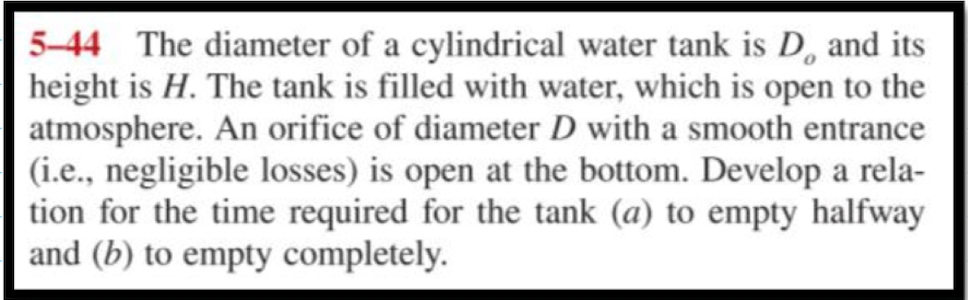 5-44 The diameter of a cylindrical water tank is D, and its
height is H. The tank is filled with water, which is open to the
atmosphere. An orifice of diameter D with a smooth entrance
(i.e., negligible losses) is open at the bottom. Develop a rela-
tion for the time required for the tank (a) to empty halfway
and (b) to empty completely.
This is AI generated Response.
Asked by: manish kumar
Created at: 2025-10-09 23:32:54
Asked by: manish kumar
Created at: 2025-10-09 23:32:54
Final Answer:
Rendered
Raw Text
Did you like this answer?
Let's solve the problem step by step:
---
## **Problem Restatement**
A cylindrical tank (diameter \( D_o \), height \( H \)) is filled with water. An orifice (diameter \( D \)) is at the bottom. Find the time required for the tank:
- (a) to empty halfway
- (b) to empty completely
Assume negligible losses (smooth entrance).
---
## **Step 1: Cross-sectional Areas**
- **Tank Area:**
\( A_{\text{tank}} = \frac{\pi}{4} D_o^2 \)
- **Orifice Area:**
\( A_{\text{orifice}} = \frac{\pi}{4} D^2 \)
---
## **Step 2: Outflow Velocity (Torricelli’s Law)**
At any instant, the water depth above the orifice is \( h \).
By Torricelli’s theorem (neglecting velocity of approach & losses):
\[
v = \sqrt{2gh}
\]
where \( g \) is the acceleration due to gravity.
---
## **Step 3: Outflow Rate**
\[
Q = A_{\text{orifice}} \cdot v = \frac{\pi}{4} D^2 \sqrt{2gh}
\]
---
## **Step 4: Rate of Change of Water Level**
The volume of water in the tank at height \( h \):
\[
V = A_{\text{tank}} \cdot h
\]
The rate of decrease of water volume:
\[
\frac{dV}{dt} = A_{\text{tank}} \frac{dh}{dt}
\]
But this equals the negative of the outflow rate:
\[
A_{\text{tank}} \frac{dh}{dt} = - Q
\]
\[
A_{\text{tank}} \frac{dh}{dt} = - \frac{\pi}{4} D^2 \sqrt{2gh}
\]
\[
\frac{dh}{dt} = - \frac{ \frac{\pi}{4} D^2 \sqrt{2g h} }{ A_{\text{tank}} }
\]
\[
\frac{dh}{dt} = - \frac{ D^2 }{ D_o^2 } \sqrt{2g h }
\]
---
## **Step 5: Separate Variables and Integrate**
\[
\frac{dh}{\sqrt{h}} = - \frac{ D^2 }{ D_o^2 } \sqrt{2g} \, dt
\]
Integrate both sides:
- From \( h = H \) to \( h = h_f \) (final height)
- From \( t = \) to \( t = t_f \)
\[
\int_{H}^{h_f} \frac{dh}{\sqrt{h}} = - \frac{ D^2 }{ D_o^2 } \sqrt{2g} \int_^{t_f} dt
\]
\[
\left[ 2\sqrt{h} \right]_{H}^{h_f} = - \frac{ D^2 }{ D_o^2 } \sqrt{2g} \cdot t_f
\]
\[
2\left(\sqrt{h_f} - \sqrt{H}\right) = - \frac{ D^2 }{ D_o^2 } \sqrt{2g} \cdot t_f
\]
\[
t_f = \frac{2 D_o^2 }{ D^2 \sqrt{2g} } \left( \sqrt{H} - \sqrt{h_f} \right)
\]
---
## **Step 6: Particular Cases**
### (a) **Time to Empty Halfway (\( h_f = H/2 \))**
\[
t_{\text{half}} = \frac{2 D_o^2 }{ D^2 \sqrt{2g} } \left( \sqrt{H} - \sqrt{H/2} \right)
\]
\[
t_{\text{half}} = \frac{2 D_o^2 }{ D^2 \sqrt{2g} } \left( \sqrt{H} - \frac{\sqrt{H}}{\sqrt{2}} \right)
\]
\[
t_{\text{half}} = \frac{2 D_o^2 \sqrt{H} }{ D^2 \sqrt{2g} } \left( 1 - \frac{1}{\sqrt{2}} \right)
\]
---
### (b) **Time to Empty Completely (\( h_f = \))**
\[
ttext{empty}} = \frac{2 D_o^2 }{ D^2 \sqrt{2g} } (\sqrt{H} - )
\]
\[
t_{\text{empty}} = \frac{2 D_o^2 \sqrt{H} }{ D^2 \sqrt{2g} }
\]
---
## **Final Answers**
### **(a) Time to empty halfway:**
\[
\boxed{
t_{\text{half}} = \frac{2 D_o^2 \sqrt{H}}{ D^2 \sqrt{2g} } \left( 1 - \frac{1}{\sqrt{2}} \right)
}
\]
### **(b) Time to empty completely:**
\[
\boxed{
t_{\text{empty}} = \frac{2 D_o^2 \sqrt{H}}{ D^2 \sqrt{2g} }
}
\]
---
If you need a numeric example or further explanation, let me know!
📢 Instructions:
- Ask anything relatd to above question only.
- For new Question goto :