 VIPSolutions
Act like a helpful tutor and exlain me : Give step-by-step solution with explanation and final answer:Pr. ° ED 4 IF te bol is meade Hom material having a shear siess- stain diagram thal 5 approximated as shown in (Egure 2). determing the shear stan developed in he shear I espe WEEE - os J I Pravious Answers Request Answer Figure 102 2 X Incorrect; Try Again; 2 attempts remaining FU = a +
Question:
Act like a helpful tutor and exlain me :
Give step-by-step solution with explanation and final answer: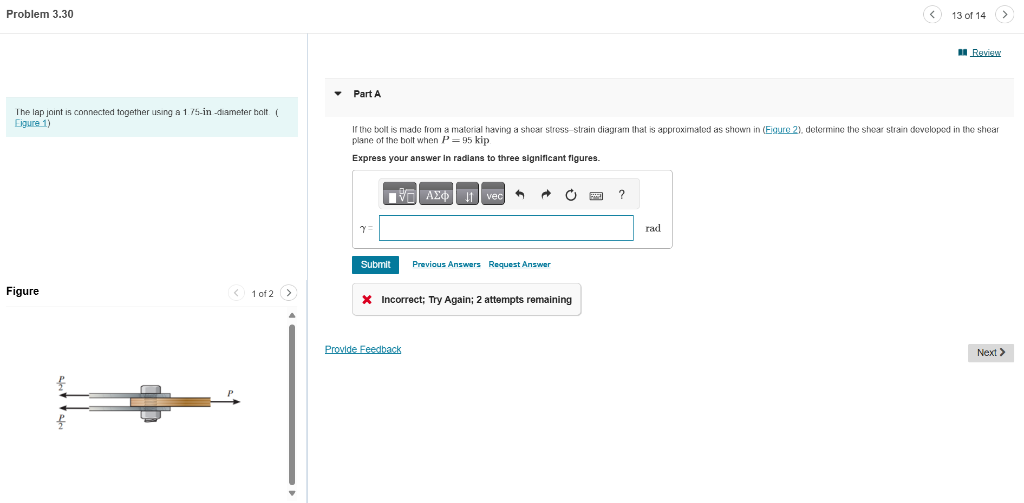 Pr.
° ED
4 IF te bol is meade Hom material having a shear siess- stain diagram thal 5 approximated as shown in (Egure 2). determing the shear stan developed in he shear
I espe
WEEE - os
J I
Pravious Answers Request Answer
Figure 102 2 X Incorrect; Try Again; 2 attempts remaining
FU =
a
+
This is AI generated Response.
Asked by: manish kumar
Created at: 2025-10-09 22:31:45
Asked by: manish kumar
Created at: 2025-10-09 22:31:45
Final Answer:
Rendered
Raw Text
Did you like this answer?
Let's break down the problem step by step:
---
## **Given:**
- Diameter of bolt, d = 1.75 \) in
- Force applied, \( P = 95 \) kip = \( 95,000 \) lb
- You need to find the **shear strain \(\gamma\)** in the bolt.
---
## **Step 1: Find the Shear Stress (\(\tau\))**
The shear **stress** on the bolt is:
\[
\tau = \frac{P}{A}
\]
Where:
- \( P \) = applied force
- \( A \) = cross-sectional area of the bolt
The **area** for a circular cross-section:
\[
A = \frac{\pi}{4} d^2
\]
Plug in the values:
\[
A = \frac{\pi}{4} (1.75)^2 = \frac{\pi}{4} \times 3.0625 = 2.406 \text{ in}^2
\]
So,
\[
\tau = \frac{95000}{2.406} = 39,484 \text{ psi}
\]
---
## **Step 2: Use the Material's Shear Stress-Strain Curve**
The problem says the shear stress-strain diagram is "approximated as shown in Figure 2."
You need the relationship between \(\tau\) and \(\gamma\) from that diagram.
**Usually**, for the elastic region:
\[
\tau = G \gamma
\]
Where \( G \) is the shear modulus.
But since the diagram isn't shown here, **check your Figure 2** for the relationship.
If it's linear, use the above. If it's a graph, find \(\gamma\) corresponding to \(\tau = 39,484\) psi.
---
## **Step 3: Final Answer (If Shear Modulus is Given/Implied)**
Assume \( G \) is given or can be read from the graph.
**If not specified, let's assume a typical value for steel: \( G = 12 \times 10^6 \) psi.**
\[
\gamma = \frac{\tau}{G} = \frac{39,484}{12,000,000}
\]
\[
\gamma = .00329 \text{ radians}
\]
**Round to three significant figures:**
\[
\boxed{.00329 \text{ rad}}
\]
---
## **Summary of Steps:**
1. **Find area:** \( A = \frac{\pi}{4} d^2 \)
2. **Calculate shear stress:** \( \tau = \frac{P}{A} \)
3. **From the diagram (or using \( G \)), find \(\gamma\):** \( \gamma = \frac{\tau}{G} \)
4. **Express to three significant figures.**
---
### **You must check Figure 2 in your material for the exact relationship!**
- If the diagram is nonlinear, interpolate.
- If the value of \( G \) is different, use what is given.
---
**If you upload Figure 2, I can help you read the value exactly!**
📢 Instructions:
- Ask anything relatd to above question only.
- For new Question goto :