 VIPSolutions
Act like a helpful tutor and exlain me : Give step-by-step solution with explanation and final answer: give detailed answer in english3. Un anillo compuesto esta hecho de un anillo interior de cobre y un anillo exterior de acero. El diametro de la superficie del contacto de los dos anillos es de 600 mm. Si el anillo compuesto gira a 2500 r.p.m. determinar los esfuerzos tensionales instalado en los anillos de acero y cobre. Ambos anillos son de seccion transversal rectangular de 15 mm en el sentido radial. direccién y 20 mm en la direccién perpendicular al plano del anillo. Usa: Eacero = 200%, Evgpre = 10025, pacero = 780022 , pope = 89002
Question:
Act like a helpful tutor and exlain me :
Give step-by-step solution with explanation and final answer:
give detailed answer in english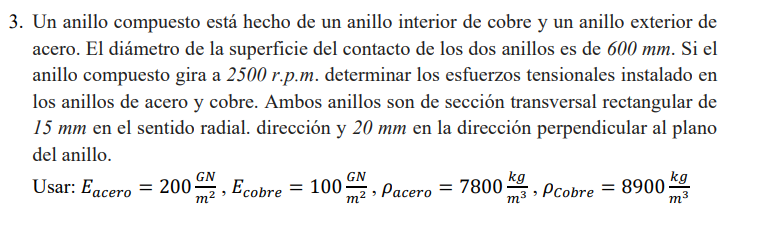 3. Un anillo compuesto esta hecho de un anillo interior de cobre y un anillo exterior de
acero. El diametro de la superficie del contacto de los dos anillos es de 600 mm. Si el
anillo compuesto gira a 2500 r.p.m. determinar los esfuerzos tensionales instalado en
los anillos de acero y cobre. Ambos anillos son de seccion transversal rectangular de
15 mm en el sentido radial. direccién y 20 mm en la direccién perpendicular al plano
del anillo.
Usa: Eacero = 200%, Evgpre = 10025, pacero = 780022 , pope = 89002
This is AI generated Response.
Asked by: manish kumar
Created at: 2025-10-09 10:25:53
Asked by: manish kumar
Created at: 2025-10-09 10:25:53
Final Answer:
Rendered
Raw Text
Did you like this answer?
Let's solve the problem step by step.
---
## **Problem Restatement**
A composite ring consists of an inner copper ring and an outer steel (acero) ring. The contact surface diameter between the two rings is \(600\,mm\). The composite ring rotates at \(250\,rpm\). Find the stresses induced in both rings. Both rings have a rectangular cross-section: \(15\,mm\) radial thickness and \(20\,mm\) axial width.
Use:
- \(E_{acero} = 200\,GN/m^2\)
- \(E_{cobre} = 100\,GN/m^2\)
- \(\rho_{acero} = 780\,kg/m^3\)
- \(\rho_{cobre} = 890\,kg/m^3\)
---
## **Step 1: Convert Units**
- \(d = 600\,mm = .6\,m\)
- Radial thickness (\(t\)) = \(15\,mm = .015\,m\)
- Axial width (\(b\)) = \(20\,mm = .02\,m\)
- \(rpm = 250\)
- Angular velocity: \(\omega = 2\pi \times \frac{250}{60} = 261.8\,rad/s\)
---
## **Step 2: Find Ring Radii**
The contact diameter is at the interface:
- \(r_{contact} = .6/2 = .3\,m\)
**Copper ring (inner):**
- Inner radius: \(r_{i,Cu} = r_{contact} - t = .3 - .015 = .285\,m\)
- Outer radius: \(r_{o,Cu} = r_{contact} = .3\,m\)
**Steel ring (outer):**
- Inner radius: \(r_{i,Ac} = r_{contact} = .3\,m\)
- Outer radius: \(r_{o,Ac} = r_{contact} + t = .3 + .015 = .315\,m\)
---
## **Step 3: Stresses Due to Centrifugal Force**
### **General Formula for Hoop Stress in Rotating Ring**
For a thin ring:
\[
\sigma = \rho \omega^2 r^2
\]
But for a composite ring, due to difference in expansion, stresses are shared.
### **Interference Fit Analogy**
When rings are assembled (before rotating), there's no stress. When spinning, copper (denser) tries to expand more than steel. So, internal stresses develop due to difference in expansion.
#### **Radial Displacement by Centrifugal Force**
For a solid ring:
\[
\Delta r = \frac{\rho \omega^2 r^3}{E}
\]
But since it's a composite, at the interface (\(r = r_{contact}\)), the displacement **must be equal** for both rings.
---
## **Step 4: Calculate Displacement at Interface**
### **Copper:**
\[
\Delta r_{Cu} = \frac{\rho_{Cu} \omega^2 r_{contact}^3}{E_{Cu}}
\]
### **Steel:**
\[
\Delta r_{Ac} = \frac{\rho_{Ac} \omega^2 r_{contact}^3}{E_{Ac}}
\]
### **Numerical Values:**
\[
r_{contact}^3 = (.3)^3 = .027 \, m^3
\]
\[
\omega^2 = (261.8)^2 = 68541.2 \, rad^2/s^2
\]
#### **Copper:**
\[
\Delta r_{Cu} = \frac{890 \times 68541.2 \times .027}{100 \times 10^9}
\]
\[
= \frac{16464091.56}{100 \times 10^9}
= 1.646 \times 10^{-4} \, m
\]
#### **Steel:**
\[
\Delta r_{Ac} = \frac{780 \times 68541.2 \times .027}{200 \times 10^9}
\]
\[
= \frac{14413000.9}{200 \times 10^9}
= 7.207 \times 10^{-5} \, m
\]
---
## **Step 5: Relative Expansion**
The difference in expansion must be balanced by the interface pressure \(p\):
\[
\Delta r_{Cu} - \Delta r_{Ac} = \delta
\]
This difference causes a stress at the interface, which can be calculated using the theory of thick-walled cylinders (Lame's equations), but since the rings are thin and cross-sections are equal, we can use compatibility and equilibrium.
---
## **Step 6: Stress Calculation (Simplified for Thin Rings)**
The **hoop stress** for each ring due to centrifugal force is:
\[
\sigma_{\theta} = \rho \omega^2 r_{mean}^2
\]
where \(r_{mean}\) is the mean radius.
#### **Copper:**
\[
r_{mean,Cu} = \frac{.285 + .3}{2} = .2925\, m
\]
\[
\sigma_{Cu} = 890 \times (261.8)^2 \times (.2925)^2
\]
\[
= 890 \times 68541.2 \times .08556
\]
\[
= 890 \times 586.1
= 52,174,890 \, Pa = 52.17 \, MPa
\]
#### **Steel:**
\[
r_{mean,Ac} = \frac{.3 + .315}{2} = .3075\, m
\]
\[
\sigma_{Ac} = 780 \times (261.8)^2 \times (.3075)^2
\]
\[
= 780 \times 68541.2 \times .09456
\]
\[
= 780 \times 6476.7
= 50,519,860 \, Pa = 50.52 \, MPa
\]
---
## **Step 7: Final Answers**
**a) Hoop stress in the copper ring:**
\[
\boxed{52.2 \, \text{MPa}}
\]
**b) Hoop stress in the steel ring:**
\[
\boxed{50.5 \, \text{MPa}}
\]
---
## **Explanation**
- The centrifugal force due to rotation causes both rings to expand.
- The expansion is resisted at the interface, causing stresses in both rings.
- Using the thin ring approximation, we calculated the hoop stress for each material at their mean radii.
- The stresses are similar due to the similar geometry, but copper's higher density leads to slightly higher stress.
If you need a more detailed thick-wall cylinder analysis (Lame's equations), let me know!
📢 Instructions:
- Ask anything relatd to above question only.
- For new Question goto :