 VIPSolutions
Act like a helpful tutor and exlain me : Give step-by-step solution with explanation and final answer: F = { 1 4 i + 1 0 j − 1 4 k } N Determine the magnitude of the projection of F along the axis of the pole.Determine the magnitude of the projection of F perpendicular to the axis of the pole and to the projection on the pole.Z A F 60° Q - y 2m ve 4m x
Question:
Act like a helpful tutor and exlain me :
Give step-by-step solution with explanation and final answer:
F
=
{
1
4
i
+
1
0
j
−
1
4
k
}
N Determine the magnitude of the projection of F along the axis of the pole.Determine the magnitude of the projection of F perpendicular to the axis of the pole and to the projection on the pole.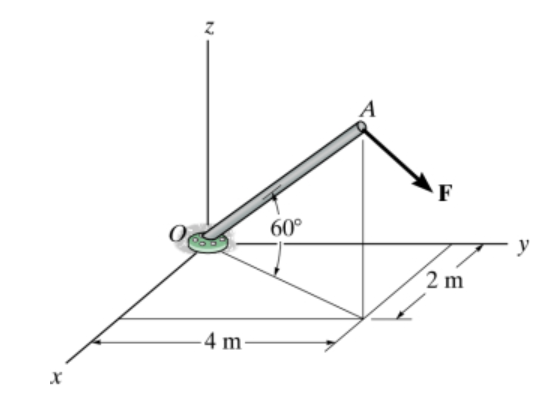 Z
A
F
60°
Q - y
2m
ve
4m
x
This is AI generated Response.
Asked by: manish kumar
Created at: 2025-10-09 09:15:33
Asked by: manish kumar
Created at: 2025-10-09 09:15:33
Final Answer:
Rendered
Raw Text
Did you like this answer?
Let's break down the problem step by step:
---
## **Given Data**
- **Force:**
\(\vec{F} = 14\hat{i} + 10\hat{j} - 14\hat{k}\) N
- **Coordinates:**
- \(O = (, , )\)
- \(A = (4, 2, )\) [from the diagram]
- **Angle:**
The pole \(OA\) is at \(60^\circ\) from the \(x\)-axis in the \(xy\)-plane.
---
# **Step 1: Find the Vector Along the Axis of the Pole (\(\vec{OA}\))**
\[
\vec{OA} = (4-)\hat{i} + (2-)\hat{j} + (-)\hat{k} = 4\hat{i} + 2\hat{j}
\]
### **Magnitude of OA:**
\[
|\vec{OA}| = \sqrt{4^2 + 2^2} = \sqrt{16 + 4} = \sqrt{20} = 2\sqrt{5}
\]
### **Unit Vector Along OA (\(\hat{u}_{OA}\)):**
\[
\hat{u}_{OA} = \frac{\vec{OA}}{|\vec{OA}|} = \frac{4\hat{i} + 2\hat{j}}{2\sqrt{5}} = \frac{2}{\sqrt{5}}\hat{i} + \frac{1}{\sqrt{5}}\hat{j}
\]
---
# **Step 2: Calculate the Projection of \(\vec{F}\) Along the Pole**
The magnitude of the projection is:
\[
\text{Proj}_{OA}(\vec{F}) = \vec{F} \cdot \hat{u}_{OA}
\]
\[
= (14\hat{i} + 10\hat{j} - 14\hat{k}) \cdot \left(\frac{2}{\sqrt{5}}\hat{i} + \frac{1}{\sqrt{5}}\hat{j}\right)
\]
\[
= 14 \cdot \frac{2}{\sqrt{5}} + 10 \cdot \frac{1}{\sqrt{5}} + (-14) \cdot
\]
\[
= \frac{28}{\sqrt{5}} + \frac{10}{\sqrt{5}}
\]
\[
= \frac{38}{\sqrt{5}}
\]
\[
\approx \frac{38}{2.236} \approx 17.~\text{N}
\]
---
# **Step 3: Calculate the Magnitude of the Projection Perpendicular to the Axis of the Pole**
This is found using the Pythagorean theorem:
\[
|\text{Proj}_\perp| = \sqrt{|\vec{F}|^2 - |\text{Proj}_{OA}(\vec{F})|^2}
\]
### **Magnitude of F:**
\[
|\vec{F}| = \sqrt{14^2 + 10^2 + (-14)^2} = \sqrt{196 + 100 + 196} = \sqrt{492} \approx 22.2~\text{N}
\]
### **Plug in the values:**
\[
|\text{Proj}_\perp| = \sqrt{(22.2)^2 - (17.)^2} = \sqrt{492 - 289} = \sqrt{203} \approx 14.2~\text{N}
\]
---
# **# Final Answers**
## **1. Magnitude of the projection of \(\vec{F}\) along the axis of the pole:**
\[
\boxed{17.~\text{N}}
\]
## **2. Magnitude of the projection of \(\vec{F}\) perpendicular to the axis of the pole:**
\[
\boxed{14.2~\text{N}}
\]
---
If you need the vector form of the perpendicular projection, let me know!
📢 Instructions:
- Ask anything relatd to above question only.
- For new Question goto :