 VIPSolutions
Act like a helpful tutor and exlain me : Give step-by-step solution with explanation and final answer:Problem #2 (A practical problem) A long, uninsulated steam line with a diameter of 89mm and a surface emissivity of 0.8 transports steam at 200°C and is exposed to atmospheric air and large surroundings at an equivalent temperature of 20°C. (a) Calculate the heat loss per unit length for a calm day. (b) Calculate the heat loss on a breezy day when the wind speed is 8 m/s.
Question:
Act like a helpful tutor and exlain me :
Give step-by-step solution with explanation and final answer: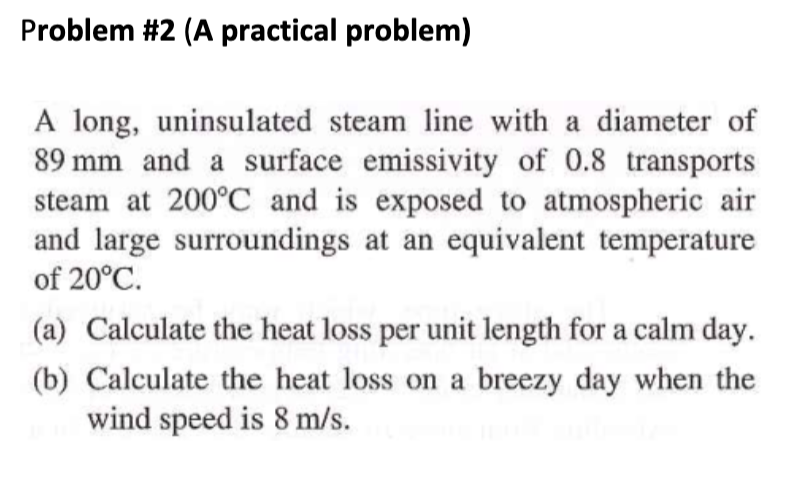 Problem #2 (A practical problem)
A long, uninsulated steam line with a diameter of
89mm and a surface emissivity of 0.8 transports
steam at 200°C and is exposed to atmospheric air
and large surroundings at an equivalent temperature
of 20°C.
(a) Calculate the heat loss per unit length for a calm day.
(b) Calculate the heat loss on a breezy day when the
wind speed is 8 m/s.
This is AI generated Response.
Asked by: manish kumar
Created at: 2025-10-08 22:42:58
Asked by: manish kumar
Created at: 2025-10-08 22:42:58
Final Answer:
Rendered
Raw Text
Did you like this answer?
Let's break down the problem into clear steps and solve both parts (a) and (b):
---
## **Given Data**
- **Diameter of pipe, \( D \):** 89 mm = .089 m
- **Emissivity, \( \epsilon \):** .8
- **Steam (surface) temperature, \( T_s \):** 200°C = 473 K
- **Surrounding temperature, \( T_\infty \):** 20°C = 293 K
- **Stefan-Boltzmann constant, \( \sigma \):** \( 5.67 \times 10^{-8} \) W/m²·K⁴
- **Wind speed (for part b):** 8 m/s
---
## **Step 1: Surface Area per Unit Length**
For a pipe of diameter \( D \), the surface area per meter length is:
\[
A = \pi D \times 1
\]
\[
A = \pi \times .089 \approx .28 \text{ m}^2/\text{m}
\]
---
## **Step 2: Radiative Heat Loss**
The heat loss by radiation per unit length:
\[
q_{rad} = \epsilon \sigma A (T_s^4 - T_\infty^4)
\]
Plug in the values:
\[
T_s = 473 \text{ K}
\]
\[
T_\infty = 293 \text{ K}
\]
\[
q_{rad} = .8 \times 5.67 \times 10^{-8} \times .28 \times (473^4 - 293^4)
\]
Calculate \( 473^4 \) and \( 293^4 \):
\[
473^4 = 5.0062 \times 10^{10}
\]
\[
293^4 = 7.3866 \times 10^9
\]
\[
473^4 - 293^4 = 4.2676 \times 10^{10}
\]
Now, substitute:
\[
q_{rad} = .8 \times 5.67 \times 10^{-8} \times .28 \times 4.2676 \times 10^{10}
\]
\[
= .8 \times 5.67 \times .28 \times 4.2676 \times 10^{2}
\]
\[
= .8 \times 5.67 \times .28 \times 426.76
\]
Calculate step by step:
- \( 5.67 \times .28 = 1.5876 \)
- \( 1.5876 \times 426.76 = 677.39 \)
- \( .8 \times 677.39 = 541.91 \)
So,
\[
\boxed{q_{rad} \approx 542\, \text{W/m}}
\]
---
## **Step 3: Convective Heat Loss**
The convective heat loss is given by:
\[
q_{conv} = h_c \cdot A \cdot (T_s - T_\infty)
\]
Where \( h_c \) is the convective heat transfer coefficient.
### **(a) Calm Day (Natural Convection)**
For a horizontal cylinder, the empirical correlation for natural convection is:
\[
Nu = .36 + \frac{.518 Ra_D^{1/4}}{[1 + (.559/Pr)^{9/16}]^{4/9}}
\]
But a simpler approximation for air:
\[
Nu = C \cdot Ra_D^n
\]
For \( 10^4 < Ra_D < 10^9 \), \( C = .53 \), \( n = .25 \).
#### **Calculate Properties at Film Temperature**
Film temperature:
\[
T_f = \frac{T_s + T_\infty}{2} = \frac{200 + 20}{2} = 110^\circ C = 383\,\text{K}
\]
**Air properties at \( 110^\circ C \) (approx):**
- \( k = .030\,\text{W/m·K} \)
- \( Pr = .7 \)
- \( \nu = 27 \times 10^{-6}\,\text{m}^2/\text{s} \)
- \( \beta = 1/T_f = 1/383 = .00261\,\text{K}^{-1} \)
#### **Calculate Grashof Number (\( Gr_D \)):**
\[
Gr_D = \frac{g \beta (T_s - T_\infty) D^3}{\nu^2}
\]
Where \( g = 9.81\,\text{m/s}^2 \)
\[
Gr_D = \frac{9.81 \times .00261 \times (200 - 20) \times (.089)^3}{(27 \times 10^{-6})^2}
\]
\[
= \frac{9.81 \times .00261 \times 180 \times .000704}{7.29 \times 10^{-10}}
\]
\[
= \frac{9.81 \times .00261 \times .12672}{7.29 \times 10^{-10}}
\]
\[
= \frac{9.81 \times .0003307}{7.29 \times 10^{-10}}
\]
\[
= \frac{.003243}{7.29 \times 10^{-10}}
\]
\[
= 4.45 \times 10^6
\]
#### **Rayleigh Number (\( Ra_D \)):**
\[
Ra_D = Gr_D \cdot Pr = 4.45 \times 10^6 \times .7 = 3.12 \times 10^6
\]
#### **Nusselt Number (\( Nu \)):**
\[
Nu = .53 Ra_D^{.25} = .53 \times (3.12 \times 10^6)^{.25}
\]
\[
= .53 \times (3.12 \times 10^6)^{.25}
\]
\[
= .53 \times 42.2 = 22.4
\]
#### **Heat Transfer Coefficient (\( h_c \)):**
\[
h_c = \frac{Nu \cdot k}{D} = \frac{22.4 \times .030}{.089} = 7.55\,\text{W/m}^2\text{K}
\]
#### **Convective Heat Loss:**
\[
q_{conv} = h_c \cdot A \cdot (T_s - T_\infty) = 7.55 \times .28 \times 180 = 380.88\,\text{W/m}
\]
---
### **Total Heat Loss (Calm Day):**
\[
q_{total} = q_{rad} + q_{conv} = 542 + 381 = \boxed{923\,\text{W/m}}
\]
---
## **Step 4: Forced Convection (Windy Day, \( v = 8\,\text{m/s} \))**
For a cylinder in cross-flow:
\[
Nu = .193 \cdot Re_D^{.618} \cdot Pr^{1/3}
\]
Where:
\[
Re_D = \frac{v D}{\nu} = \frac{8 \times .089}{27 \times 10^{-6}} = 26363
\]
\[
Nu = .193 \times (26363)^{.618} \times (.7)^{1/3}
\]
First, \( (26363)^{.618} \approx 502 \)
\[
Nu = .193 \times 502 \times .887 = .193 \times 445 = 85.9
\]
\[
h_c = \frac{Nu \cdot k}{D} = \frac{85.9 \times .030}{.089} = 28.94\,\text{W/m}^2\text{K}
\]
\[
q_{conv} = h_c \cdot A \cdot (T_s - T_\infty) = 28.94 \times .28 \times 180 = 1458.5\,\text{W/m}
\]
---
### **Total Heat Loss (Windy Day):**
\[
q_{total} = q_{rad} + q_{conv} = 542 + 1459 = \boxed{2001\,\text{W/m}}
\]
---
## **Summary Table**
| Condition | Conv. Loss (W/m) | Rad. Loss (W/m) | Total Loss (W/m) |
|---------------------|------------------|-----------------|------------------|
| Calm (natural) | 381 | 542 | 923 |
| Windy (forced, 8 m/s)| 1459 | 542 | 2001 |
---
## **Final Answers**
**(a) Heat loss per unit length on a calm day:**
\[
\boxed{923\,\text{W/m}}
\]
**(b) Heat loss per unit length on a breezy day (8 m/s wind):**
\[
\boxed{2001\,\text{W/m}}
\]
---
If you need clarification on any step or want more details, just ask!
📢 Instructions:
- Ask anything relatd to above question only.
- For new Question goto :