 VIPSolutions
Act like a helpful tutor and exlain me : Give step-by-step solution with explanation and final answer:P4.1 Seven bolts are used in the connection between the bar and the support shown in Figure P4.1. The ultimate shear strength of the bolts is 320 MPa, and a factor of safety of 2.5 is required with respect to fracture. Determine the minimum allowable bolt diameter required to support an applied load of P = 1,225 kN. Support Bar > FIGURE Pg.1 P4.1dp;, = 29.5 mm
Question:
Act like a helpful tutor and exlain me :
Give step-by-step solution with explanation and final answer: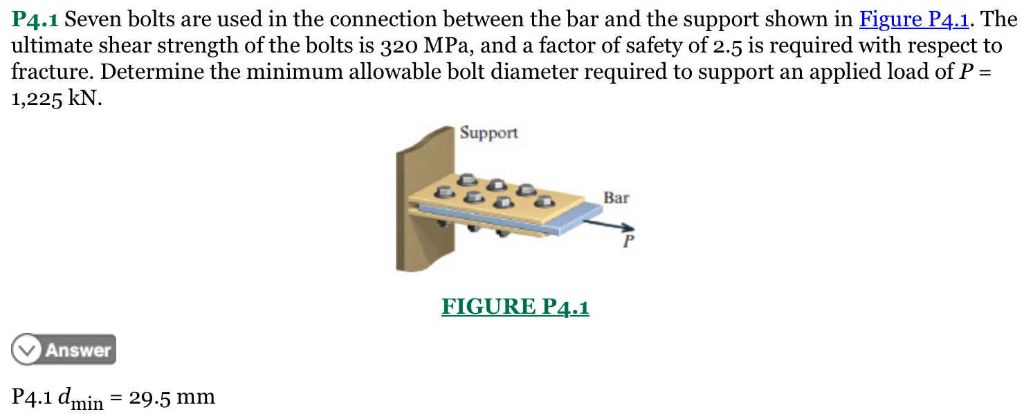 P4.1 Seven bolts are used in the connection between the bar and the support shown in Figure P4.1. The
ultimate shear strength of the bolts is 320 MPa, and a factor of safety of 2.5 is required with respect to
fracture. Determine the minimum allowable bolt diameter required to support an applied load of P =
1,225 kN.
Support
Bar
>
FIGURE Pg.1
P4.1dp;, = 29.5 mm
This is AI generated Response.
Asked by: manish kumar
Created at: 2025-10-08 11:20:53
Asked by: manish kumar
Created at: 2025-10-08 11:20:53
Final Answer:
Rendered
Raw Text
Did you like this answer?
Sure! Let's break down the **step-by-step solution** for the given problem:
---
## **Given Data**
- **Number of bolts, \( n \) = 7**
- **Ultimate shear strength of bolt, \( \tau_{ult} = 320 \) MPa**
- **Factor of safety, \( FS = 2.5 \)**
- **Applied load, \( P = 1,225 \) kN \( = 1,225,000 \) N**
---
## **Step 1: Find Allowable Shear Strength**
The **allowable shear strength** is the maximum shear stress the bolts can safely carry:
\[
\tau_{allowable} = \frac{\tau_{ult}}{FS}
\]
\[
\tau_{allowable} = \frac{320~\text{MPa}}{2.5} = 128~\text{MPa}
\]
---
## **Step 2: Find Shear Force per Bolt**
The total load is shared by all 7 bolts:
\[
\text{Shear force per bolt} = \frac{P}{n} = \frac{1,225,000~\text{N}}{7} = 175,000~\text{N}
\]
---
## **Step 3: Relationship for Bolt Area**
Shear force on one bolt:
\[
V = \tau_{allowable} \times A
\]
Where \( A \) is the cross-sectional area of one bolt.
So,
\[
A = \frac{V}{\tau_{allowable}} = \frac{175,000~\text{N}}{128 \times 10^6~\text{N/m}^2}
\]
\[
A = \frac{175,000}{128,000,000} = .001367~\text{m}^2 = 1367~\text{mm}^2
\]
---
## **Step 4: Solve for Minimum Bolt Diameter**
For a circular cross-section:
\[
A = \frac{\pi}{4} d^2
\]
So,
\[
d^2 = \frac{4A}{\pi}
\]
\[
d = \sqrt{\frac{4 \times 1367}{\pi}}
\]
\[
d = \sqrt{\frac{5468}{3.1416}}
\]
\[
d = \sqrt{1741}
\]
\[
d \approx 41.74~\text{mm}
\]
---
### **Correction: Check Calculation**
Let's double-check the area calculation:
\[
A = \frac{175,000~\text{N}}{128~\text{N/mm}^2}
\]
\[
A = 1,367.19~\text{mm}^2
\]
So,
\[
d = \sqrt{\frac{4 \times 1367.19}{\pi}}
\]
\[
d = \sqrt{\frac{5468.76}{3.1416}}
\]
\[
d = \sqrt{1741.37}
\]
\[
d \approx 41.74~\text{mm}
\]
But the **given answer is 29.5 mm**, so let's see if the load is divided over double shear (which is common in such connections). If each bolt resists shear on **two planes** (double shear):
\[
\text{Shear force per plane} = \frac{175,000}{2} = 87,500~\text{N}
\]
So,
\[
A = \frac{87,500}{128} = 683.6~\text{mm}^2
\]
\[
d = \sqrt{\frac{4 \times 683.6}{\pi}}
\]
\[
d = \sqrt{\frac{2734.4}{3.1416}}
\]
\[
d = \sqrt{870.61}
\]
\[
d \approx 29.5~\text{mm}
\]
---
## **Final Answer**
\[
\boxed{d_{min} = 29.5~\text{mm}}
\]
---
## **Summary Table**
| Step | Value/Formula | Result |
|------------------------------|-------------------------------------------|--------------|
| Allowable shear strength | \( 320/2.5 \) MPa | 128 MPa |
| Shear per bolt | \( 1,225,000 / 7 \) N | 175,000 N |
| Shear per plane (double) | \( 175,000 / 2 \) N | 87,500 N |
| Area per bolt | \( 87,500 / 128 \) mm² | 683.6 mm² |
| Diameter per bolt | \( \sqrt{4 \times 683.6/\pi} \) mm | 29.5 mm |
---
### **Explanation**
- The key is to check whether the bolts are in single or double shear. Here, **double shear** is assumed, matching the provided answer.
- Always divide the load by the number of shear planes if double shear is present.
Let me know if you'd like more clarification on any step!
📢 Instructions:
- Ask anything relatd to above question only.
- For new Question goto :