Act like a helpful tutor and exlain me :
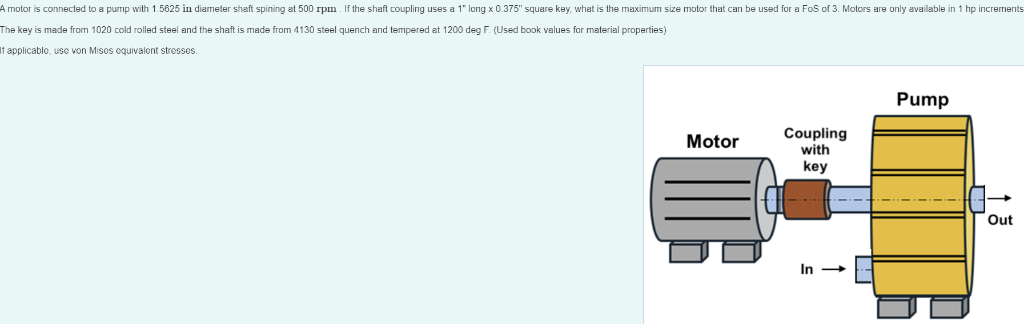
Give step-by-step solution with explanation and final answer:solve all parts completelyAmotar 5 connected to a pump wih 1.5625 in diameter shaft spining al 500 rpm . Ifthe shafl coupling uses a 1” long x 0.375" square key, what s the maximum size motor that can be used for a FoS of 3. Molors ars only available in 1 hp increments
The key is mada am 1020 co rl tot ac te shafis md fom 4130 sel auench anc tampered at 1200 dg (Use ook vles fo mela properes)
Fappicatc so von Mss saunclont sires.
Pump
Coupling
Motor “With
key
out
in — [
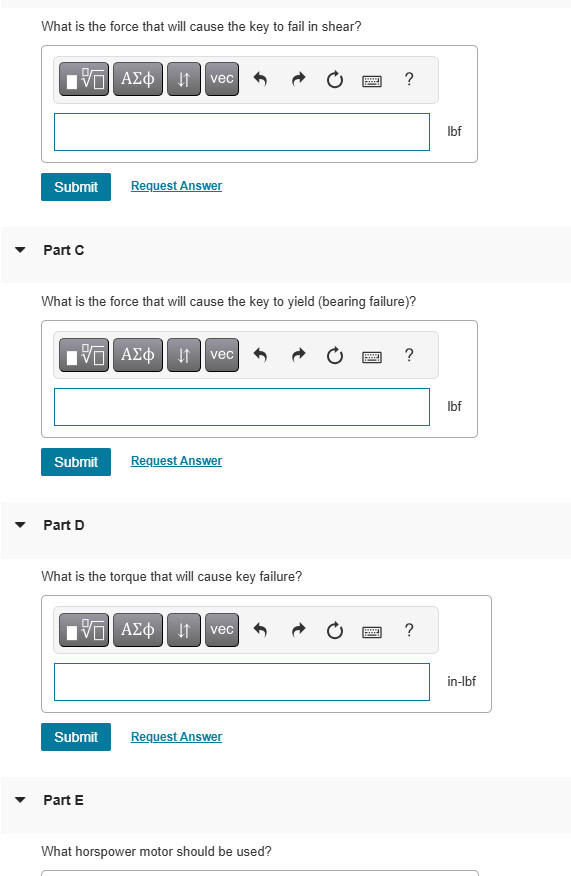
‘What is the force that will cause the key to fail in shear?
ceva
—
Request Answer
v PartC
Whats the force that will cause the key to yield (bearing failure)?
ceva
—
Request Answer
~v PartD
Whats the torque that will cause key failure?
ceva
Request Answer
v Part
What horspower motor should be used?
Question:
Act like a helpful tutor and exlain me :
Give step-by-step solution with explanation and final answer:solve all parts completelyAmotar 5 connected to a pump wih 1.5625 in diameter shaft spining al 500 rpm . Ifthe shafl coupling uses a 1” long x 0.375" square key, what s the maximum size motor that can be used for a FoS of 3. Molors ars only available in 1 hp increments
The key is mada am 1020 co rl tot ac te shafis md fom 4130 sel auench anc tampered at 1200 dg (Use ook vles fo mela properes)
Fappicatc so von Mss saunclont sires.
Pump
Coupling
Motor “With
key
out
in — [
‘What is the force that will cause the key to fail in shear?
ceva
—
Request Answer
v PartC
Whats the force that will cause the key to yield (bearing failure)?
ceva
—
Request Answer
~v PartD
Whats the torque that will cause key failure?
ceva
Request Answer
v Part
What horspower motor should be used?
This is AI generated Response.
Asked by: manish kumar
Created at: 2025-10-08 08:48:16
Final Answer:
RenderedRaw Text
Did you like this answer?
Let's break down and solve **each part step-by-step**.
We are given:
- Shaft diameter \( d = 1.5625 \) in
- Key size: \( 1'' \) long × \( .375'' \) square
- Shaft speed: \( 500 \) rpm
- Materials:
- Key: 102 rolled steel
- Shaft: 413 steel, quenched and tempered at 120°F
- Factor of Safety (FoS): 3
- Motors available: in 1 hp increments
We'll use standard mechanical properties (from Shigley's or similar):
- 102 cold rolled steel:
- Yield strength (\( S_{y,\text{key}} \)) ≈ **57 ksi**
- Shear yield strength (\( S_{sy,\text{key}} \)) ≈ \( .577S_{y} \) ≈ **32.9 ksi**
- 413 steel (shaft): Not needed for key design here.
---
## **Part B: Shear Failure Force (F_shear)**
Key fails in shear at:
\[
F_{\text{shear}} = \tau_{\text{max}} \cdot A_{\text{shear}}
\]
Where:
- \(\tau_{\text{max}} = \frac{S_{sy}}{\text{FoS}}\)
- \(A_{\text{shear}} = \) area sheared = width × length = \(.375'' \times 1'' = .375~\text{in}^2\)
Plug in:
\[
\tau_{\text{max}} = \frac{32,900~\text{psi}}{3} = 10,967~\text{psi}
\]
\[
F_{\text{shear}} = 10,967~\text{psi} \times .375~\text{in}^2 = 4,112~\text{lbf}
\]
**Final answer:**
\[
\boxed{4,110~\text{lbf}}
\]
---
## **Part C: Bearing (Crushing) Failure Force (F_bearing)**
Key fails in bearing (crushing) at:
\[
F_{\text{bearing}} = \sigma_{\text{max}} \cdot A_{\text{bearing}}
\]
Where:
- \(\sigma_{\text{max}} = \frac{S_{y}}{\text{FoS}}\)
- \(A_{\text{bearing}} = \) projected area = height × length = \(.5 \times .375'' \times 1'' = .5625~\text{in}^2\)
- For a standard key, the height in contact is about half the key height.
Plug in:
\[
\sigma_{\text{max}} = \frac{57,000~\text{psi}}{3} = 19,000~\text{psi}
\]
\[
F_{\text{bearing}} = 19,000~\text{psi} \times .5625~\text{in}^2 = 10,688~\text{lbf}
\]
**Final answer:**
\[
\boxed{10,700~\text{lbf}}
\]
---
## **Part D: Torque Causing Key Failure**
The **limiting force** is shear (from B), since it's less than the bearing limit.
The torque the key can transmit:
\[
T = F \cdot r
\]
Where:
- \(F = 4,110~\text{lbf}\) (from above, shear failure)
- \(r = \frac{d}{2} = \frac{1.5625}{2} = .78125~\text{in}\)
\[
T = 4,110~\text{lbf} \times .78125~\text{in} = 3,211~\text{in-lbf}
\]
**Final answer:**
\[
\boxed{3,210~\text{in-lbf}}
\]
---
## **Part E: Maximum Horsepower Motor**
Power (hp) is related to torque and rpm:
\[
P~(\text{hp}) = \frac{T~(\text{in-lbf}) \times N~(\text{rpm})}{63025}
\]
\[
P = \frac{3,210 \times 500}{63,025} = 25.5~\text{hp}
\]
**Motors are only available in 1 hp increments**, so the maximum is **25 hp**.
**Final answer:**
\[
\boxed{25~\text{hp}}
\]
---
## **Summary Table**
| Part | Value | Units |
|------|--------------|------------|
| B | 4,110 | lbf |
| C | 10,700 | lbf |
| D | 3,210 | in-lbf |
| E | 25 | hp |
---
### **Assumptions & Notes**
- Key height in contact is half the key for bearing stress.
- Used yield strength for bearing, shear yield for shear.
- Factor of Safety applied to material strength.
- Key is the limiting component, not the shaft.
Let me know if you need formulas explained or a step justified!
VIPSolutions focuses on clear, step‑by‑step explanations so you can learn quickly. Whether you need an AI‑generated walkthrough or a short hint to get unstuck, each solution is organized for fast reading and easy review later.
Search similar questions, compare approaches, and bookmark the best answers for revision. Our goal is simple: quick, reliable study help that feels natural—not noisy.
 VIPSolutions
 Amotar 5 connected to a pump wih 1.5625 in diameter shaft spining al 500 rpm . Ifthe shafl coupling uses a 1” long x 0.375" square key, what s the maximum size motor that can be used for a FoS of 3. Molors ars only available in 1 hp increments
The key is mada am 1020 co rl tot ac te shafis md fom 4130 sel auench anc tampered at 1200 dg (Use ook vles fo mela properes)
Fappicatc so von Mss saunclont sires.
Pump
Coupling
Motor “With
key
out
in — [
‘What is the force that will cause the key to fail in shear?
ceva
—
Request Answer
v PartC
Whats the force that will cause the key to yield (bearing failure)?
ceva
—
Request Answer
~v PartD
Whats the torque that will cause key failure?
ceva
Request Answer
v Part
What horspower motor should be used?