 VIPSolutions
Act like a helpful tutor and exlain me : Give step-by-step solution with explanation and final answer:Q2: [Forced damped vibration] A 400-kg motor supported by four springs, each of constant 150 kN/m, and a dashpot of constant c = 6500 N- s/m is constrained to move vertically. Knowing that the unbalance of the rotor is equivalent to a 23-g mass located at a distance of 100 mm from the axis of rotation, determine for a speed of 800 rpm, the amplitude of the vertical motion of the motor. Py p | — 9 © = | =
Question:
Act like a helpful tutor and exlain me :
Give step-by-step solution with explanation and final answer: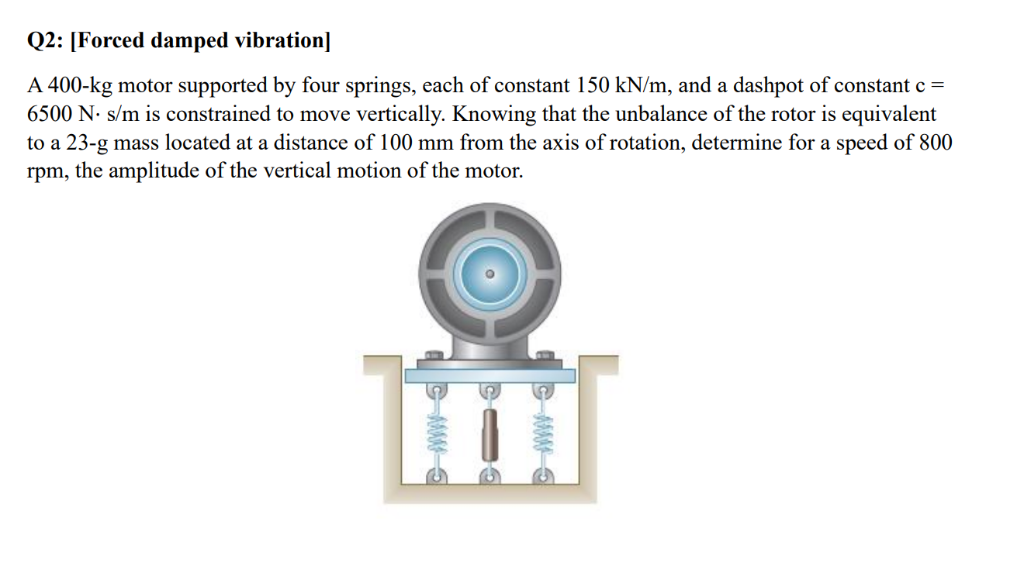 Q2: [Forced damped vibration]
A 400-kg motor supported by four springs, each of constant 150 kN/m, and a dashpot of constant c =
6500 N- s/m is constrained to move vertically. Knowing that the unbalance of the rotor is equivalent
to a 23-g mass located at a distance of 100 mm from the axis of rotation, determine for a speed of 800
rpm, the amplitude of the vertical motion of the motor.
Py p
| —
9 ©
= | =
This is AI generated Response.
Asked by: manish kumar
Created at: 2025-10-07 12:14:27
Asked by: manish kumar
Created at: 2025-10-07 12:14:27
Final Answer:
Rendered
Raw Text
Did you like this answer?
Let's solve the forced damped vibration problem step by step:
---
## **Step 1: List the given data**
- **Mass of motor, \( M \):** 400 kg
- **Number of springs:** 4
- **Spring constant per spring, \( k_s \):** 150 kN/m = 150,000 N/m
- **Total spring constant, \( k \):** \( 4 \times 150,000 = 600,000 \) N/m
- **Damping coefficient, \( c \):** 650 N·s/m
- **Unbalanced mass, \( m \):** 23 g = .023 kg
- **Radius of rotation, \( e \):** 100 mm = .1 m
- **Rotational speed, \( N \):** 800 rpm
---
## **Step 2: Calculate the excitation force**
Unbalanced rotating mass causes a centrifugal force:
\[
F_ = m \cdot e \cdot \omega^2
\]
Where \( \omega = 2\pi f \), and \( f = \frac{N}{60} \).
\[
f = \frac{800}{60} = 13.33 \text{ Hz}
\]
\[
\omega = 2\pi \times 13.33 = 83.78 \text{ rad/s}
\]
\[
F_ = .023 \times .1 \times (83.78)^2 \approx 16.09 \text{ N}
\]
---
## **Step 3: Find the natural frequency of the system**
\[
\omega_n = \sqrt{\frac{k}{M}}
\]
\[
\omega_n = \sqrt{\frac{600,000}{400}} = \sqrt{150} \approx 38.73 \text{ rad/s}
\]
---
## **Step 4: Damping ratio**
\[
\xi = \frac{c}{2M\omega_n}
\]
\[
\xi = \frac{650}{2 \times 400 \times 38.73} = \frac{650}{30,984} \approx .21
\]
---
## **Step 5: Frequency ratio**
\[
r = \frac{\omega}{\omega_n} = \frac{83.78}{38.73} \approx 2.16
\]
---
## **Step 6: Amplitude of steady-state vibration**
The amplitude \( X \) of the forced vibration is:
\[
X = \frac{F_/k}{\sqrt{(1 - r^2)^2 + (2\xi r)^2}}
\]
First, \( F_/k \):
\[
\frac{F_}{k} = \frac{16.09}{600,000} = 2.682 \times 10^{-5} \text{ m}
\]
Now the denominator:
\[
(1 - r^2)^2 = (1 - 2.16^2)^2 = (1 - 4.67)^2 = (-3.67)^2 = 13.45
\]
\[
(2\xi r)^2 = [2 \times .21 \times 2.16]^2 = [.9072]^2 = .823
\]
\[
\text{Denominator} = \sqrt{13.45 + .823} = \sqrt{14.273} = 3.78
\]
So,
\[
X = \frac{2.682 \times 10^{-5}}{3.78} = 7.1 \times 10^{-6} \text{ m} = 7.1 \ \mu \text{m}
\]
---
## **Final Answer**
### **The amplitude of the vertical motion of the motor is:**
\[
\boxed{7.1\ \mu\text{m}}
\]
---
### **Summary of Steps**
1. Calculate total spring constant and excitation force.
2. Find natural frequency and frequency ratio.
3. Calculate damping ratio.
4. Use forced vibration formula to get amplitude.
If you have any questions on any particular step, let me know!
📢 Instructions:
- Ask anything relatd to above question only.
- For new Question goto :