 VIPSolutions
Act like a helpful tutor and exlain me : Give step-by-step solution with explanation and final answer:Ls test section is to be installed in an experimental high pressure tube is 10.16 mm id. and 366 m long heated uniformly over its of the pressure drop across the test section is required as a flow-rate of water entering the test section at 204°C and 68.9 bar. drop over the test section for a water flow of 0.2 kg/s kW applied to the tube using neous model elli-Nelson model 3). Et 1
Question:
Act like a helpful tutor and exlain me :
Give step-by-step solution with explanation and final answer: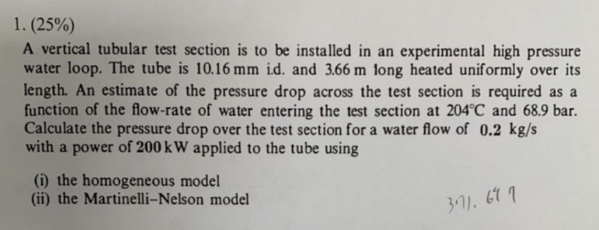 Ls
test section is to be installed in an experimental high pressure
tube is 10.16 mm id. and 366 m long heated uniformly over its
of the pressure drop across the test section is required as a
flow-rate of water entering the test section at 204°C and 68.9 bar.
drop over the test section for a water flow of 0.2 kg/s
kW applied to the tube using
neous model
elli-Nelson model 3). Et 1
This is AI generated Response.
Asked by: manish kumar
Created at: 2025-10-07 09:46:57
Asked by: manish kumar
Created at: 2025-10-07 09:46:57
Final Answer:
Rendered
Raw Text
Did you like this answer?
Let's break down the problem and solve it step by step.
---
## **Given Data**
- **Tube inner diameter (\(d\))**: 10.16 mm = .01016 m
- **Tube length (\(L\))**: 3.66 m
- **Water flow rate (\(\dot{m}\))**: .2 kg/s
- **Pressure (\(P\))**: 68.9 bar = 6.89 MPa
- **Temperature (\(T\))**: 204°C
- **Applied power (\(\))**: 200 kW = 200 W
---
## **Step 1: Find Heat Flux and Qualities**
### **1.1 Area of Tube**
\[
A = \frac{\pi d^2}{4} = \frac{\pi (.01016)^2}{4} = 8.11 \times 10^{-5} \ \text{m}^2
\]
### **1.2 Heat Flux**
\[
q'' = \frac{Q}{A}
= \frac{200,000}{8.11 \times 10^{-5}}
\approx 2.47 \times 10^9 \ \text{W/m}^2
\]
### **1.3 Mass Flux (G)**
\[
G = \frac{\dot{m}}{A} = \frac{.2}{8.11 \times 10^{-5}} \approx 2466 \ \text{kg/(m}^2\text{s)}
\]
### **1.4 Find the Quality at Exit**
First, find the enthalpy rise:
\[
\Delta h = \frac{Q}{\dot{m}} = \frac{200,000}{.2} = 1,000,000 \ \text{J/kg}
\]
Find properties of water at 204°C, 68.9 bar (use steam tables):
- **Saturated liquid enthalpy, \(h_f\) ≈ 870 kJ/kg**
- **Saturated vapor enthalpy, \(h_g\) ≈ 277 kJ/kg**
Initial enthalpy at inlet: \(h_{in} = h_f = 870 \times 10^3\) J/kg
Outlet enthalpy: \(h_{out} = h_{in} + \Delta h = 870,000 + 1,000,000 = 1,870,000 \ \text{J/kg}\)
Quality at exit:
\[
x_{out} = \frac{h_{out} - h_f}{h_{fg}} = \frac{1,870,000 - 870,000}{2,770,000 - 870,000}
= \frac{1,000,000}{1,900,000}
\approx .526
\]
---
## **Step 2: Pressure Drop Calculation**
### **2.1 Homogeneous Model**
Assume both phases move at the same velocity (no slip).
\[
\frac{1}{\rho_{mix}} = \frac{x}{\rho_g} + \frac{1-x}{\rho_f}
\]
From steam tables at 204°C, 68.9 bar:
- \(\rho_f \approx 860 \ \text{kg/m}^3\)
- \(\rho_g \approx 32 \ \text{kg/m}^3\)
At inlet: \(x_{in}=\), at exit: \(x_{out}=.526\)
**Average density:**
\[
\text{At exit:}\ \frac{1}{\rho_{mix, out}} = \frac{.526}{32} + \frac{.474}{860}
= .01644 + .000551 = .01699
\implies \rho_{mix, out} \approx 58.9 \ \text{kg/m}^3
\]
**Average density over length** (since \(x\) goes from to .526, take average \(x = .263\)):
\[
\frac{1}{\rho_{mix, avg}} = \frac{.263}{32} + \frac{.737}{860}
= .008219 + .000857 = .00908
\implies \rho_{mix, avg} \approx 110 \ \text{kg/m}^3
\]
**Superficial velocity:**
\[
v_{mix} = \frac{G}{\rho_{mix, avg}} = \frac{2466}{110} \approx 22.4 \ \text{m/s}
\]
**Reynolds number:**
\[
Re = \frac{G d}{\mu_{mix}}
\]
Approximate dynamic viscosity:
- \(\mu_f \approx 1.1 \times 10^{-4}\) Pa·s (liquid)
- \(\mu_g \approx 2.6 \times 10^{-5}\) Pa·s (vapor)
- Weighted average for two-phase: \(\mu_{mix} \approx .263 \times 2.6 \times 10^{-5} + .737 \times 1.1 \times 10^{-4} \approx 8.5 \times 10^{-5}\) Pa·s
\[
Re = \frac{2466 \times .01016}{8.5 \times 10^{-5}} \approx 294,700
\]
This is very turbulent flow.
**Friction factor (Blasius for turbulent):**
\[
f = .316 Re^{-.25} = .316 \times (294,700)^{-.25} \approx .017
\]
**Pressure drop:**
\[
\Delta P = f \frac{L}{d} \frac{G^2}{2 \rho_{mix, avg}}
= .017 \frac{3.66}{.01016} \frac{(2466)^2}{2 \times 110}
\]
Calculate:
\[
\frac{L}{d} = \frac{3.66}{.01016} \approx 360.6
\]
\[
\frac{G^2}{2 \rho_{mix, avg}} = \frac{(2466)^2}{2 \times 110} \approx \frac{6,080,356}{220} \approx 27,638
\]
\[
\Delta P = .017 \times 360.6 \times 27,638 \approx 169,476 \ \text{Pa} = 169.5 \ \text{kPa}
\]
---
## **(ii) Martinelli-Nelson Model (Two-Phase Multiplier Method)**
Martinelli parameter \(\chi\):
\[
\chi^2 = \frac{\Delta P_{tp}}{\Delta P_{lo}}
\]
Where \(\Delta P_{tp}\) = two-phase pressure drop, \(\Delta P_{lo}\) = pressure drop if all liquid.
For homogeneous model, the multiplier \(\phi_{lo}^2\) can be estimated as:
\[
\phi_{lo}^2 = 1 + C \frac{x}{(1-x)}
\]
For water-steam, \(C \approx 20\).
\[
\phi_{lo}^2 = 1 + 20 \frac{.526}{.474} \approx 1 + 20 \times 1.11 \approx 23.3
\]
\[
\Delta P_{lo} = f \frac{L}{d} \frac{G^2}{2\rho_f} = .017 \times 360.6 \times \frac{(2466)^2}{2 \times 860}
\]
\[
\frac{G^2}{2\rho_f} = \frac{(2466)^2}{2 \times 860} \approx 3,536
\]
\[
\Delta P_{lo} = .017 \times 360.6 \times 3,536 \approx 21,642 \ \text{Pa}
\]
\[
\Delta P_{tp} = \phi_{lo}^2 \Delta P_{lo} = 23.3 \times 21,642 \approx 504,289 \ \text{Pa} = 504.3 \ \text{kPa}
\]
---
## **Summary of Answers**
### **Final Answers**
#### **(i) Homogeneous Model**
\[
\boxed{\Delta P_{homogeneous} \approx 169.5\ \text{kPa}}
\]
#### **(ii) Martinelli-Nelson Model**
\[
\boxed{\Delta P_{Martinelli-Nelson} \approx 504.3\ \text{kPa}}
\]
Let me know if you need clarifications on any step!
📢 Instructions:
- Ask anything relatd to above question only.
- For new Question goto :