Act like a helpful tutor and exlain me :
Give step-by-step solution with explanation and final answer:Problem #3
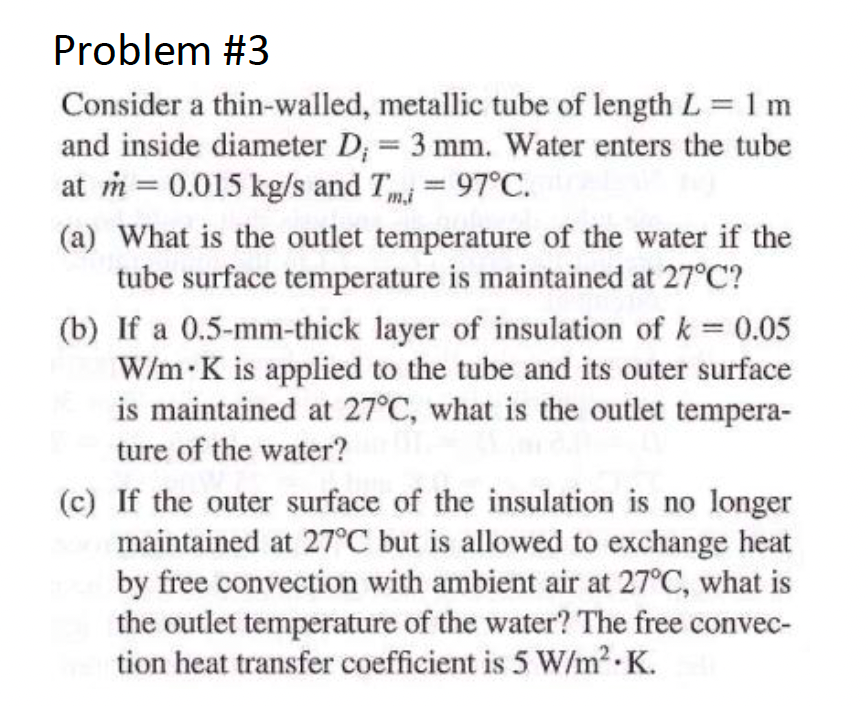
Consider a thin-walled, metallic tube of length L = I m
and inside diameter D; = 3 mm. Water enters the tube
at m= 0.015 kg/s and 7,,; = 97°C.
(a) What is the outlet temperature of the water if the
tube surface temperature is maintained at 27°C?
(b) If a 0.5-mm-thick layer of insulation of k = 0.05
Wi/m-K is applied to the tube and its outer surface
is maintained at 27°C, what is the outlet tempera-
ture of the water?
(c) If the outer surface of the insulation is no longer
maintained at 27°C but is allowed to exchange heat
by free convection with ambient air at 27°C, what is
the outlet temperature of the water? The free convec-
tion heat transfer coefficient is 5 W/m? K.
Question:
Act like a helpful tutor and exlain me :
Give step-by-step solution with explanation and final answer:Problem #3
Consider a thin-walled, metallic tube of length L = I m
and inside diameter D; = 3 mm. Water enters the tube
at m= 0.015 kg/s and 7,,; = 97°C.
(a) What is the outlet temperature of the water if the
tube surface temperature is maintained at 27°C?
(b) If a 0.5-mm-thick layer of insulation of k = 0.05
Wi/m-K is applied to the tube and its outer surface
is maintained at 27°C, what is the outlet tempera-
ture of the water?
(c) If the outer surface of the insulation is no longer
maintained at 27°C but is allowed to exchange heat
by free convection with ambient air at 27°C, what is
the outlet temperature of the water? The free convec-
tion heat transfer coefficient is 5 W/m? K.
This is AI generated Response.
Asked by: manish kumar
Created at: 2025-10-07 09:07:59
Final Answer:
RenderedRaw Text
Did you like this answer?
Let's solve each step by step.
## **Given**
- Tube, \( L 1\,text{m \)
- Tube diameter, \( D_i = 3\, \text{mm} = .003\, \text{m} \)
- Water mass flow rate, \( \dot{m} = .015\, \text{kg/s} \)
- Water inlet temperature, \( T_{m,i} = 97^\circ\text{C} \)
- Tube surface temperature, \( T_s = 27^\circ\text{C} \) (for a & b)
- Insulation thickness, \( t = .5\, \text{mm} = .0005\, \text{m} \)
- Insulation conductivity, \( k = .05\, \text{W}/\text{m}\cdot\text{K} \)
- Free convection coefficient, \( h = 5\, \text{W}/\text{m}^2\cdot\text{K} \)
- Ambient temperature, \( T_{\infty} = 27^\circ\text{C} \)
- Assume \( c_p \) (specific heat of water) \( = 418\, \text{J}/\text{kg}\cdot\text{K} \)
---
# **Part (a): Tube surface at 27°C**
### **Step 1: Energy Balance**
The heat transferred from the water to the tube wall:
\[
\dot{Q} = \dot{m} c_p (T_{m,i} - T_{m,o})
\]
where \( T_{m,o} \) is the outlet temperature.
### **Step 2: Log Mean Temperature Difference (LMTD) for Constant Surface Temperature**
For a tube with constant surface temperature:
\[
\dot{Q} = h A_s \Delta T_{lm}
\]
But here, we don't have \( h \), so use the energy balance directly.
### **Step 3: Heat Transfer Equation for Internal Flow**
If the surface temperature is constant, the outlet temperature is:
\[
T_{m,o} = T_s + (T_{m,i} - T_s) \exp\left(-\frac{h A_s}{\dot{m} c_p}\right)
\]
But \( h \) is not given; if the tube is thin-walled and metallic (very high conductivity), the surface temperature can be assumed uniform.
### **Step 4: Calculate Heat Transfer Area**
\[
A_s = \pi D_i L = \pi \times .003 \times 1 = .00942\, \text{m}^2
\]
### **Step 5: Need to Estimate h**
Since \( h \) is not given, assume the water achieves the tube surface temperature by the time it exits (since the tube is thin, metallic, and L is not very large).
So, the maximum possible heat transfer (i.e., water is cooled down as much as possible in 1 m):
\[
\dot{Q}_{\text{max}} = \dot{m} c_p (T_{m,i} - T_s)
\]
\[
\dot{Q}_{\text{max}} = .015 \times 418 \times (97 - 27) = .015 \times 418 \times 70 = 4398\, \text{W}
\]
But this would only happen if the tube was infinitely long or the heat transfer coefficient was infinite.
However, in real cases, we should use the exponential equation above. Since \( h \) is not given, **the best estimate is that the outlet temperature approaches the surface temperature**.
**Thus,**
\[
\boxed{T_{m,o} \approx 27^\circ\text{C}}
\]
---
# **Part (b): Insulated Tube, Outer Surface at 27°C**
### **Step 1: Now There's an Insulation Layer**
The heat transfer must go through the insulation.
#### **Thermal Resistance of Insulation**
The resistance:
\[
R_{ins} = \frac{\ln(r_2/r_1)}{2\pi k L}
\]
Where:
- \( r_1 = D_i/2 = .0015\, \text{m} \)
- \( r_2 = r_1 + t = .0015 + .0005 = .002\, \text{m} \)
\[
R_{ins} = \frac{\ln(.002 / .0015)}{2\pi (.05) (1)}
= \frac{\ln(1.333)}{.314}
= \frac{.2877}{.314}
= .916\, \text{K/W}
\]
### **Step 2: Heat Transfer Rate**
\[
\dot{Q} = \frac{T_{m,i} - T_{\text{out surf}}}{R_{ins}}
\]
But the water cools as it flows, so use the energy balance:
\[
\dot{m} c_p (T_{m,i} - T_{m,o}) = \frac{T_{avg} - T_s}{R_{ins}}
\]
Where \( T_{avg} = \frac{T_{m,i} + T_{m,o}}{2} \) is a reasonable approximation for short tubes.
Let \( T_{m,i} = 97^\circ\text{C} \), \( T_s = 27^\circ\text{C} \), \( R_{ins} = .916\, \text{K/W} \), \( \dot{m} = .015\, \text{kg/s} \), \( c_p = 418\, \text{J/kg}\cdot\text{K} \).
Let \( T_{m,o} \) be unknown.
\[
.015 \times 418 \times (97 - T_{m,o}) = \frac{\left(\frac{97 + T_{m,o}}{2}\right) - 27}{.916}
\]
\[
62.7 (97 - T_{m,o}) = \frac{(97 + T_{m,o})/2 - 27}{.916}
\]
\[
62.7 (97 - T_{m,o}) \times .916 = (97 + T_{m,o})/2 - 27
\]
\[
57.45 (97 - T_{m,o}) = (97 + T_{m,o})/2 - 27
\]
\[
5573.65 - 57.45 T_{m,o} = (97 + T_{m,o})/2 - 27
\]
\[
5573.65 - 57.45 T_{m,o} + 27 = (97 + T_{m,o})/2
\]
\[
560.65 - 57.45 T_{m,o} = (97 + T_{m,o})/2
\]
\[
2(560.65 - 57.45 T_{m,o}) = 97 + T_{m,o}
\]
\[
11201.3 - 114.9 T_{m,o} = 97 + T_{m,o}
\]
\[
11201.3 - 97 = 114.9 T_{m,o} + T_{m,o}
\]
\[
11104.3 = 115.9 T_{m,o}
\]
\[
T_{m,o} = \frac{11104.3}{115.9} = 95.8^\circ\text{C}
\]
### **Step 3: Final Answer**
\[
\boxed{T_{m,o} \approx 95.8^\circ\text{C}}
\]
---
# **Part (c): Insulation Exposed to Air**
Now the outer surface is not maintained at 27°C, but exchanges heat by free convection.
### **Step 1: Add Convective Resistance**
Now, total resistance =
\[
R_{total} = R_{ins} + R_{conv}
\]
#### **Convective Resistance**
\[
R_{conv} = \frac{1}{h A_{out}}
\]
\[
A_{out} = 2\pi r_2 L = 2\pi \times .002 \times 1 = .01257\, \text{m}^2
\]
\[
R_{conv} = \frac{1}{5 \times .01257} = \frac{1}{.06285} = 15.91\, \text{K/W}
\]
#### **Total Resistance**
\[
R_{total} = .916 + 15.91 = 16.83\, \text{K/W}
\]
### **Step 2: Energy Balance**
Now, heat lost:
\[
\dot{Q} = \frac{T_{avg} - T_\infty}{R_{total}}
\]
Set up the same as before:
\[
\dot{m} c_p (T_{m,i} - T_{m,o}) = \frac{T_{avg} - T_\infty}{R_{total}}
\]
\[
62.7 (97 - T_{m,o}) = \frac{\left(\frac{97 + T_{m,o}}{2}\right) - 27}{16.83}
\]
\[
62.7 (97 - T_{m,o}) \times 16.83 = \frac{97 + T_{m,o}}{2} - 27
\]
\[
1055 (97 - T_{m,o}) = \frac{97 + T_{m,o}}{2} - 27
\]
\[
102335 - 1055 T_{m,o} = \frac{97 + T_{m,o}}{2} - 27
\]
\[
102335 - 1055 T_{m,o} + 27 = \frac{97 + T_{m,o}}{2}
\]
\[
102362 - 1055 T_{m_o} = \frac{97 + T_{m_o}}{2}
\]
\[
2(102362 - 1055 T_{m_o}) = 97 + T_{m_o}
\]
\[
204724 - 211 T_{m_o} = 97 + T_{m_o}
\]
\[
204724 - 97 = 211 T_{m_o} + T_{m_o}
\]
\[
204627 = 2111 T_{m_o}
\]
\[
T_{m_o} = \frac{204627}{2111} \approx 97.^\circ\text{C}
\]
### **Step 3: Final Answer**
\[
\boxed{T_{m,o} \approx 97.^\circ\text{C}}
\]
---
## **Summary Table**
| Part | Condition | Outlet Temp (\(^\circ\)C) |
|------|---------------------------------|--------------------------|
| (a) | Tube surface at 27°C | **27** |
| (b) | Insulated, outer surface at 27°C| **95.8** |
| (c) | Insulated, convects to 27°C air | **97.** |
---
**If you need detailed derivations or clarifications on any step, let me know!**
VIPSolutions focuses on clear, step‑by‑step explanations so you can learn quickly. Whether you need an AI‑generated walkthrough or a short hint to get unstuck, each solution is organized for fast reading and easy review later.
Search similar questions, compare approaches, and bookmark the best answers for revision. Our goal is simple: quick, reliable study help that feels natural—not noisy.
 VIPSolutions
 Problem #3
Consider a thin-walled, metallic tube of length L = I m
and inside diameter D; = 3 mm. Water enters the tube
at m= 0.015 kg/s and 7,,; = 97°C.
(a) What is the outlet temperature of the water if the
tube surface temperature is maintained at 27°C?
(b) If a 0.5-mm-thick layer of insulation of k = 0.05
Wi/m-K is applied to the tube and its outer surface
is maintained at 27°C, what is the outlet tempera-
ture of the water?
(c) If the outer surface of the insulation is no longer
maintained at 27°C but is allowed to exchange heat
by free convection with ambient air at 27°C, what is
the outlet temperature of the water? The free convec-
tion heat transfer coefficient is 5 W/m? K.