 VIPSolutions
Act like a helpful tutor and exlain me : Give step-by-step solution with explanation and final answer:2. Determine the velocity and volumetric flow rate of flow — through the capillary flow meter as shown in the figure. The 1 5 I = fluid flowing in the inclined tube is water at 20°C (density Water vo h = 0.9982 g/em?), and the manometer fluid is carbon tetrachloride - FF (CCly) with density 1.594 g/cm®. The capillary diameter is 0.010 Ce in. H ca” i:
Question:
Act like a helpful tutor and exlain me :
Give step-by-step solution with explanation and final answer: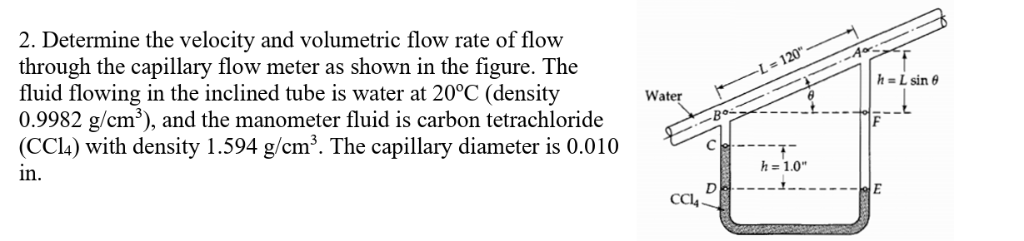 2. Determine the velocity and volumetric flow rate of flow —
through the capillary flow meter as shown in the figure. The 1 5 I =
fluid flowing in the inclined tube is water at 20°C (density Water vo h =
0.9982 g/em?), and the manometer fluid is carbon tetrachloride - FF
(CCly) with density 1.594 g/cm®. The capillary diameter is 0.010 Ce
in. H
ca” i:
This is AI generated Response.
Asked by: manish kumar
Created at: 2025-10-07 08:39:59
Asked by: manish kumar
Created at: 2025-10-07 08:39:59
Final Answer:
Rendered
Raw Text
Did you like this answer?
Let's break down the problem and solve it step by step.
---
## **Step 1: Given Data**
- **Water Density (\(\rho_{water}\))**: .9982 g/cm³ = 998.2 kg/m³
- **CCl₄ Density (\(\rho_{CCl4}\))**: 1.594 g/cm³ = 1594 kg/m³
- **Capillary Diameter (\(d\))**: .010 in = .010 × 2.54 cm = .0254 cm = 2.54 × 10⁻⁴ m
- **Inclined Tube Length (\(L\))**: 120 in = 304.8 cm = 3.048 m
- **Inclined Height Difference (\(h\))**: \(L \sin\theta = h = 1\) in = 2.54 cm = .0254 m
- **Height difference in manometer (\(h_{man}\))**: 1. in = .0254 m
- **Gravity (\(g\))**: 9.81 m/s²
---
## **Step 2: Find Pressure Difference (\(\Delta P\))**
The manometer measures the pressure drop along the capillary length:
\[
\Delta P = (\rho_{man} - \rho_{water}) g h_{man}
\]
Where:
- \(\rho_{man} = 1594 \text{ kg/m}^3\)
- \(\rho_{water} = 998.2 \text{ kg/m}^3\)
- \(h_{man} = .0254 \text{ m}\)
\[
\Delta P = (1594 - 998.2) \times 9.81 \times .0254
\]
\[
\Delta P = 595.8 \times 9.81 \times .0254
\]
\[
\Delta P = 595.8 \times .249174
\]
\[
\Delta P \approx 148.5 \text{ Pa}
\]
---
## **Step 3: Calculate Velocity in Capillary (\(v\))**
For laminar flow in a capillary (using Hagen-Poiseuille’s law):
\[
Q = \frac{\pi d^4}{128 \mu L} \Delta P
\]
Where:
- \(Q\) is volumetric flow rate (m³/s)
- \(d\) is diameter (m)
- \(\mu\) is viscosity of water at 20°C (\(= 1.002 \times 10^{-3}\) Pa·s)
- \(L\) is capillary length (m)
- \(\Delta P\) is pressure difference (Pa)
Plug in values:
- \(d = 2.54 \times 10^{-4}\) m
- \(\mu = 1.002 \times 10^{-3}\) Pa·s
- \(L = 3.048\) m
- \(\Delta P = 148.5\) Pa
\[
Q = \frac{\pi (2.54 \times 10^{-4})^4}{128 \times 1.002 \times 10^{-3} \times 3.048} \cdot 148.5
\]
First, calculate \(d^4\):
\[
d^4 = (2.54 \times 10^{-4})^4 = (2.54^4) \times 10^{-16} = 41.62 \times 10^{-16} = 4.162 \times 10^{-15}
\]
Now plug values in:
\[
Q = \frac{\pi \times 4.162 \times 10^{-15}}{128 \times 1.002 \times 10^{-3} \times 3.048} \cdot 148.5
\]
Calculate denominator:
\[
128 \times 1.002 \times 10^{-3} \times 3.048 = 128 \times .001002 \times 3.048
= .128256 \times 3.048 = .390875
\]
Now plug in:
\[
Q = \frac{3.1416 \times 4.162 \times 10^{-15}}{.390875} \cdot 148.5
\]
\[
= \frac{13.075 \times 10^{-15}}{.390875} \cdot 148.5
= 3.346 \times 10^{-14} \cdot 148.5
= 4.97 \times 10^{-12} \text{ m}^3/\text{s}
\]
---
## **Step 4: Calculate Average Velocity (\(v\))**
\[
v = \frac{Q}{A}
\]
Where \(A = \frac{\pi d^2}{4}\)
\[
A = \frac{\pi (2.54 \times 10^{-4})^2}{4}
= \frac{3.1416 \times 6.4516 \times 10^{-8}}{4}
= \frac{2.026 \times 10^{-7}}{4}
= 5.065 \times 10^{-8} \text{ m}^2
\]
\[
v = \frac{4.97 \times 10^{-12}}{5.065 \times 10^{-8}}
= 9.82 \times 10^{-5} \text{ m/s}
\]
---
## **Final Answers**
### **1. Velocity of Flow (\(v\))**
\[
\boxed{9.8 \times 10^{-5} \text{ m/s}}
\]
### **2. Volumetric Flow Rate (\(Q\))**
\[
\boxed{5. \times 10^{-12} \text{ m}^3/\text{s}}
\]
---
### **Summary Table**
| Quantity | Value |
|---------------|----------------------------|
| Velocity (\(v\)) | \(9.8 \times 10^{-5}\) m/s |
| Vol. Flow (\(Q\)) | \(5. \times 10^{-12}\) m³/s |
---
**Let me know if you want to see the step-by-step in a different unit (e.g., cm³/s or mL/min)!**
📢 Instructions:
- Ask anything relatd to above question only.
- For new Question goto :