 VIPSolutions
Act like a helpful tutor and exlain me : Give step-by-step solution with explanation and final answer:1. Carbon dioxide steadily enters a pipe at 3 MPa and 500 K at a rate of 2 kg/s. Carbon dioxide (CO) is cooled at constant pressure as it flows in the pipe so that the temperature of CO: drops to 450 K at the exit. Assuming working fluid behaves as an ideal gas, Determine (a) Density of CO: behaving as an ideal gas at the inlet of the pipe (10 pts). (b) Density of CO: as a real gas employing generalized compressibility chart (10 pts). (¢) Volumetric flow rate of ideal gas CO; at the exit of the pipe (15 pts). 500 K 450K 2 kes
Question:
Act like a helpful tutor and exlain me :
Give step-by-step solution with explanation and final answer: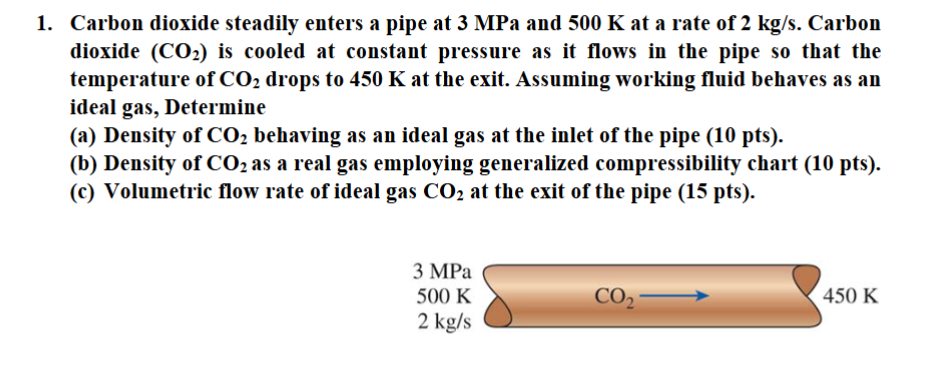 1. Carbon dioxide steadily enters a pipe at 3 MPa and 500 K at a rate of 2 kg/s. Carbon
dioxide (CO) is cooled at constant pressure as it flows in the pipe so that the
temperature of CO: drops to 450 K at the exit. Assuming working fluid behaves as an
ideal gas, Determine
(a) Density of CO: behaving as an ideal gas at the inlet of the pipe (10 pts).
(b) Density of CO: as a real gas employing generalized compressibility chart (10 pts).
(¢) Volumetric flow rate of ideal gas CO; at the exit of the pipe (15 pts).
500 K 450K
2 kes
This is AI generated Response.
Asked by: manish kumar
Created at: 2025-10-06 23:40:43
Asked by: manish kumar
Created at: 2025-10-06 23:40:43
Final Answer:
Rendered
Raw Text
Did you like this answer?
Let's solve the problem step by step.
---
## **Given Data**
- Inlet Pressure, \( P_1 = 3\, \text{MPa} = 300\, \text{kPa} \)
- Inlet Temperature, \( T_1 = 500\, \text{K} \)
- Mass flow rate, \( \dot{m} = 2\, \text{kg/s} \)
- Exit Temperature, \( T_2 = 450\, \text{K} \)
- Working fluid: **CO₂**
- Behave as **ideal gas** for (a) and (c); **real gas** for (b).
---
## **(a) Density of CO₂ as an Ideal Gas at Inlet**
The **ideal gas equation** is:
\[
PV = nRT
\]
or
\[
P = \rho R_{\text{specific}} T
\]
where
- \( \rho \) = density (kg/m³)
- \( R_{\text{specific}} = \frac{R_u}{M} \)
- \( R_u \) = Universal gas constant = \( 8.314\, \text{kJ}/(\text{kmol}\cdot\text{K}) \)
- \( M \) = Molar mass of CO₂ = **44.01 kg/kmol**
So,
\[
R_{\text{specific}} = \frac{8.314}{44.01} = .189 \, \text{kJ}/(\text{kg}\cdot\text{K}) = 189\, \text{J}/(\text{kg}\cdot\text{K})
\]
Now, rearrange for \(\rho\):
\[
\rho = \frac{P}{R_{\text{specific}} T}
\]
Plug in the values (convert P to Pa):
- \( P = 3\, \text{MPa} = 3 \times 10^6\, \text{Pa} \)
- \( R = 189\, \text{J}/(\text{kg}\cdot\text{K}) \)
- \( T = 500\, \text{K} \)
\[
\rho = \frac{3 \times 10^6}{189 \times 500}
\]
\[
\rho = \frac{3 \times 10^6}{94,500}
\]
\[
\rho = 31.75\, \text{kg/m}^3
\]
---
### **Final Answer (a):**
\[
\boxed{
\rho_{ideal,\,inlet} = 31.75\, \text{kg/m}^3
}
\]
---
## **(b) Density of CO₂ as a Real Gas (Using Compressibility Factor \(Z\))**
The real gas equation is:
\[
\rho = \frac{P}{Z R_{\text{specific}} T}
\]
We need to find the compressibility factor \( Z \) using the **generalized compressibility chart**.
#### **Step 1: Find Reduced Properties**
- \( P_{cr} = 7.38\, \text{MPa} \)
- \( T_{cr} = 304.2\, \text{K} \)
\[
P_r = \frac{P}{P_{cr}} = \frac{3}{7.38} = .406
\]
\[
T_r = \frac{T}{T_{cr}} = \frac{500}{304.2} = 1.643
\]
#### **Step 2: Find Z from Chart**
At \( P_r = .406 \), \( T_r = 1.643 \):
- From the generalized compressibility chart, \( Z \approx .85 \) (value may slightly vary based on chart).
#### **Step 3: Calculate Density**
\[
\rho = \frac{P}{Z R T}
\]
\[
\rho = \frac{3 \times 10^6}{.85 \times 189 \times 500}
\]
\[
\rho = \frac{3 \times 10^6}{80,325}
\]
\[
\rho = 37.36\, \text{kg/m}^3
\]
---
### **Final Answer (b):**
\[
\boxed{
\rho_{real,\,inlet} = 37.36\, \text{kg/m}^3
}
\]
---
## **(c) Volumetric Flow Rate of Ideal Gas CO₂ at Exit**
\[
\dot{V} = \frac{\dot{m}}{\rho}
\]
First, calculate the **exit density** as ideal gas:
- \( P = 3 \times 10^6\, \text{Pa} \)
- \( R = 189\, \text{J}/(\text{kg}\cdot\text{K}) \)
- \( T_2 = 450\, \text{K} \)
\[
\rho_{exit} = \frac{3 \times 10^6}{189 \times 450}
\]
\[
\rho_{exit} = \frac{3 \times 10^6}{85,050}
\]
\[
\rho_{exit} = 35.28\, \text{kg/m}^3
\]
Now,
\[
\dot{V}_{exit} = \frac{2}{35.28} = .0567\, \text{m}^3/\text{s}
\]
---
### **Final Answer (c):**
\[
\boxed{
\dot{V}_{exit,\,ideal} = .0567\, \text{m}^3/\text{s}
}
\]
---
## **Summary Table**
| Part | Parameter | Value |
|------|-----------|-------|
| (a) | Inlet density (ideal) | \( 31.75\, \text{kg/m}^3 \) |
| (b) | Inlet density (real, \(Z \approx .85\)) | \( 37.36\, \text{kg/m}^3 \) |
| (c) | Volumetric flow (ideal, exit) | \( .0567\, \text{m}^3/\text{s} \) |
---
If you need more explanation on any step, **let me know!**
📢 Instructions:
- Ask anything relatd to above question only.
- For new Question goto :