Question:
Act like a helpful tutor and exlain me :
Give step-by-step solution with explanation and final answer:
Did you like this answer?
👍 0
👎 0
Let's break down and solve each part step-by-step.
---
## **Given Data**
- **Flow rate, \( Q \):** 100 gal/min (in both directions)
- **Frictional head loss, \( h_f \):** 30 ft
- **Reservoir elevations:**
\( Z_1 = 150 \) ft (upper), \( Z_2 = 20 \) ft (lower)
- **Duration (day/night):** 12 h each
- **Water temperature:** 20°C (density ≈ 100 kg/m³)
- **Pump-turbine system**
---
## **Step 1: Unit Conversions**
### **Convert Flow Rate to m³/s**
\[
1\, \text{gal} = 3.785 \times 10^{-3}\, \text{m}^3
\]
\[
Q = 100\, \text{gal/min} \times 3.785 \times 10^{-3}\, \text{m}^3/\text{gal} = 3.785\, \text{m}^3/\text{min}
\]
\[
Q = \frac{3.785}{60}\, \text{m}^3/\text{s} \approx .0631\, \text{m}^3/\text{s}
\]
### **Convert Head and Loss to meters**
\[
1\, \text{ft} = .3048\, \text{m}
\]
\[
\Delta z = Z_1 - Z_2 = 150 - 20 = 130\, \text{ft} \times .3048 = 39.624\, \text{m}
\]
\[
h_f = 30\, \text{ft} \times .3048 = 9.144\, \text{m}
\]
---
## **Step 2: Power Calculations**
### **(a) Power extracted by the turbine during the daytime**
**Effective head available to the turbine:**
\[
H = \Delta z - h_f = 39.624 - 9.144 = 30.48\, \text{m}
\]
**Power extracted (turbine):**
\[
P_{turbine} = \rho g Q H
\]
Where:
- \( \rho = 100\, \text{kg/m}^3 \)
- \( g = 9.81\, \text{m/s}^2 \)
- \( Q = .0631\, \text{m}^3/\text{s} \)
- \( H = 30.48\, \text{m} \)
\[
P_{turbine} = 100 \times 9.81 \times .0631 \times 30.48
\]
\[
P_{turbine} = 100 \times 9.81 \times 1.924
\]
\[
P_{turbine} = 100 \times 18.887
\]
\[
P_{turbine} \approx 18,887\, \text{W} = \boxed{18.9\, \text{kW}}
\]
---
### **(b) Power delivered by the pump at night**
**Total head pump must overcome:**
\[
H_{pump} = \Delta z + h_f = 39.624 + 9.144 = 48.768\, \text{m}
\]
\[
P_{pump} = \rho g Q H_{pump}
\]
\[
P_{pump} = 100 \times 9.81 \times .0631 \times 48.768
\]
\[
P_{pump} = 100 \times 9.81 \times 3.079
\]
\[
P_{pump} = 100 \times 30.201
\]
\[
P_{pump} \approx 30,201\, \text{W} = \boxed{30.2\, \text{kW}}
\]
---
### **(c) Net Power Produced Over 24 Hours**
**Time for each phase:** 12 h
**Energy extracted:**
\[
E_{turbine} = P_{turbine} \times 12\, \text{h} = 18.9\, \text{kW} \times 12 = 226.8\, \text{kWh}
\]
**Energy consumed by pump:**
\[
E_{pump} = P_{pump} \times 12\, \text{h} = 30.2\, \text{kW} \times 12 = 362.4\, \text{kWh}
\]
**Net energy:**
\[
E_{net} = E_{turbine} - E_{pump} = 226.8 - 362.4 = \boxed{-135.6\, \text{kWh}}
\]
**Net power is negative.**
This means more energy is consumed by the pump than is produced by the turbine.
---
### **(d) Why is this type of system practical?**
**Pumped storage** is practical because it allows storing energy during periods of low demand (cheap electricity at night) and generating electricity during periods of high demand (expensive electricity during the day), despite round-trip losses. It helps stabilize the grid and balance supply and demand.
---
## **Summary Table**
| Part | Value |
|------|------------------------|
| a | 18.9 kW (turbine) |
| b | 30.2 kW (pump) |
| c | -135.6 kWh (net, 24h) |
| d | Stores energy for peak demand, grid stability |
---
### **Let me know if you want to see efficiency calculations or more details!**
 VIPSolutions
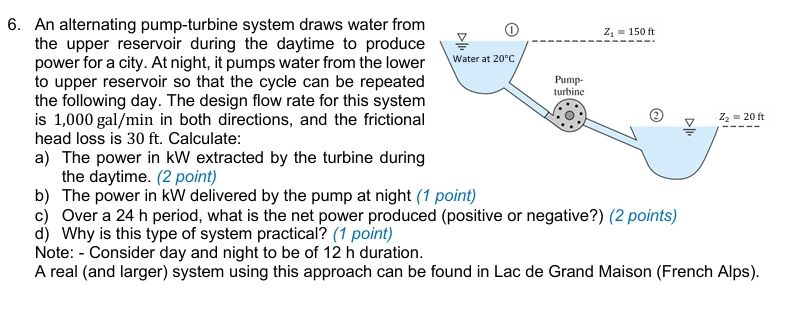 6. An alternating pump-turbine system draws water from Io) isi
the upper reservoir during the daytime to produce \ < memTRnRRE eae
power for a city. At night, it pumps water from the lower ~~ \Werat 20°C
to upper reservoir so that the cycle can be repeated id
the following day. The design flow rate for this system
is 1,000 gal/min in both directions, and the frictional 3) © mzme
head loss is 30 ft. Calculate: =
a) The power in KW extracted by the turbine during
the daytime. (2 point)
b) The power in kW delivered by the pump at night (7 point)
©) Over a 24 h period, what is the net power produced (positive or negative?) (2 points)
d) Why is this type of system practical? (1 point)
Note: - Consider day and night to be of 12 h duration.
Areal (and larger) system using this approach can be found in Lac de Grand Maison (French Alps).