 VIPSolutions
Act like a helpful tutor and exlain me : Give step-by-step solution with explanation and final answer:2. Ajet of circular cross-section at 20°C exits a water hose we nozzle into air at sea-level standard conditions and Som 1 strikes an open stagnation tube as shown in the figure. If | wae ON) # the pressure at section (1) is 175 kPa and losses are | ~~ = | ly neglected, calculate: 1 PRE a) the mass flow rate of water in kg/s and, (2 point) | > b) the volume flow rate in L/h, (1 point) LL ©) the height of the fluid in the stagnation tube, H. (7 point)
Question:
Act like a helpful tutor and exlain me :
Give step-by-step solution with explanation and final answer: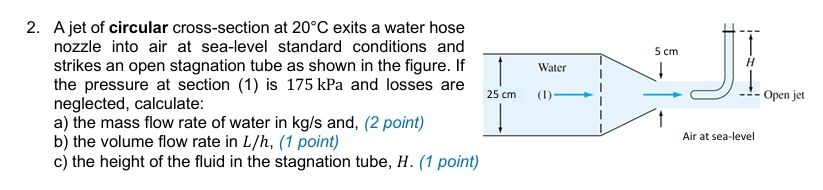 2. Ajet of circular cross-section at 20°C exits a water hose we
nozzle into air at sea-level standard conditions and Som 1
strikes an open stagnation tube as shown in the figure. If | wae ON) #
the pressure at section (1) is 175 kPa and losses are | ~~ = | ly
neglected, calculate: 1 PRE
a) the mass flow rate of water in kg/s and, (2 point) | >
b) the volume flow rate in L/h, (1 point) LL
©) the height of the fluid in the stagnation tube, H. (7 point)
This is AI generated Response.
Asked by: manish kumar
Created at: 2025-10-06 11:55:57
Asked by: manish kumar
Created at: 2025-10-06 11:55:57
Final Answer:
Rendered
Raw Text
Did you like this answer?
Let's break down the problem step by step.
Given:
- **Circular jet** (diameter not given, but radius can be figured from "5 cm" notation for the jet)
- **Section (1) pressure:** \( P_1 = 175\,\text{kPa} \)
- **Temperature:** \( 20^\circ\text{C} \) (properties of water)
- **Neglect losses**
- **Jet diameter:** \( d = 5\,\text{cm} = .05\,\text{m} \)
- **Section (1) diameter:** \( D = 25\,\text{cm} = .25\,\text{m} \)
- **Atmospheric pressure:** \( P_\text{atm} = 101.3\,\text{kPa} \)
- **Density of water at 20°C:** \( \rho = 998\,\text{kg/m}^3 \)
---
## a) **Mass flow rate of water (\(\dot{m}\)) in kg/s**
### **Step 1: Find velocity at the jet exit using Bernoulli's Equation**
Apply Bernoulli between section (1) and the jet exit (open to atmosphere):
\[
P_1 + \frac{1}{2}\rho V_1^2 = P_\text{atm} + \frac{1}{2}\rho V_2^2
\]
Assume velocity at (1), \(V_1\), is much smaller than at the nozzle (due to area difference), so \(V_1 \approx \):
\[
P_1 = P_\text{atm} + \frac{1}{2}\rho V_2^2
\]
\[
P_1 - P_\text{atm} = \frac{1}{2}\rho V_2^2
\]
\[
V_2 = \sqrt{\frac{2(P_1 - P_\text{atm})}{\rho}}
\]
Plug in the numbers:
\[
P_1 - P_\text{atm} = 175,000\,\text{Pa} - 101,300\,\text{Pa} = 73,700\,\text{Pa}
\]
\[
V_2 = \sqrt{\frac{2 \times 73,700}{998}} = \sqrt{\frac{147,400}{998}} \approx \sqrt{147.7} \approx 12.15\,\text{m/s}
\]
---
### **Step 2: Calculate mass flow rate**
The area of the jet (\(A_2\)):
\[
A_2 = \frac{\pi d^2}{4} = \frac{\pi (.05)^2}{4} \approx .00196\,\text{m}^2
\]
\[
\dot{m} = \rho A_2 V_2 = 998 \times .00196 \times 12.15 \approx 23.8\,\text{kg/s}
\]
---
## b) **Volume flow rate in L/h**
\[
Q = A_2 V_2 = .00196 \times 12.15 \approx .0238\,\text{m}^3/\text{s}
\]
Convert to L/h:
\[
.0238\,\text{m}^3/\text{s} \times 100\,\text{L}/\text{m}^3 \times 360\,\text{s}/\text{h} = 85,680\,\text{L}/\text{h}
\]
---
## c) **Height of the fluid in the stagnation tube, \(H\)**
This is a classic Pitot tube measurement: The height \(H\) is equivalent to the **velocity head**:
\[
\Delta P = \rho g H
\]
\[
H = \frac{P_1 - P_\text{atm}}{\rho g}
\]
\[
H = \frac{73,700}{998 \times 9.81} \approx \frac{73,700}{9,788} \approx 7.53\,\text{m}
\]
---
## **Final Answers**
**a) Mass flow rate:**
\[
\boxed{23.8\,\text{kg/s}}
\]
**b) Volume flow rate:**
\[
\boxed{85,680\,\text{L/h}}
\]
**c) Height in stagnation tube, \(H\):**
\[
\boxed{7.53\,\text{m}}
\]
Let me know if you need any clarifications or step breakdowns!
📢 Instructions:
- Ask anything relatd to above question only.
- For new Question goto :