 VIPSolutions
Act like a helpful tutor and exlain me : Give step-by-step solution with explanation and final answer: give explanation for both the correct and incorrect options also, ignore the pink mark give your correct answer and explanation[© Question 1 1pts Which strategies help reduce end effects in compression testing? Select all that apply. A. Applying lubricant to specimen ends C. Increasing specimen height-to-diameter ratio (J D. Increasing strain rate during loading (0) E. Removing one platen to allow free deformation [| Question 2 1 pts
Question:
Act like a helpful tutor and exlain me :
Give step-by-step solution with explanation and final answer:
give explanation for both the correct and incorrect options also, ignore the pink mark give your correct answer and explanation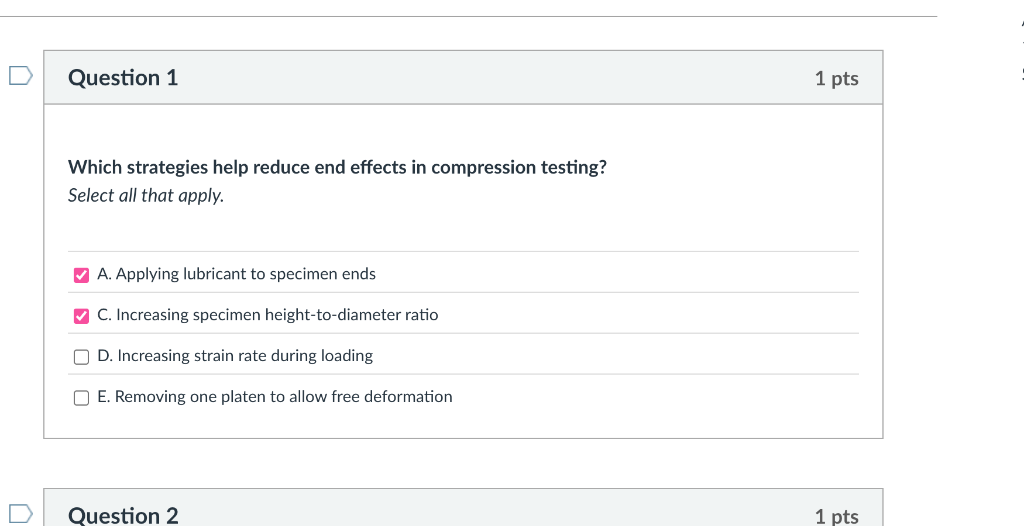 [© Question 1 1pts
Which strategies help reduce end effects in compression testing?
Select all that apply.
A. Applying lubricant to specimen ends
C. Increasing specimen height-to-diameter ratio
(J D. Increasing strain rate during loading
(0) E. Removing one platen to allow free deformation
[| Question 2 1 pts
This is AI generated Response.
Asked by: manish kumar
Created at: 2025-10-06 10:22:45
Asked by: manish kumar
Created at: 2025-10-06 10:22:45
Final Answer:
Rendered
Raw Text
Did you like this answer?
# Step-by-Step Solution
## Question
**Which strategies help reduce end effects in compression testing?**
*Select all that apply.*
Options:
- **A. Applying lubricant to specimen ends**
- **C. Increasing specimen height-to-diameter ratio**
- D. Increasing strain rate during loading
- E. Removing one platen to allow free deformation
---
## Explanation
### What are "End Effects" in Compression Testing?
End effects occur when the friction between the specimen and the platens (the compression plates) causes non-uniform deformation, leading to inaccurate results. Strategies to reduce end effects aim to ensure more uniform stress and strain distributions.
---
### Option A: Applying lubricant to specimen ends
**Correct.**
- **Explanation:** Lubricant reduces friction between the specimen and the platens, allowing the specimen to deform more uniformly and minimizing constraints at the ends.
---
### Option C: Increasing specimen height-to-diameter ratio
**Correct.**
- **Explanation:** A higher height-to-diameter ratio reduces the relative influence of the ends on the overall deformation, making the test results more representative of the material's true properties.
---
### Option D: Increasing strain rate during loading
**Incorrect.**
- **Explanation:** Increasing the strain rate affects the material's response but does **not** address friction or the geometric end effects. It could even introduce additional artifacts or errors.
---
### Option E: Removing one platen to allow free deformation
**Incorrect.**
- **Explanation:** Removing a platen is **not** a valid compression test setup. Both platens are needed to apply compressive force. Removing one would not allow you to perform the test properly and would not reduce end effects.
---
## **Final Answer**
The strategies that help reduce end effects in compression testing are:
- **A. Applying lubricant to specimen ends**
- **C. Increasing specimen height-to-diameter ratio**
---
### **Summary Table**
| Option | Correct? | Explanation |
|--------|----------|-------------|
| A | Yes | Reduces friction, decreases end effects |
| C | Yes | Lessens end influence, improves uniformity |
| D | No | Does not address end effects |
| E | No | Not a valid test method |
---
If you have more questions on compression testing or material science, feel free to ask!
📢 Instructions:
- Ask anything relatd to above question only.
- For new Question goto :