 VIPSolutions
Act like a helpful tutor and exlain me : Give step-by-step solution with explanation and final answer:3. Assume that link 2 is the input, write the vector loop equations and indicate the fixed constants (knowns), variables (unknowns), and constraints (with the corresponding constraint equations) for the following mechanisms. & 3 7 2 + < 2
Question:
Act like a helpful tutor and exlain me :
Give step-by-step solution with explanation and final answer: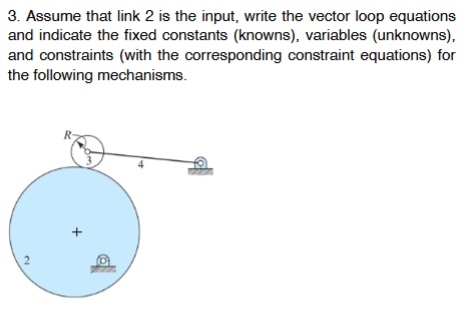 3. Assume that link 2 is the input, write the vector loop equations
and indicate the fixed constants (knowns), variables (unknowns),
and constraints (with the corresponding constraint equations) for
the following mechanisms.
&
3 7 2
+
< 2
This is AI generated Response.
Asked by: manish kumar
Created at: 2025-10-06 09:11:56
Asked by: manish kumar
Created at: 2025-10-06 09:11:56
Final Answer:
Rendered
Raw Text
Did you like this answer?
# Step-by-Step Solution
Let's break down the problem and find the **vector loop equation** for the given four-bar mechanism.
---
## **Step 1: Understanding the Mechanism**
- **Link 2** (Crank): The input link rotating about a fixed point.
- **Link 3** (Coupler): Connects link 2 and link 4.
- **Link 4** (Slider): Moves linearly.
- **Ground (Frame)**: Fixed points.
---
## **Step 2: Assign Notation and Vectors**
Let’s assign:
- \( r_2 \): Length of link 2 (crank)
- \( r_3 \): Length of link 3 (coupler)
- \( r_4 \): Length of link 4 (slider, variable distance)
- \( \theta_2 \): Angle of link 2 (input, **known**)
- \( \theta_3 \): Angle of link 3 (unknown)
- \( \theta_4 \): Angle of link 4 (slider, usually or π, as it's horizontal)
---
## **Step 3: Draw the Vector Loop**
The vector loop for the mechanism is:
\[
\vec{r}_2 + \vec{r}_3 = \vec{r}_4
\]
But in proper closing form (starting and ending at the fixed point):
\[
\vec{r}_2 + \vec{r}_3 = \vec{r}_4
\]
So, more precisely:
\[
\vec{r}_2 + \vec{r}_3 - \vec{r}_4 =
\]
### **Express Each Vector in Components**
Assuming the ground (frame) is on the x-axis:
- \( \vec{r}_2 = r_2 \cos\theta_2 \hat{i} + r_2 \sin\theta_2 \hat{j} \)
- \( \vec{r}_3 = r_3 \cos\theta_3 \hat{i} + r_3 \sin\theta_3 \hat{j} \)
- \( \vec{r}_4 = r_4 \hat{i} \) (slider moves along x-direction, so angle is )
---
## **Step 4: Write the Vector Loop Equation in Components**
\[
(r_2 \cos\theta_2 + r_3 \cos\theta_3 - r_4)\hat{i} + (r_2 \sin\theta_2 + r_3 \sin\theta_3)\hat{j} =
\]
This gives two scalar equations (since vectors must sum to zero):
### **Constraint Equations**
1. **x-component:**
\[
r_2 \cos\theta_2 + r_3 \cos\theta_3 - r_4 =
\]
2. **y-component:**
\[
r_2 \sin\theta_2 + r_3 \sin\theta_3 =
\]
---
## **Step 5: Identify Constants, Variables, and Constraints**
- **Knowns (Constants):**
- \( r_2 \): Length of link 2 (input crank)
- \( r_3 \): Length of link 3 (coupler)
- \( \theta_2 \): Input angle (since link 2 is input)
- **Unknowns (Variables):**
- \( r_4 \): Position of slider (output)
- \( \theta_3 \): Angle of coupler
- **Constraints (Equations):**
- \( r_2 \cos\theta_2 + r_3 \cos\theta_3 - r_4 = \)
- \( r_2 \sin\theta_2 + r_3 \sin\theta_3 = \)
---
## **Step 6: Final Answers**
### **a) Vector Loop Equation**
\[
\vec{r}_2 + \vec{r}_3 - \vec{r}_4 =
\]
### **b) Scalar Constraint Equations**
\[
\begin{cases}
r_2 \cos\theta_2 + r_3 \cos\theta_3 - r_4 = \\
r_2 \sin\theta_2 + r_3 \sin\theta_3 =
\end{cases}
\]
### **c) Knowns, Unknowns, Constraints**
- **Knowns:** \( r_2, r_3, \theta_2 \)
- **Unknowns:** \( \theta_3, r_4 \)
- **Constraints:** Two equations above
---
## **Summary Table**
| Quantity | Type | Description |
|-----------------|-----------|------------------------------------|
| \( r_2 \) | Known | Length of input crank |
| \( r_3 \) | Known | Length of coupler |
| \( \theta_2 \) | Known | Input angle |
| \( \theta_3 \) | Unknown | Coupler angle |
| \( r_4 \) | Unknown | Slider position (output) |
| Constraint 1 | Equation | \( r_2\cos\theta_2 + r_3\cos\theta_3 - r_4 = \) |
| Constraint 2 | Equation | \( r_2\sin\theta_2 + r_3\sin\theta_3 = \) |
---
**If you need a numerical solution or further clarification, just ask!**
📢 Instructions:
- Ask anything relatd to above question only.
- For new Question goto :