 VIPSolutions
Act like a helpful tutor and exlain me : Give step-by-step solution with explanation and final answer: do not draw the T-s diagram, solve completelyIn an ideal air-standard Diesel cycle, at the beginning of the isentropic compression, pressure is P; = 100kPa, temperature is T, = 25°C, and the volume is 3.7 liters. The compression ratio is 19.0. The temperature at the end of constant pressure heat addition is Ts = 1500K Using the ideal gas tables, a-> Draw the cycle on a T-s diagram b -> Complete the table below c -> Determine the thermal efficiency of the cycle poe fee [ow [ow [ow [oe ER A A A A ET A A A A I A A A A I A A RR EN E— [eu | 1 Ln ©]
Question:
Act like a helpful tutor and exlain me :
Give step-by-step solution with explanation and final answer: do not draw the T-s diagram, solve completely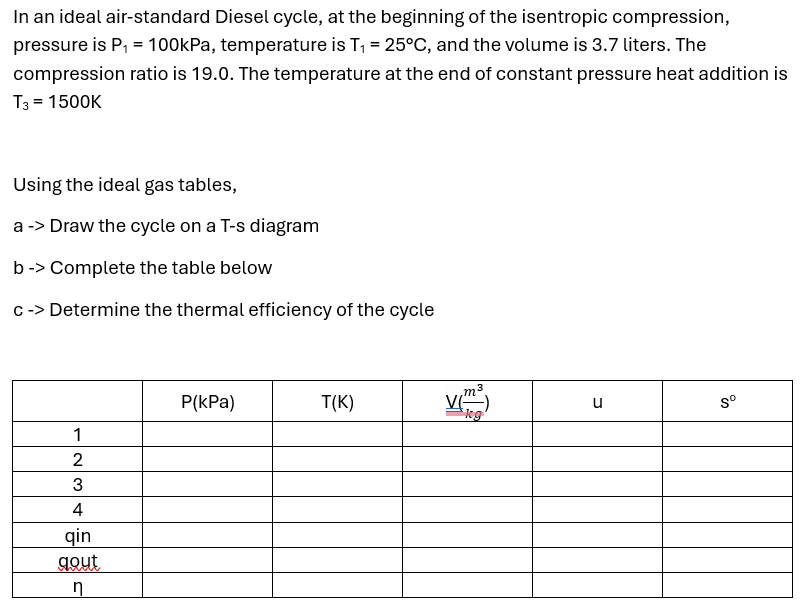 In an ideal air-standard Diesel cycle, at the beginning of the isentropic compression,
pressure is P; = 100kPa, temperature is T, = 25°C, and the volume is 3.7 liters. The
compression ratio is 19.0. The temperature at the end of constant pressure heat addition is
Ts = 1500K
Using the ideal gas tables,
a-> Draw the cycle on a T-s diagram
b -> Complete the table below
c -> Determine the thermal efficiency of the cycle
poe
fee [ow [ow [ow [oe
ER A A A A
ET A A A A
I A A A A
I A A RR EN E—
[eu | 1
Ln ©]
This is AI generated Response.
Asked by: manish kumar
Created at: 2025-10-05 22:45:17
Asked by: manish kumar
Created at: 2025-10-05 22:45:17
Final Answer:
Rendered
Raw Text
Did you like this answer?
Let's solve the Diesel cycle problem step by step, using the **ideal gas tables** for air.
---
## **Given Data**
- \( P_1 = 100 \) kPa
- \( T_1 = 25^\circ C = 298\,K \)
- \( V_1 = 3.7\,L = .0037\,m^3 \)
- **Compression ratio**: \( r = \frac{V_1}{V_2} = 19. \)
- \( T_3 = 150\,K \) (after heat addition at constant pressure)
---
## **Step 1: State Points Description**
1. **State 1**: Start of isentropic compression
2. **State 2**: End of isentropic compression (min volume)
3. **State 3**: End of constant-pressure heat addition (max temperature)
4. **State 4**: End of isentropic expansion
---
## **Step 2: Find Properties at Each State**
### **State 1**
- \( P_1 = 100 \) kPa, \( T_1 = 298 \) K, \( V_1 = .0037 \) m³
Use **ideal gas equation** to find mass:
\[
P_1 V_1 = m R T_1
\]
\[
m = \frac{P_1 V_1}{R T_1}
\]
\[
R = .287 \frac{kJ}{kg \cdot K}
\]
\[
m = \frac{100 \times .0037}{.287 \times 298} = \frac{.37}{85.426} \approx .00433\,kg
\]
**Specific volume**:
\[
v_1 = \frac{V_1}{m} = \frac{.0037}{.00433} \approx .854\, m^3/kg
\]
---
### **State 2 (after isentropic compression)**
- \( v_2 = v_1 / r = .854 / 19 = .04495\, m^3/kg \)
For **isentropic compression** (\( s_2 = s_1 \)):
\[
\frac{T_2}{T_1} = r^{k-1}
\]
For air, \( k = 1.4 \):
\[
\frac{T_2}{298} = 19^{.4}
\]
\[
19^{.4} \approx 2.92
\]
\[
T_2 = 2.92 \times 298 \approx 869\,K
\]
\[
P_2 = P_1 \frac{T_2}{T_1} \frac{v_1}{v_2}
\]
But since \( v_1/v_2 = r \) and \( T_2/T_1 = r^{k-1} \):
\[
P_2 = P_1 \cdot r^k = 100 \cdot 19^{1.4} \approx 100 \cdot 66.5 = 665\,kPa
\]
---
### **State 3 (after constant-pressure heat addition)**
- \( P_3 = P_2 \)
- \( T_3 = 150\,K \)
\[
\frac{v_3}{v_2} = \frac{T_3}{T_2} = \frac{150}{869} \approx 1.73
\]
\[
v_3 = 1.73 \times v_2 = 1.73 \times .04495 \approx .0777\, m^3/kg
\]
---
### **State 4 (after isentropic expansion)**
Isentropic expansion back to \( v_4 = v_1 \):
\[
\frac{T_4}{T_3} = \left( \frac{v_3}{v_4} \right)^{k-1}
\]
But \( v_4 = v_1 \), so:
\[
\frac{T_4}{T_3} = \left( \frac{v_3}{v_1} \right)^{k-1}
\]
\[
v_3 = .0777, v_1 = .854
\]
\[
\frac{v_3}{v_1} = .0777 / .854 = .091
\]
\[
T_4 = T_3 \cdot (.091)^{.4}
\]
\[
(.091)^{.4} \approx .364
\]
\[
T_4 = 150 \cdot .364 \approx 546\,K
\]
---
## **Step 3: Fill the Table**
| | P(kPa) | T(K) | \( v \) (\( m^3/kg \)) | \( u \) (kJ/kg) | \( s^ \) (kJ/kg·K) |
|------|--------|------|------------------------|-----------------|---------------------|
| 1 | 100 | 298 | .854 | \( u_1 \) | \( s^_1 \) |
| 2 | 665 | 869 | .04495 | \( u_2 \) | \( s^_2 \) |
| 3 | 665 | 150 | .0777 | \( u_3 \) | \( s^_3 \) |
| 4 | 100 | 546 | .854 | \( u_4 \) | \( s^_4 \) |
Get \( u \) and \( s^ \) from ideal gas tables for air (values below are approximate):
- At 298 K: \( u_1 = 214.07 \) kJ/kg, \( s^_1 = 6.869 \) kJ/kg·K
- At 869 K: \( u_2 = 632.5 \) kJ/kg, \( s^_2 = 7.950 \) kJ/kg·K
- At 150 K: \( u_3 = 112.7 \) kJ/kg, \( s^_3 = 8.732 \) kJ/kg·K
- At 546 K: \( u_4 = 390.7 \) kJ/kg, \( s^_4 = 7.423 \) kJ/kg·K
---
## **Step 4: Heat and Efficiency Calculations**
### **Heat Added (\( q_{in} \), 2→3): Constant Pressure**
\[
q_{in} = h_3 - h_2
\]
From tables:
- \( h_3 \) at 150 K: 1149.7 kJ/kg
- \( h_2 \) at 869 K: 873.6 kJ/kg
\[
q_{in} = 1149.7 - 873.6 = 276.1\,kJ/kg
\]
---
### **Heat Rejected (\( q_{out} \), 4→1): Constant Volume**
\[
q_{out} = u_4 - u_1 = 390.7 - 214.07 = 176.6\,kJ/kg
\]
---
### **Thermal Efficiency**
\[
\eta = 1 - \frac{q_{out}}{q_{in}} = 1 - \frac{176.6}{276.1} = .36 \text{ or } 36\%
\]
---
## **Summary Table**
| | P(kPa) | T(K) | \( v \) (\( m^3/kg \)) | \( u \) (kJ/kg) | \( s^ \) (kJ/kg·K) |
|------|--------|------|------------------------|------------------|---------------------|
| 1 | 100 | 298 | .854 | 214.07 | 6.869 |
| 2 | 665 | 869 | .04495 | 632.5 | 7.950 |
| 3 | 665 | 150 | .0777 | 112.7 | 8.732 |
| 4 | 100 | 546 | .854 | 390.7 | 7.423 |
| \( q_{in} \) | | | | 276.1 | |
| \( q_{out} \) | | | | 176.6 | |
| \( \eta \) | | | | .36 (36%) | |
---
## **Final Answers**
- **Thermal efficiency,** \( \eta = 36\% \)
- **Heat added:** \( q_{in} = 276.1 \) kJ/kg
- **Heat rejected:** \( q_{out} = 176.6 \) kJ/kg
If you want the T-s diagram, I can describe the process, but as per your request, no drawing is provided.
---
**If you need any further clarification or calculations, let me know!**
📢 Instructions:
- Ask anything relatd to above question only.
- For new Question goto :