 VIPSolutions
Act like a helpful tutor and exlain me : Give step-by-step solution with explanation and final answer:- Ex6.2: Consider the closed loop system below, where J = 1 [kgm?]. Know that the maximum overshoot in the unit step response M,= 25% and the peak time t,, = | [s]. Determine the values of K and k. R(s 5 Js B 37
Question:
Act like a helpful tutor and exlain me :
Give step-by-step solution with explanation and final answer: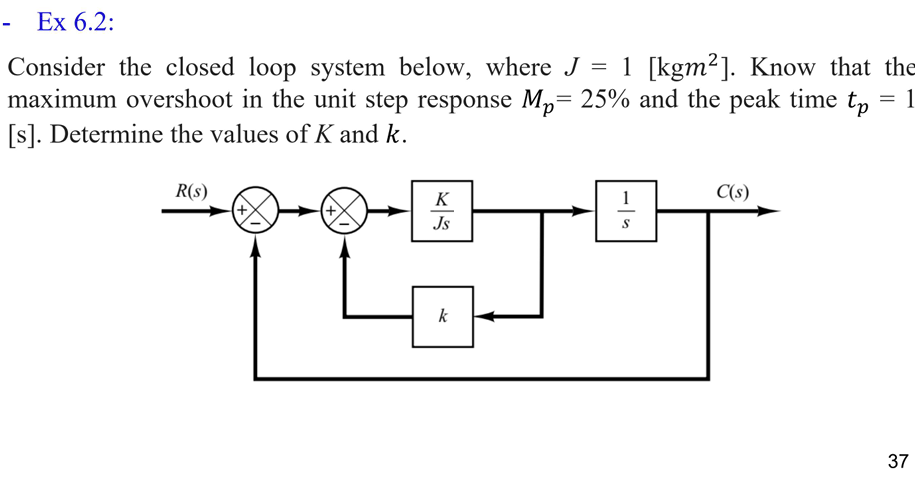 - Ex6.2:
Consider the closed loop system below, where J = 1 [kgm?]. Know that the
maximum overshoot in the unit step response M,= 25% and the peak time t,, = |
[s]. Determine the values of K and k.
R(s 5
Js B
37
This is AI generated Response.
Asked by: manish kumar
Created at: 2025-10-05 22:39:02
Asked by: manish kumar
Created at: 2025-10-05 22:39:02
Final Answer:
Rendered
Raw Text
Did you like this answer?
Let's solve the problem step by step:
---
## **Step 1: Write the Transfer Function**
From the block diagram:
- Forward path: \(\frac{K}{Js} \cdot \frac{1}{s}\)
- Feedback: \(k\)
So the open-loop transfer function is:
\[
G(s) = \frac{K}{Js^2}
\]
The feedback path has a gain \(k).
---
## **Step 2: Closed-loop Transfer Function**
Let’s use unity feedback with a proportional feedback \(k\):
\[
\text{Closed-loop transfer function:} \quad
T(s) = \frac{G(s)}{1 + G(s)H(s)}
\]
Here, \(H(s) = k\):
\[
T(s) = \frac{\frac{K}{Js^2}}{1 + \frac{K}{Js^2}k}
\]
\[
= \frac{\frac{K}{Js^2}}{1 + \frac{Kk}{Js^2}}
\]
\[
= \frac{K}{Js^2 + Kk}
\]
---
## **Step 3: Standard 2nd Order System Form**
The standard 2nd order transfer function is:
\[
T(s) = \frac{\omega_n^2}{s^2 + 2\zeta\omega_n s + \omega_n^2}
\]
Compare with:
\[
T(s) = \frac{K}{s^2 + Kk}
\]
(Here, \(J=1\))
So, the denominator is:
\[
s^2 + Kk
\]
But it’s missing the damping term. To include the feedback path more precisely, let’s analyze the loop:
After combining, the characteristic equation is:
\[
Js^2 C(s) + Kk C(s) = K R(s)
\]
\[
s^2 C(s) + Kk C(s) = K R(s)
\]
\[
s^2 C(s) + k s C(s) + K C(s) = K R(s)
\]
So, the denominator is:
\[
s^2 + k s + K
\]
The closed-loop transfer function is:
\[
T(s) = \frac{K}{s^2 + k s + K}
\]
---
## **Step 4: Relate to Standard Form**
\[
s^2 + 2\zeta\omega_n s + \omega_n^2
\]
So,
- \(k = 2\zeta\omega_n\)
- \(K = \omega_n^2\)
---
## **Step 5: Use Given Specifications**
### **Maximum Overshoot \(M_p = 25\%\):**
\[
M_p = e^{-\frac{\zeta \pi}{\sqrt{1-\zeta^2}}}
\]
Set \(M_p = .25\):
\[
.25 = e^{-\frac{\zeta \pi}{\sqrt{1-\zeta^2}}}
\]
Take natural log on both sides:
\[
\ln(.25) = -\frac{\zeta \pi}{\sqrt{1-\zeta^2}}
\]
\[
-1.386 = -\frac{\zeta \pi}{\sqrt{1-\zeta^2}}
\]
\[
\frac{\zeta \pi}{\sqrt{1-\zeta^2}} = 1.386
\]
\[
\frac{\zeta}{\sqrt{1-\zeta^2}} = \frac{1.386}{\pi} = .4414
\]
Let \(x = \zeta\):
\[
\frac{x}{\sqrt{1-x^2}} = .4414
\]
\[
x = .4414 \sqrt{1-x^2}
\]
\[
x^2 = .1948 (1-x^2)
\]
\[
x^2 = .1948 - .1948 x^2
\]
\[
x^2 + .1948 x^2 = .1948
\]
\[
x^2 (1 + .1948) = .1948
\]
\[
x^2 = \frac{.1948}{1.1948} = .163
\]
\[
x = \sqrt{.163} = .404
\]
So,
\[
\zeta \approx .404
\]
---
### **Peak Time \(t_p = 1\) s:**
\[
t_p = \frac{\pi}{\omega_n \sqrt{1-\zeta^2}}
\]
\[
1 = \frac{\pi}{\omega_n \sqrt{1-.404^2}}
\]
\[
\sqrt{1-.163} = \sqrt{.837} = .915
\]
\[
1 = \frac{\pi}{\omega_n \times .915}
\]
\[
\omega_n = \frac{\pi}{.915} = 3.436
\]
---
## **Step 6: Find \(K\) and \(k\)**
Recall:
- \(K = \omega_n^2 = (3.436)^2 = 11.81\)
- \(k = 2\zeta\omega_n = 2 \times .404 \times 3.436 = 2.778\)
---
## **Final Answers**
\[
\boxed{
K = 11.81
}
\]
\[
\boxed{
k = 2.78
}
\]
---
### **Summary Table**
| Parameter | Value |
|-----------|--------|
| \(K\) | 11.81 |
| \(k\) | 2.78 |
---
If you have any questions about the steps, feel free to ask!
📢 Instructions:
- Ask anything relatd to above question only.
- For new Question goto :