 VIPSolutions
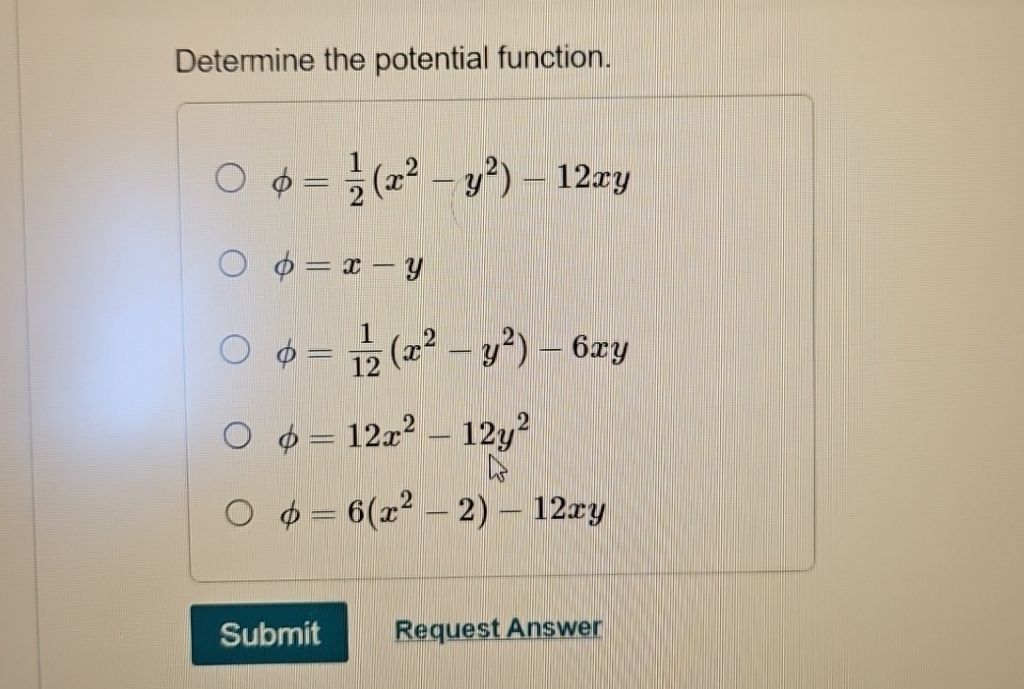
Act like a helpful tutor and exlain me : Give step-by-step solution with explanation and final answer:Afiuid has velocity components u = (z — 12y) ft/s and v = — (y + 12x) ft/s, where z and y are in feet. Determine the potential function. 1 oo lz Et be d=z—y | y | ) ¢— 5 (af ml) in Gey OQ dot Hoye kk | O ¢=6(z?—2)—12zy | | Request Answer Il ll fff Il Il
Question:
Act like a helpful tutor and exlain me :
Give step-by-step solution with explanation and final answer: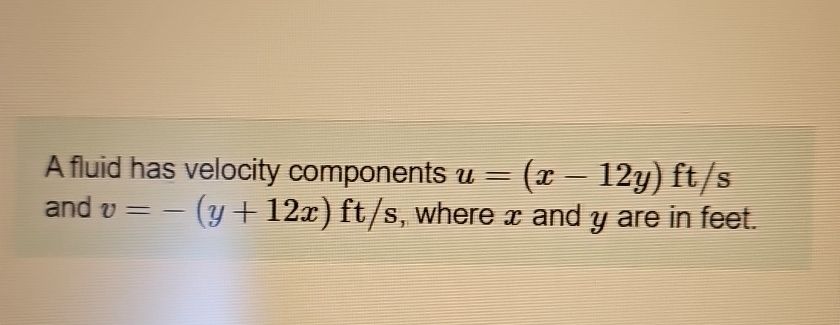
 Afiuid has velocity components u = (z — 12y) ft/s
and v = — (y + 12x) ft/s, where z and y are in feet.
Determine the potential function.
1
oo lz Et be
d=z—y |
y |
) ¢— 5 (af ml) in Gey
OQ dot Hoye
kk
| O ¢=6(z?—2)—12zy |
|
Request Answer
Il ll fff Il Il
This is AI generated Response.
Asked by: manish kumar
Created at: 2025-10-05 21:35:18
Asked by: manish kumar
Created at: 2025-10-05 21:35:18
Final Answer:
Rendered
Raw Text
Did you like this answer?
Let's solve the problem step by step!
## **Step 1: Understand the Problem**
You are given the velocity components of a fluid:
- \( u = (x - 12y) \) ft/s
- \( v = - (y + 12x) \) ft/s
You are asked to **determine the potential function** \( \phi \).
## **Step 2: Relationship Between Velocity and Potential Function**
For a potential function \( \phi(x, y) \) in a velocity field:
- \( u = \frac{\partial \phi}{\partial x} \)
- \( v = \frac{\partial \phi}{\partial y} \)
But since \( v \) is often given as negative in potential flow:
- \( u = \frac{\partial \phi}{\partial x} \)
- \( v = \frac{\partial \phi}{\partial y} \)
But here, the negative sign is already included in \( v \), so **keep the direct sign**.
## **Step 3: Find \( \phi \) Using Integration**
### **Integrate for \( u \):**
Given \( u = x - 12y \):
\[
u = \frac{\partial \phi}{\partial x} = x - 12y
\]
Integrate with respect to \( x \):
\[
\phi(x, y) = \int (x - 12y) \, dx = \frac{1}{2}x^2 - 12y x + f(y)
\]
where \( f(y) \) is a function of \( y \) only.
### **Differentiate for \( v \):**
Given \( v = - (y + 12x) \):
\[
v = \frac{\partial \phi}{\partial y} = - (y + 12x)
\]
Now, use the \( \phi(x, y) \) found above:
\[
\frac{\partial \phi}{\partial y} = -12x + f'(y)
\]
Set equal to above:
\[
-12x + f'(y) = - (y + 12x)
\]
\[
-12x + f'(y) = -y - 12x
\]
\[
f'(y) = -y
\]
Integrate both sides with respect to \( y \):
\[
f(y) = -\frac{1}{2}y^2 + C
\]
## **Step 4: Write the General Potential Function**
Combine all parts:
\[
\phi(x, y) = \frac{1}{2}x^2 - 12x y - \frac{1}{2}y^2 + C
\]
## **Step 5: Match With the Choices**
Looking at the choices, the correct one is:
\[
\boxed{\phi = \frac{1}{2}(x^2 - y^2) - 12xy}
\]
## **Final Answer**
\[
\boxed{\phi = \frac{1}{2}(x^2 - y^2) - 12xy}
\]
---
**Summary of Steps:**
1. Use \( u = \frac{\partial \phi}{\partial x} \) to integrate for \( \phi \).
2. Use \( v = \frac{\partial \phi}{\partial y} \) to find the function of \( y \).
3. Combine results and match with the answer choices.
Let me know if you'd like to see how each choice compares!
📢 Instructions:
- Ask anything relatd to above question only.
- For new Question goto :