 VIPSolutions
Act like a helpful tutor and exlain me : Give step-by-step solution with explanation and final answer:A solid circular shaft is used to transmit torque from an electric motor to a pump. The shaft is made of ductile steel and operates under pure torsional loading. Explain the theoretical basis of the relation- ship between shear stress and angle of twist for such a shaft, and derive the torsion equation using the concept of uniform shear strain. You explain should 1rclude: ¢ Assumptions made in the derivation e Meaning of each term in the equation ¢ The relation between polar moment of inertia, shear modulus, and twist per unit length The physical significance of the torsion
Question:
Act like a helpful tutor and exlain me :
Give step-by-step solution with explanation and final answer: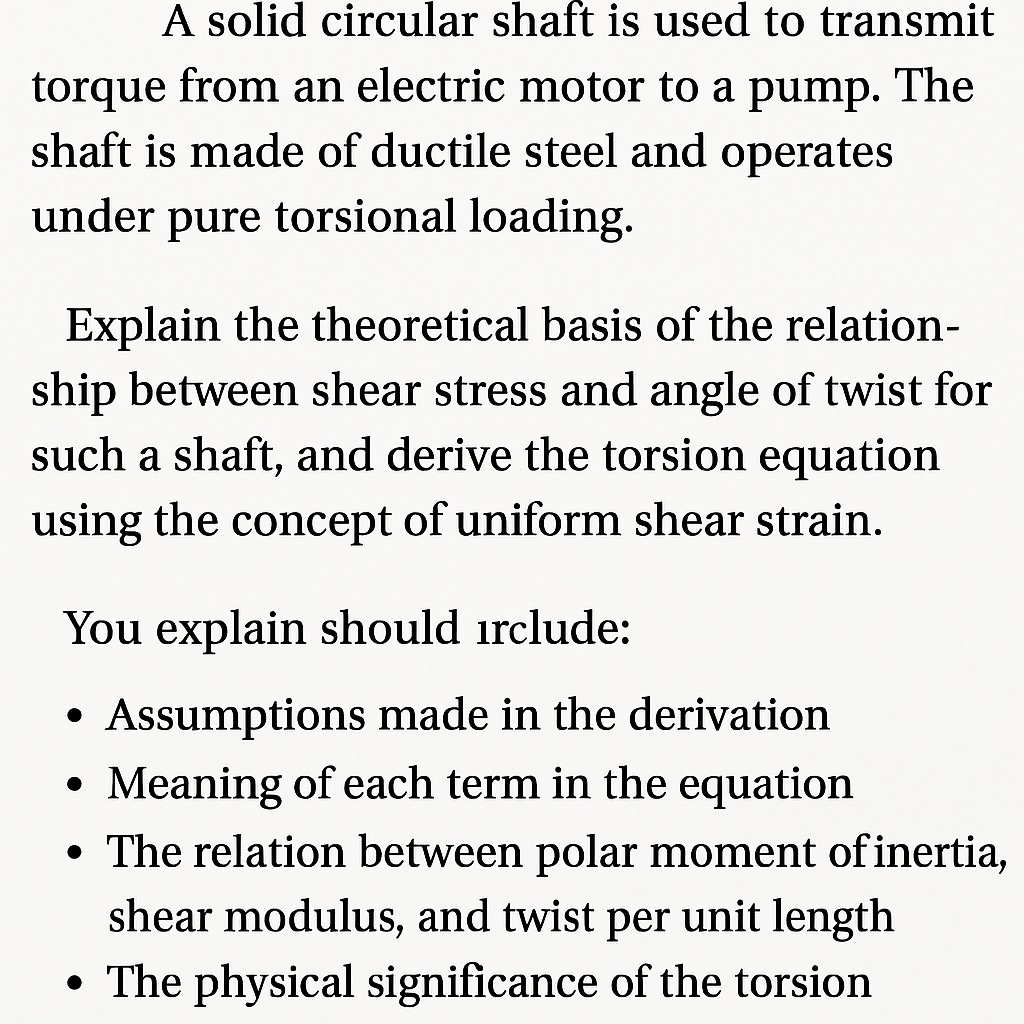 A solid circular shaft is used to transmit
torque from an electric motor to a pump. The
shaft is made of ductile steel and operates
under pure torsional loading.
Explain the theoretical basis of the relation-
ship between shear stress and angle of twist for
such a shaft, and derive the torsion equation
using the concept of uniform shear strain.
You explain should 1rclude:
¢ Assumptions made in the derivation
e Meaning of each term in the equation
¢ The relation between polar moment of inertia,
shear modulus, and twist per unit length
The physical significance of the torsion
This is AI generated Response.
Asked by: manish kumar
Created at: 2025-10-05 19:37:06
Asked by: manish kumar
Created at: 2025-10-05 19:37:06
Final Answer:
Rendered
Raw Text
Did you like this answer?
# Torsion of a Solid Circular Shaft: Theory and Derivation
Let's break down the derivation and meaning behind the relationship between **shear stress** and **angle of twist** in a solid circular shaft under pure torsion.
---
## **Step 1: Assumptions in the Derivation**
1. **Material is homogeneous and isotropic:** Properties are the same at every point and in every direction.
2. **Shaft is solid and circular in cross-section.**
3. **Pure torsion:** Only torque is applied; no bending or axial forces.
4. **Deformations are small:** Linear elastic behavior (Hooke’s law applies).
5. **Plane sections remain plane:** Cross sections remain perpendicular to the shaft axis during twist.
6. **Uniform shear strain across the shaft's length.**
---
## **Step 2: Derivation Using Uniform Shear Strain**
### **A. Shear Strain and Angle of Twist**
- **Let:**
\( L \) = Length of shaft
\( r \) = Radius at which we measure strain
\( \theta \) = Total angle of twist (radians)
\( \phi = \frac{d\theta}{dx} \) = Rate of twist per unit length
- **Shear Strain (\( \gamma \)):**
\[
\gamma = r \frac{d\theta}{dx} = r \phi
\]
### **B. Shear Stress**
- **From Hooke’s Law for shear:**
\( \tau = G \gamma \)
Where \( G \) = Shear modulus of the material
\[
\tau = G r \frac{d\theta}{dx}
\]
### **C. Torque and Polar Moment of Inertia**
- **At radius \( r \), elemental torque:**
\[
dT = \tau \cdot r \cdot dA
\]
Where \( dA \) = Elemental area at radius \( r \)
- **Total torque \( T \):**
\[
T = \int_A \tau r\, dA = \int_A G r \frac{d\theta}{dx} r\, dA
\]
\[
T = G \frac{d\theta}{dx} \int_A r^2\, dA = G \frac{d\theta}{dx} J
\]
Where \( J = \int_A r^2 dA \) is the **polar moment of inertia** for the shaft.
---
## **Step 3: The Torsion Equation**
\[
\boxed{ \frac{T}{J} = \frac{\tau}{r} = G \frac{d\theta}{dx} }
\]
- \( T \) = Applied torque
- \( J \) = Polar moment of inertia (\( \frac{\pi d^4}{32} \) for a solid shaft of diameter \( d \))
- \( \tau \) = Shear stress at radius \( r \)
- \( r \) = Radius where stress is calculated (maximum at surface, \( r = R \))
- \( G \) = Shear modulus
- \( \frac{d\theta}{dx} \) = Twist per unit length
---
## **Step 4: Relationship Between Variables**
- **Polar moment of inertia (\( J \))**: Measures resistance to twisting, depends on cross-sectional shape and size.
- **Shear modulus (\( G \))**: Material property, relates shear stress and strain.
- **Twist per unit length (\( \frac{d\theta}{dx} \))**: How much the shaft twists per unit length.
### **Solving for Angle of Twist**
For total angle of twist over length \( L \):
\[
\theta = \frac{T L}{G J}
\]
---
## **Step 5: Physical Significance**
- **Torsion equation** tells us how much a shaft will twist and how much shear stress develops for a given torque.
- **Engineers use this to ensure**:
- Shaft does not fail in shear (check \( \tau_{max} \))
- Shaft does not twist excessively (\( \theta \) is within acceptable limits)
- Shaft’s dimensions are suitable for the torque and material used.
---
### **Summary Table**
| Term | Meaning |
|---------------|------------------------------------------------------------------|
| \( T \) | Applied torque (Nm) |
| \( J \) | Polar moment of inertia (\( m^4 \)), \( = \frac{\pi d^4}{32} \) |
| \( \tau \) | Shear stress (Pa or N/m²) |
| \( r \) | Radial distance from shaft center (m) |
| \( G \) | Shear modulus (Pa) |
| \( \theta \) | Total angle of twist (radians) |
| \( L \) | Length of shaft (m) |
---
## **Final Summary Equation**
\[
\boxed{
\frac{T}{J} = \frac{\tau}{r} = G \frac{d\theta}{dx}
}
\]
This relates torque, shear stress, shaft geometry, material properties, and angle of twist for a circular shaft under torsion.
📢 Instructions:
- Ask anything relatd to above question only.
- For new Question goto :