 VIPSolutions
Act like a helpful tutor and exlain me : Give step-by-step solution with explanation and final answer: use one tresca theory2. Design loads of a machine component made of a brittle material produce the following stresses at a critical section in the component: ox = -80 MPa, oy = 90 MPa, and ty, = 60 MPa. The ultimate strength of the material is 350 MPa and Poisson ratio 0.20. Use two (2) different yield (failure) criteria (of your choice) to determine the factor of safety for this design. Briefly discuss why you choose these two criteria (10 Marks).
Question:
Act like a helpful tutor and exlain me :
Give step-by-step solution with explanation and final answer:
use one tresca theory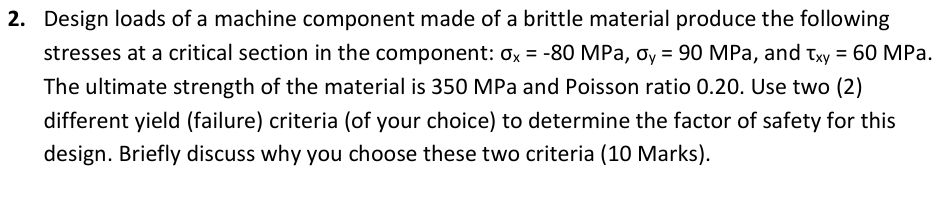 2. Design loads of a machine component made of a brittle material produce the following
stresses at a critical section in the component: ox = -80 MPa, oy = 90 MPa, and ty, = 60 MPa.
The ultimate strength of the material is 350 MPa and Poisson ratio 0.20. Use two (2)
different yield (failure) criteria (of your choice) to determine the factor of safety for this
design. Briefly discuss why you choose these two criteria (10 Marks).
This is AI generated Response.
Asked by: manish kumar
Created at: 2025-10-04 22:56:01
Asked by: manish kumar
Created at: 2025-10-04 22:56:01
Final Answer:
Rendered
Raw Text
Did you like this answer?
# Step-by-Step Solution
Let's break down the problem as requested, using **Tresca (Maximum Shear Stress)** theory and **Maximum Normal Stress** theory, which are both relevant for brittle materials.
---
## **Given Data**
- \( \sigma_x = -80\, \text{MPa} \)
- \( \sigma_y = 90\, \text{MPa} \)
- \( \tau_{xy} = 60\, \text{MPa} \)
- Ultimate strength (\( \sigma_{ult} \)): **350 MPa**
- Poisson's ratio (\( \nu \)): **.20**
---
## **Step 1: Find Principal Stresses**
The principal stresses (\( \sigma_1, \sigma_2 \)) for a 2D stress state are given by:
\[
\sigma_{1,2} = \frac{(\sigma_x + \sigma_y)}{2} \pm \sqrt{ \left( \frac{\sigma_x - \sigma_y}{2} \right)^2 + \tau_{xy}^2 }
\]
Plug in the values:
\[
\frac{(\sigma_x + \sigma_y)}{2} = \frac{-80 + 90}{2} = 5\, \text{MPa}
\]
\[
\frac{(\sigma_x - \sigma_y)}{2} = \frac{-80 - 90}{2} = -85\, \text{MPa}
\]
\[
\sqrt{(-85)^2 + 60^2} = \sqrt{7225 + 360} = \sqrt{10825} \approx 104\, \text{MPa}
\]
So,
\[
\sigma_1 = 5 + 104 = \textbf{109 MPa}
\]
\[
\sigma_2 = 5 - 104 = \textbf{-99 MPa}
\]
---
## **Step 2: Tresca (Maximum Shear Stress) Theory**
Tresca theory states that yielding begins when the maximum shear stress in the material reaches the maximum shear stress in a simple tension test (half the ultimate strength for brittle materials):
\[
\tau_{max} = \frac{|\sigma_1 - \sigma_2|}{2}
\]
\[
\tau_{max} = \frac{|109 - (-99)|}{2} = \frac{208}{2} = 104\, \text{MPa}
\]
**Factor of Safety (FOS) using Tresca:**
\[
\text{FOS}_{\text{Tresca}} = \frac{\text{Ultimate Strength}/2}{\tau_{max}} = \frac{350/2}{104} = \frac{175}{104} \approx \boxed{1.68}
\]
---
## **Step 3: Maximum Normal Stress Theory**
For brittle materials, the maximum normal stress theory (Rankine theory) is often used, which states failure occurs when the maximum principal stress exceeds the ultimate strength.
\[
\text{FOS}_{\text{Max Normal}} = \frac{\text{Ultimate Strength}}{|\sigma_{max}|}
\]
Here, \( |\sigma_{max}| = \max(|\sigma_1|, |\sigma_2|) = \max(109, 99) = 109\, \text{MPa} \):
\[
\text{FOS}_{\text{Max Normal}} = \frac{350}{109} \approx \boxed{3.21}
\]
---
## **Step 4: Brief Discussion**
- **Tresca Theory:**
Chosen because it is widely used for ductile materials but can offer a conservative estimate for brittle materials when shear failure is possible. It considers the maximum shear stress, which is important in many engineering applications.
- **Maximum Normal Stress Theory:**
Directly applicable to brittle materials, as they usually fail in tension rather than shear. It compares the maximum principal (normal) stress to the ultimate strength.
---
## **Final Answers**
**a) Tresca Factor of Safety:**
\[
\boxed{1.68}
\]
**b) Maximum Normal Stress Factor of Safety:**
\[
\boxed{3.21}
\]
---
**Summary Table:**
| Failure Theory | Factor of Safety |
|-------------------------|:----------------:|
| Tresca (Shear) | 1.68 |
| Max Normal Stress | 3.21 |
---
**Why these criteria?**
- **Tresca** gives a conservative estimate for safety, especially if there is any possibility of shear-driven failure.
- **Max Normal Stress** is most appropriate for brittle materials, as they tend to fracture when the maximum normal stress exceeds their strength.
---
If you want to see the calculation steps for other criteria (such as von Mises), let me know!
📢 Instructions:
- Ask anything relatd to above question only.
- For new Question goto :