 VIPSolutions
Act like a helpful tutor and exlain me : Give step-by-step solution with explanation and final answer:Q16. Drive the differential equation of motion and find the expressions for the critical damping coefficient and the frequency of vibration for the system shown in figure below. Take m = 2 kg, K = 400 N/n, 1 = 200 mm and a= 75 mm.
Question:
Act like a helpful tutor and exlain me :
Give step-by-step solution with explanation and final answer: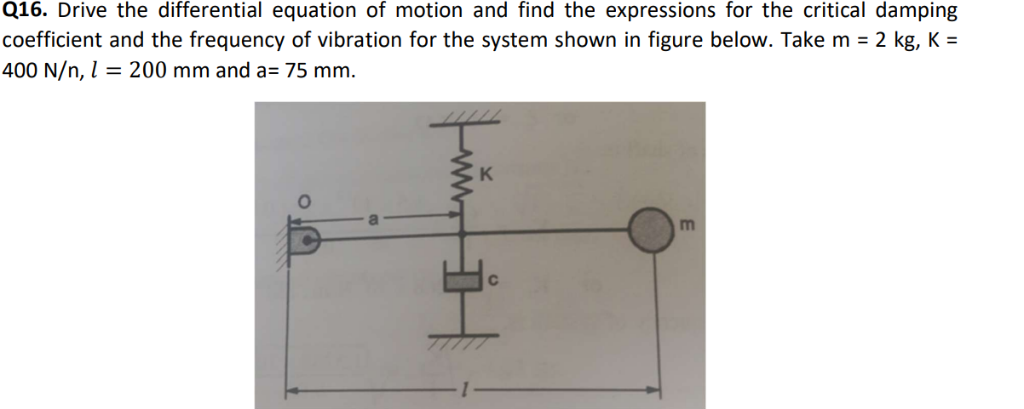 Q16. Drive the differential equation of motion and find the expressions for the critical damping
coefficient and the frequency of vibration for the system shown in figure below. Take m = 2 kg, K =
400 N/n, 1 = 200 mm and a= 75 mm.
This is AI generated Response.
Asked by: manish kumar
Created at: 2025-10-04 11:34:24
Asked by: manish kumar
Created at: 2025-10-04 11:34:24
Final Answer:
Rendered
Raw Text
Did you like this answer?
Let's break down the problem step by step:
---
## **Step 1: Understand the System**
- **Given:**
- Mass, \( m = 2 \) kg
- Spring constant, \( K = 400 \) N/m
- Lengths: \( l = 200 \) mm = .2 m, \( a = 75 \) mm = .075 m
This is a rotational vibrating system with a damper and spring attached *not at the pivot* but at a distance \( a \) from it.
---
## **Step 2: Equation of Motion**
Let \(\theta\) be the angular displacement of the rod (measured from equilibrium).
- **Moment of Inertia about O:**
For a point mass at the end of a rod:
\[
I = ml^2
\]
- **Spring Force:**
When rod rotates by \(\theta\), point at distance \(a\) moves vertically by \(a\theta\).
So, force in spring = \(K(a\theta)\) (Hooke's law).
Moment about O due to spring:
\[
M_{spring} = K(a\theta) \cdot a = Ka^2 \theta
\]
- **Damping Force:**
Damper at \(a\): vertical velocity = \(a\dot{\theta}\).
Damping force = \(c(a\dot{\theta})\).
Moment about O due to damper:
\[
M_{damper} = c(a\dot{\theta}) \cdot a = ca^2\dot{\theta}
\]
---
## **Step 3: Write the Differential Equation**
Sum of moments about O (using D'Alembert's Principle):
\[
I\ddot{\theta} + ca^2\dot{\theta} + Ka^2\theta =
\]
Substitute \( I = ml^2 \):
\[
ml^2\ddot{\theta} + ca^2\dot{\theta} + Ka^2\theta =
\]
Or,
\[
\boxed{
\ddot{\theta} + \frac{ca^2}{ml^2}\dot{\theta} + \frac{Ka^2}{ml^2}\theta =
}
\]
---
## **Step 4: Expressions for Critical Damping Coefficient and Frequency**
This is a standard second-order ODE:
\[
\ddot{\theta} + 2\zeta\omega_n\dot{\theta} + \omega_n^2\theta =
\]
- **Natural Frequency (\(\omega_n\)):**
\[
\omega_n = \sqrt{\frac{Ka^2}{ml^2}}
\]
- **Critical Damping Coefficient (\(c_{cr}\)):**
\[
2\zeta\omega_n = \frac{ca^2}{ml^2}
\]
For critical damping, \(\zeta = 1\):
\[
2\omega_n = \frac{c_{cr}a^2}{ml^2}
\implies c_{cr} = \frac{2ml^2}{a^2}\omega_n
\]
Substitute \(\omega_n\):
\[
c_{cr} = \frac{2ml^2}{a^2} \sqrt{\frac{Ka^2}{ml^2}}
\]
Simplifying:
\[
c_{cr} = 2\sqrt{Km}\frac{l}{a}
\]
---
## **Step 5: Frequency of Vibration**
- **Natural Frequency (\(f_n\)):**
\[
f_n = \frac{\omega_n}{2\pi} = \frac{1}{2\pi}\sqrt{\frac{Ka^2}{ml^2}}
\]
---
## **Step 6: Substitute Values**
Given:
- \(m = 2\) kg
- \(K = 400\) N/m
- \(l = .2\) m
- \(a = .075\) m
### **Calculate \(\omega_n\):**
\[
\omega_n = \sqrt{\frac{400 \times (.075)^2}{2 \times (.2)^2}}
\]
\[
= \sqrt{\frac{400 \times .005625}{2 \times .04}}
\]
\[
= \sqrt{\frac{2.25}{.08}}
\]
\[
= \sqrt{28.125}
\]
\[
\approx 5.306~\text{rad/s}
\]
### **Calculate \(c_{cr}\):**
\[
c_{cr} = 2 \sqrt{400 \times 2} \cdot \frac{.2}{.075}
\]
\[
= 2 \cdot \sqrt{800} \cdot \frac{.2}{.075}
\]
\[
\sqrt{800} \approx 28.284
\]
\[
c_{cr} = 2 \cdot 28.284 \cdot 2.6667
\]
\[
= 56.568 \cdot 2.6667 \approx 151.05~\text{N·s/m}
\]
### **Calculate \(f_n\):**
\[
f_n = \frac{5.306}{2\pi} \approx .844~\text{Hz}
\]
---
## **Final Answers**
### **1. Differential Equation:**
\[
\boxed{ml^2\ddot{\theta} + ca^2\dot{\theta} + Ka^2\theta = }
\]
### **2. Critical Damping Coefficient:**
\[
\boxed{c_{cr} = 2\sqrt{Km}\frac{l}{a} = 151.05~\text{N·s/m}}
\]
### **3. Frequency of Vibration:**
\[
\boxed{f_n = \frac{1}{2\pi}\sqrt{\frac{Ka^2}{ml^2}} = .844~\text{Hz}}
\]
If you need further clarifications or a breakdown of any step, just ask!
📢 Instructions:
- Ask anything relatd to above question only.
- For new Question goto :