VIPSolutions logo ✨ VIPSolutions

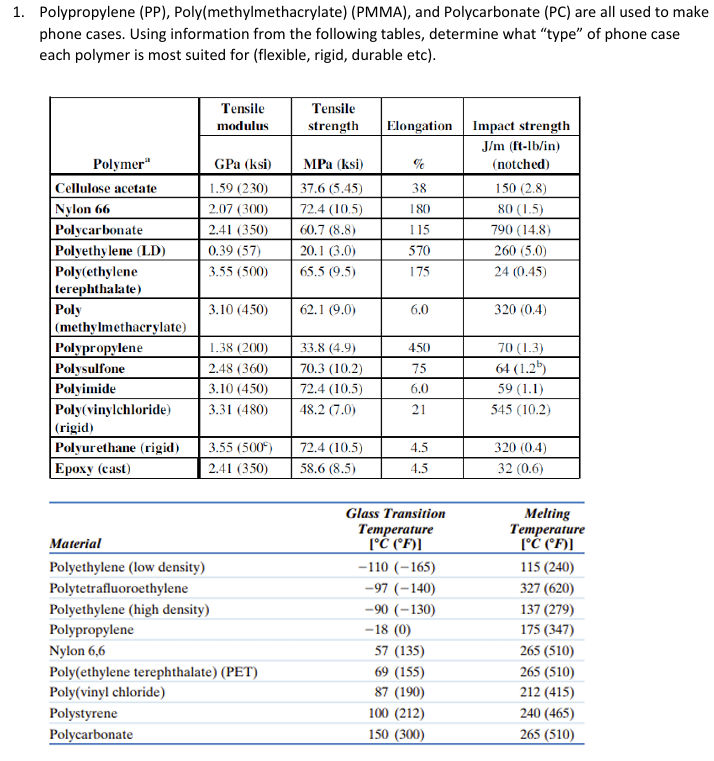
Act like a helpful tutor and exlain me : Give step-by-step solution with explanation and final answer:1. Polypropylene (PP), Poly(methylmethacrylate) (PMMA), and Polycarbonate (PC) are all used to make phone cases. Using information from the following tables, determine what “type” of phone case each polymer is most suited for (flexible, rigid, durable etc). CEE pe] mentee | asontts | tongation | impact srg J/m (ft-1b/in) [Cte setae soc [vocm | w | ics | [mee ovo Jeans | iw | wis] [Pobcarbanze [2100 [wrow | is | wow] Re (methyImethaerylate) pont Glass Transition Melting Temperature Temperature ‘Material cen °c cn) Frey =” SE TT Polytetrafluoroethylene 97 (~140) 327 (620) Polyethylene (high density) ~90 (~130) 137279) Polypropylene ~18 (0) 175 (347) Nylon 66 57 (135) 265 (510) Poly(ethylene terephthalate) (PET) 69 (155) 265 (510) Poly(vinyl chloride) 87 (190) 212415) Polystyrene 100 (212) 240 (465) Polycarbonate 150 (300) 265 (510)
Question:

Act like a helpful tutor and exlain me : Give step-by-step solution with explanation and final answer:Uploaded Image1. Polypropylene (PP), Poly(methylmethacrylate) (PMMA), and Polycarbonate (PC) are all used to make phone cases. Using information from the following tables, determine what “type” of phone case each polymer is most suited for (flexible, rigid, durable etc). CEE pe] mentee | asontts | tongation | impact srg J/m (ft-1b/in) [Cte setae soc [vocm | w | ics | [mee ovo Jeans | iw | wis] [Pobcarbanze [2100 [wrow | is | wow] Re (methyImethaerylate) pont Glass Transition Melting Temperature Temperature ‘Material cen °c cn) Frey =” SE TT Polytetrafluoroethylene 97 (~140) 327 (620) Polyethylene (high density) ~90 (~130) 137279) Polypropylene ~18 (0) 175 (347) Nylon 66 57 (135) 265 (510) Poly(ethylene terephthalate) (PET) 69 (155) 265 (510) Poly(vinyl chloride) 87 (190) 212415) Polystyrene 100 (212) 240 (465) Polycarbonate 150 (300) 265 (510)

This is AI generated Response.
Asked by: manish kumar
Created at: 2025-10-04 08:37:40

Final Answer:

Rendered Raw Text
Did you like this answer?
## Step-by-Step Solution Let's analyze each polymer for phone case suitability using the tables: ### 1. **Polypropylene (PP)** #### Properties: - **Tensile modulus:** 1.38 GPa (low, so more flexible) - **Tensile strength:** 33.8 MPa (moderate) - **Elongation:** 450% (very high, very flexible/stretchable) - **Impact strength:** 70 J/m (moderate) - **Glass transition temp:** -18°C (very low; stays flexible at room temp) - **Melting temp:** 175°C #### Suitability: - **Flexible cases:** Very high elongation and low modulus mean PP is excellent for flexible, bendable phone cases (e.g., soft, snap-on covers). - **Not extremely tough or rigid.** --- ### 2. **Poly(methylmethacrylate) (PMMA, Acrylic)** #### Properties: - **Tensile modulus:** 3.10 GPa (high, rigid) - **Tensile strength:** 62.1 MPa (good) - **Elongation:** 6% (very low, brittle) - **Impact strength:** 320 J/m (notch) (good but not as high as others) - **Glass transition temp:** Not listed, but typically ~105°C - **Melting temp:** Not listed, but decomposes before melting #### Suitability: - **Rigid, transparent cases:** High modulus (stiffness), low elongation (brittle), decently strong. - **Not flexible**—best for hard, clear cases (like "hard shell" acrylic covers). --- ### 3. **Polycarbonate (PC)** #### Properties: - **Tensile modulus:** 2.41 GPa (moderate-high) - **Tensile strength:** 60.7 MPa (good) - **Elongation:** 115% (high, ductile) - **Impact strength:** 790 J/m (very high, extremely tough) - **Glass transition temp:** 150°C (very high, stable at high temps) - **Melting temp:** 265°C #### Suitability: - **Durable, impact-resistant cases:** High modulus (somewhat rigid), **very high impact strength** (shockproof), can deform before breaking (high elongation). - **Used for rugged or protective cases** (e.g., "tough" cases, drop-proof cases). --- ## **Summary Table** | Polymer | Flexible | Rigid | Durable (Impact) | Best Use Type | |------------------|----------|-------|------------------|-------------------------| | PP | ✅ | ❌ | Moderate | Flexible, soft cases | | PMMA (Acrylic) | ❌ | ✅ | Moderate-high | Hard, clear, rigid cases| | PC | ❓ (Some) | ✅ | ✅✅✅ | Rugged, protective cases| --- ## **Final Answers** ### **Which type of phone case is each polymer best for?** 1. **Polypropylene (PP):** - **Best for:** **Flexible** phone cases - **Reason:** High elongation, low modulus (soft, bendable, not brittle) 2. **Poly(methylmethacrylate) (PMMA):** - **Best for:** **Rigid, clear** phone cases - **Reason:** High modulus, low elongation (brittle), usually transparent 3. **Polycarbonate (PC):** - **Best for:** **Durable, impact-resistant** (protective) phone cases - **Reason:** Highest impact strength, good stiffness, ductile (can absorb shocks) --- ### **Summary Sentence** - **Polypropylene** is best for flexible, soft phone cases. - **PMMA** is best for hard, rigid, transparent phone cases. - **Polycarbonate** is best for rugged, durable, and impact-resistant phone cases.

📢 Instructions:

  • Ask anything relatd to above question only.
  • For new Question goto :

Study Help, Fast Answers

VIPSolutions focuses on clear, step‑by‑step explanations so you can learn quickly. Whether you need an AI‑generated walkthrough or a short hint to get unstuck, each solution is organized for fast reading and easy review later.

Search similar questions, compare approaches, and bookmark the best answers for revision. Our goal is simple: quick, reliable study help that feels natural—not noisy.