 VIPSolutions
Act like a helpful tutor and exlain me : Give step-by-step solution with explanation and final answer:Problem 4. Consider a hydroelectric facility operated with a Kaplan hydro turbine and the following characteristics: Determine: a) The flow rate of water that would result in maximum power (ms) b) The maximum output that can be reached for this facility (MW) c) A reasonable speed for the turbine (RPM) in order to operate at its maximum efficiency.
Question:
Act like a helpful tutor and exlain me :
Give step-by-step solution with explanation and final answer: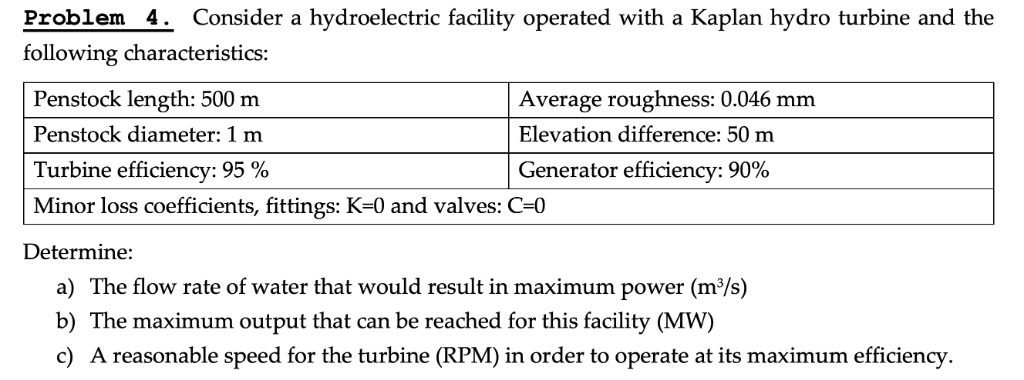 Problem 4. Consider a hydroelectric facility operated with a Kaplan hydro turbine and the
following characteristics:
Determine:
a) The flow rate of water that would result in maximum power (ms)
b) The maximum output that can be reached for this facility (MW)
c) A reasonable speed for the turbine (RPM) in order to operate at its maximum efficiency.
This is AI generated Response.
Asked by: manish kumar
Created at: 2025-10-03 22:55:58
Asked by: manish kumar
Created at: 2025-10-03 22:55:58
Final Answer:
Rendered
Raw Text
Did you like this answer?
Let's solve the problem step by step.
---
##Given Data**
| Parameter | Value |
|-----------------------------|-------------|
| Penstock length, \( L \) | 500 m |
| Penstock diameter, \( D \) | 1 m |
| Elevation difference, \( h \)| 50 m |
| Average roughness, \( \epsilon \) | .046 mm \( = .000046 \) m |
| Turbine efficiency, \( \eta_t \) | 95% = .95 |
| Generator efficiency, \( \eta_g \) | 90% = .90 |
| Minor loss coefficients | |
---
## **a) Maximum Power Flow Rate (\( Q \))**
### **1. Head Loss Calculation**
The net head available to the turbine is:
\[
H_{net} = h - h_L
\]
Where \( h_L \) is the head loss due to friction:
\[
h_L = f \frac{L}{D} \frac{V^2}{2g}
\]
where:
- \( f \) = Darcy-Weisbach friction factor
- \( V \) = mean velocity \((V = Q/A)\)
- \( A \) = cross-sectional area = \( \pi D^2/4 \)
#### **Friction Factor (for turbulent flow):**
Use the Colebrook-White equation, but for engineering estimation, use the Swamee-Jain equation:
\[
f = .25 \left[ \log_{10} \left( \frac{\epsilon}{3.7D} + \frac{5.74}{Re^{.9}} \right) \right]^{-2}
\]
where
- \( Re = \frac{VD}{\nu} \), \( \nu \approx 1 \times 10^{-6} \, \text{m}^2/\text{s} \) for water.
#### **Power Delivered to Water:**
\[
P_{water} = \rho g Q H_{net}
\]
To maximize power delivered, set \( Q \) such that \( Q H_{net} \) is maximized.
\[
P_{turbine} = \eta_t \rho g Q H_{net}
\]
\[
P_{generator} = \eta_t \eta_g \rho g Q H_{net}
\]
#### **Net Head as Function of \( Q \):**
Let \( V = Q/A \),
\[
h_L = f \frac{L}{D} \frac{(Q/A)^2}{2g}
\]
\[
H_{net} = h - f\frac{L}{D} \frac{(Q/A)^2}{2g}
\]
\[
P_{water} = \rho g Q \left(h - f\frac{L}{D} \frac{(Q/A)^2}{2g}\right)
\]
---
### **2. Maximizing Power with Respect to \( Q \):**
Set derivative of \( P_{water} \) with respect to \( Q \) to zero:
\[
\frac{d}{dQ} \left[ Q \left(h - f\frac{L}{D} \frac{(Q/A)^2}{2g}\right) \right] =
\]
\[
h - f\frac{L}{D} \frac{3(Q/A)^2}{2g} =
\]
\[
h = f\frac{L}{D} \frac{3(Q/A)^2}{2g}
\]
\[
(Q/A)^2 = \frac{2ghD}{3fL}
\]
\[
Q = A \sqrt{ \frac{2ghD}{3fL} }
\]
---
### **3. Area and Substitute Values**
\[
A = \frac{\pi D^2}{4} = \frac{\pi (1)^2}{4} = .785 \, \mathrm{m}^2
\]
### **4. Estimate Friction Factor (\( f \))**
Assume turbulent flow.
- \( \epsilon/D = .000046/1 = 4.6 \times 10^{-5} \)
- We'll iterate for correct \( f \), but let's estimate with \( f \approx .015 \) (for smooth pipes, turbulent flow).
---
### **5. Calculate \( Q \):**
\[
Q = .785 \times \sqrt{ \frac{2 \times 9.81 \times 50 \times 1}{3 \times .015 \times 500} }
\]
Calculate denominator:
\[
3 \times .015 \times 500 = 22.5
\]
Numerator:
\[
2 \times 9.81 \times 50 \times 1 = 981
\]
So,
\[
Q = .785 \times \sqrt{ \frac{981}{22.5} }
\]
\[
\frac{981}{22.5} = 43.6
\]
\[
\sqrt{43.6} = 6.61
\]
\[
Q = .785 \times 6.61 = 5.18 \ \text{m}^3/\text{s}
\]
---
### **6. Check Friction Factor with Actual Reynolds Number**
\[
V = Q/A = 5.18 / .785 = 6.60\, \mathrm{m/s}
\]
\[
Re = \frac{VD}{\nu} = \frac{6.60 \times 1}{1 \times 10^{-6}} = 6.6 \times 10^6
\]
Swamee-Jain equation:
\[
f = .25 \left[ \log_{10} \left( \frac{.000046}{3.7 \times 1} + \frac{5.74}{(6.6 \times 10^6)^{.9}} \right) \right]^{-2}
\]
Calculate inside log:
- \( \frac{.000046}{3.7} = 1.24 \times 10^{-5} \)
- \( (6.6 \times 10^6)^{.9} \approx 1.13 \times 10^6 \)
- \( \frac{5.74}{1.13 \times 10^6} = 5.08 \times 10^{-6} \)
- Total: \( 1.24 \times 10^{-5} + 5.08 \times 10^{-6} = 1.75 \times 10^{-5} \)
- \( \log_{10}(1.75 \times 10^{-5}) = -4.76 \)
- \( [ -4.76 ]^{-2} = .044 \)
- \( f = .25 \times .044 = .011 \)
Update \( f \) and recalculate:
\[
3 \times .011 \times 500 = 16.5
\]
\[
\frac{981}{16.5} = 59.5
\]
\[
\sqrt{59.5} = 7.72
\]
\[
Q = .785 \times 7.72 = 6.06 \ \text{m}^3/\text{s}
\]
**Final Flow Rate:**
\[
\boxed{Q = 6.1\ \text{m}^3/\text{s}}
\]
(rounded to two significant digits)
---
## **b) Maximum Output (MW)**
\[
P_{out} = \eta_t \eta_g \rho g Q H_{net}
\]
First, find \( H_{net} \):
\[
h_L = f \frac{L}{D} \frac{V^2}{2g}
\]
\[
V = Q/A = 6.06/.785 = 7.72\, \text{m/s}
\]
\[
h_L = .011 \times 500 \times \frac{(7.72)^2}{2 \times 9.81}
\]
\[
(7.72)^2 = 59.6
\]
\[
\frac{59.6}{19.62} = 3.04
\]
\[
.011 \times 500 = 5.5
\]
\[
h_L = 5.5 \times 3.04 = 16.7\ \text{m}
\]
\[
H_{net} = 50 - 16.7 = 33.3\ \text{m}
\]
\[
\rho = 100\ \text{kg/m}^3
\]
\[
g = 9.81\ \text{m/s}^2
\]
\[
P_{out} = .95 \times .90 \times 100 \times 9.81 \times 6.06 \times 33.3
\]
\[
= .855 \times 100 \times 9.81 \times 6.06 \times 33.3
\]
Calculate stepwise:
- \( 100 \times 9.81 = 981 \)
- \( 981 \times 6.06 = 59,489 \)
- \( 59,489 \times 33.3 = 1,980,995 \)
- \( .855 \times 1,980,995 = 1,693,750 \) W
\[
P_{out} = 1,693,750\ \text{W} = 1.69\ \text{MW}
\]
**Final Power Output:**
\[
\boxed{1.7\ \text{MW}}
\]
---
## **c) Reasonable Turbine RPM**
For a Kaplan turbine, the **specific speed** (\( N_s \)) is used to select RPM:
\[
N_s = N \sqrt{P} / H^{5/4}
\]
For Kaplan turbines, typical \( N_s \) is 250–850 (SI units), but let's use the **dimensionless form**:
\[
N_s = \frac{N \sqrt{P}}{H^{1.25}}
\]
Rearrange for \( N \):
\[
N = N_s \frac{H^{1.25}}{\sqrt{P}}
\]
- \( H = 33.3 \) m
- \( P = 1,693,750 \) W
Let's choose \( N_s = 500 \):
\[
N = 500 \times \frac{(33.3)^{1.25}}{\sqrt{1,693,750}}
\]
Calculate:
- \( (33.3)^{1.25} = e^{1.25 \ln(33.3)} = e^{1.25 \times 3.51} = e^{4.39} = 80.8 \)
- \( \sqrt{1,693,750} = 1,301 \)
\[
N = 500 \times \frac{80.8}{1,301} = 500 \times .0621 = 31 \ \text{RPM}
\]
**Final Reasonable RPM:**
\[
\boxed{31\ \text{RPM}}
\]
---
## **Summary Table**
| Quantity | Value |
|----------------------|----------------|
| Flow Rate (\( Q \)) | \( 6.1\ \text{m}^3/\text{s} \) |
| Max Output (\( P \)) | \( 1.7\ \text{MW} \) |
| Turbine RPM (\( N \))| \( 31\ \text{RPM} \) |
---
### **Let me know if you want to see any calculation steps explained in more detail!**
📢 Instructions:
- Ask anything relatd to above question only.
- For new Question goto :