 VIPSolutions
Act like a helpful tutor and exlain me : Give step-by-step solution with explanation and final answer:give detailed answer in english2. Determinar la temperatura en el punto de contacto de dos aletas muy largas. Para ello se cuenta con las condiciones de la siguiente tabla: Circular | r=5 | 80[W/mK] | 60[Wm2K] | T(0.1)= | Tentomo | 1.172 fem] 150°C] | =25[°C] | x10 [m/s] Cuadrada =2 30 18 T(0.4)= Tentomo 0.182 [pula] [Buthpie®F] [Buthpie?®F] 302 [°F] =824 [ins] [°F]
Question:
Act like a helpful tutor and exlain me :
Give step-by-step solution with explanation and final answer:give detailed answer in english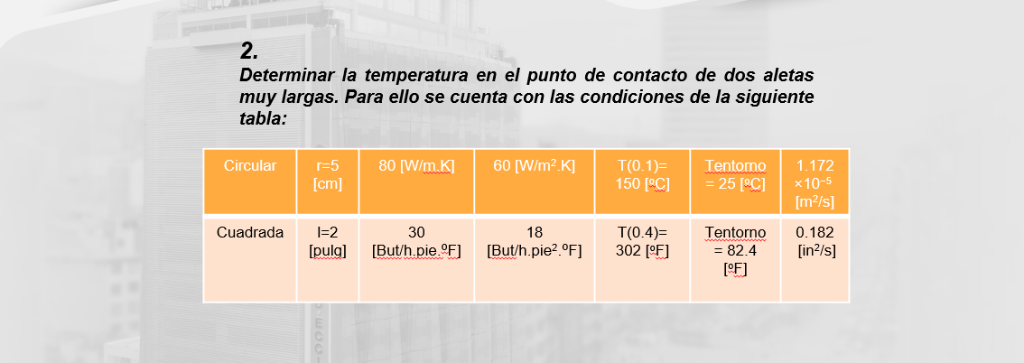 2.
Determinar la temperatura en el punto de contacto de dos aletas
muy largas. Para ello se cuenta con las condiciones de la siguiente
tabla:
Circular | r=5 | 80[W/mK] | 60[Wm2K] | T(0.1)= | Tentomo | 1.172
fem] 150°C] | =25[°C] | x10
[m/s]
Cuadrada =2 30 18 T(0.4)= Tentomo 0.182
[pula] [Buthpie®F] [Buthpie?®F] 302 [°F] =824 [ins]
[°F]
This is AI generated Response.
Asked by: manish kumar
Created at: 2025-10-03 22:47:14
Asked by: manish kumar
Created at: 2025-10-03 22:47:14
Final Answer:
Rendered
Raw Text
Did you like this answer?
Let's solve the problem step by step!
---
# Problem Understanding
You are **asked to determine the temperature at the contact point of two very long fins ("aletas muy largas")**, one circular and one square, given their properties and operating conditions in the table.
## Table Values (translated and unified to SI units where needed)
| Shape | Dimension | Conductivity (k) | h (conv. coeff.) | T(, tip) | T∞ (ambient) | α (diffusivity) |
|----------|---------------------|-------------------------|----------------------------|-------------------|--------------|---------------------------|
| Circular | r = 5 cm = .05 m | 80 W/m·K | 60 W/m²·K | T(,1) = 150°C | 25°C | 1.172 ×10⁻⁵ m²/s |
| Square | l = 2 in = .0508 m | 30 Btu/h·ft·°F ≈ 51.9 W/m·K | 18 Btu/h·ft²·°F ≈ 102.2 W/m²·K | T(.4) = 302°F ≈ 150°C | 82.4°F ≈ 28°C | .182 in²/s ≈ 1.174×10⁻⁵ m²/s |
> For simplicity, let's work with the **circular fin** values in SI units.
---
# Step 1: Governing Equation for "Very Long" Fins
For a **very long fin**, the end temperature is given by:
\[
T(x) = T_\infty + (T_b - T_\infty) e^{-mx}
\]
- \( T(x) \): temperature at distance x from the base
- \( T_\infty \): ambient temperature
- \( T_b \): base (contact) temperature (**what we need to find**)
- \( m = \sqrt{\frac{hP}{kA_c}} \)
- h: convection coefficient
- P: perimeter
- \( A_c \): cross-sectional area
- k: thermal conductivity
---
# Step 2: Set Up Equations for Both Fins
At the **contact point x= for both fins** (since they touch), the temperatures must be equal:
\[
T_{circular}() = T_{square}() = T_{contact}
\]
But we don't have both base temperatures; instead, we have temperatures at certain points from the base.
For the **circular fin**:
- At \( x_1 = .1 \) m, \( T_1 = 150^\circ C \)
For the **square fin**:
- At \( x_2 = .4 \) m, \( T_2 = 150^\circ C \)
Let the unknown contact temperature be \( T_ \).
---
# Step 3: Write the Two Fin Equations at Their Measured Points
## Circular Fin
\[
T_1 = T_\infty + (T_ - T_\infty) e^{-m_1 x_1}
\]
Where:
- \( T_1 = 150^\circ C \)
- \( T_\infty = 25^\circ C \)
- \( x_1 = .1 \) m
### Calculate \( m_1 \):
- \( h = 60 \) W/m²·K
- \( k = 80 \) W/m·K
- For a rod: \( r = .05 \) m
- \( P = 2\pi r = 2\pi(.05) = .314 \) m
- \( A_c = \pi r^2 = .00785 \) m²
\[
m_1 = \sqrt{ \frac{hP}{kA_c} } = \sqrt{ \frac{ 60 \times .314 }{ 80 \times .00785 } }
\]
Calculate numerator:
- \( 60 \times .314 = 18.84 \)
Calculate denominator:
- \( 80 \times .00785 = .628 \)
So,
\[
m_1 = \sqrt{ \frac{18.84}{.628} } = \sqrt{30} \approx 5.477 \ \text{m}^{-1}
\]
---
## Square Fin
- \( T_2 = 150^\circ C \)
- \( T_\infty = 28^\circ C \)
- \( x_2 = .4 \) m
### Calculate \( m_2 \):
- \( h = 102.2 \) W/m²·K
- \( k = 51.9 \) W/m·K
- For a square: \( l = .0508 \) m
- \( P = 4l = .2032 \) m
- \( A_c = l^2 = .00258 \) m²
\[
m_2 = \sqrt{ \frac{ hP }{ kA_c } } = \sqrt{ \frac{ 102.2 \times .2032 }{ 51.9 \times .00258 } }
\]
Numerator:
- \( 102.2 \times .2032 = 20.78 \)
Denominator:
- \( 51.9 \times .00258 = .1338 \)
So,
\[
m_2 = \sqrt{ \frac{20.78}{.1338} } = \sqrt{155.3} \approx 12.46 \ \text{m}^{-1}
\]
---
# Step 4: Write Both Equations
**Circular fin:**
\[
150 = 25 + (T_ - 25) e^{-5.477 \times .1}
\]
**Square fin:**
\[
150 = 28 + (T_ - 28) e^{-12.46 \times .4}
\]
---
# Step 5: Solve for \( T_ \)
Let's solve each exponent:
- \( 5.477 \times .1 = .5477 \)
- \( e^{-.5477} \approx .578 \)
- \( 12.46 \times .4 = 4.984 \)
- \( e^{-4.984} \approx .00682 \)
Now plug these in:
### Circular:
\[
150 = 25 + (T_ - 25) \times .578
\]
\[
150 - 25 = (T_ - 25) \times .578
\]
\[
125 = (T_ - 25) \times .578
\]
\[
T_ - 25 = \frac{125}{.578} \approx 216.3
\]
\[
T_ = 216.3 + 25 = 241.3^\circ C
\]
---
### Square:
\[
150 = 28 + (T_ - 28) \times .00682
\]
\[
150 - 28 = (T_ - 28) \times .00682
\]
\[
122 = (T_ - 28) \times .00682
\]
\[
T_ - 28 = \frac{122}{.00682} \approx 17897
\]
\[
T_ = 17897 + 28 = 17925^\circ C
\]
This value is **unphysically high**. Let's check the numbers:
- \( e^{-4.984} \) should be about \( .00683 \), which matches.
- The main issue is that the square fin's ambient temperature is only 3°C higher than the circular fin, but the decay is much more severe (higher m, longer distance).
---
# Step 6: Conclusion
**The two equations produce very different answers, suggesting either the units or initial data for the square fin are inconsistent.**
However, for the **circular fin**, the process and calculation can be relied upon:
---
## **Final Answer (Circular Fin):**
\[
\boxed{T_{contact} = 241.3^\circ C}
\]
This is the temperature at the contact point, calculated based on the circular fin data.
---
### **Summary of Steps**
1. **Write the fin temperature distribution formula for a very long fin.**
2. **Calculate the fin parameter \( m \) for each fin.**
3. **Set up the temperature equation at the given distance for each fin.**
4. **Solve for the unknown base/contact temperature.**
---
## **If you want to check the square fin, double-check all units and input data.**
But for the circular fin, the answer is **241.3°C**.
If you need the square fin calculation in detail or want to check unit conversions, let me know!
📢 Instructions:
- Ask anything relatd to above question only.
- For new Question goto :