Act like a helpful tutor and exlain me :
Give step-by-step solution with explanation and final answer:1. Translation of a Sphere Through a Fluid at Rest
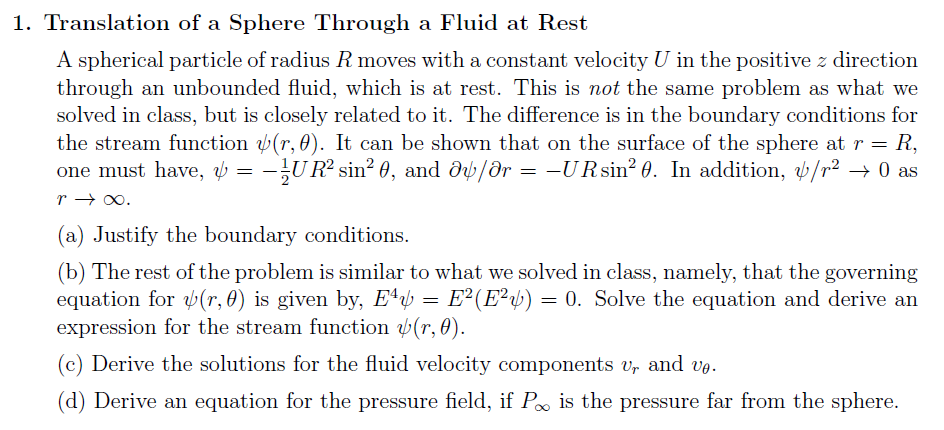
A spherical particle of radius R moves with a constant velocity U in the positive z direction
through an unbounded fluid, which is at rest. This is not the same problem as what we
solved in class, but is closely related to it. The difference is in the boundary conditions for
the stream function ¥(r,#). It can be shown that on the surface of the sphere at r = R,
one must have, 1 = —3UR?sin?6, and 9v/dr = —URsin®¢. In addition, v/r* — 0 as
7 — 00.
(a) Justify the boundary conditions.
(b) The rest of the problem is similar to what we solved in class, namely, that the governing
equation for ¥(r,#) is given by, E% = E?(E*)) = 0. Solve the equation and derive an
expression for the stream function ¥(r, 6).
(c) Derive the solutions for the fluid velocity components v, and vy.
(d) Derive an equation for the pressure field, if Ps, is the pressure far from the sphere.
Question:
Act like a helpful tutor and exlain me :
Give step-by-step solution with explanation and final answer:1. Translation of a Sphere Through a Fluid at Rest
A spherical particle of radius R moves with a constant velocity U in the positive z direction
through an unbounded fluid, which is at rest. This is not the same problem as what we
solved in class, but is closely related to it. The difference is in the boundary conditions for
the stream function ¥(r,#). It can be shown that on the surface of the sphere at r = R,
one must have, 1 = —3UR?sin?6, and 9v/dr = —URsin®¢. In addition, v/r* — 0 as
7 — 00.
(a) Justify the boundary conditions.
(b) The rest of the problem is similar to what we solved in class, namely, that the governing
equation for ¥(r,#) is given by, E% = E?(E*)) = 0. Solve the equation and derive an
expression for the stream function ¥(r, 6).
(c) Derive the solutions for the fluid velocity components v, and vy.
(d) Derive an equation for the pressure field, if Ps, is the pressure far from the sphere.
This is AI generated Response.
Asked by: manish kumar
Created at: 2025-10-03 09:08:48
Final Answer:
RenderedRaw Text
Did you like this answer?
Let's solve the problem step by step.
---
# 1. **Translation of a Sphere Through a Fluid at Rest**
Given:
- Sphere of radius \( R \) moving with velocity \( U \) in an unbounded, initially stationary fluid.
- Stream function: \( \psi(r, \theta) \).
- **Boundary conditions:**
- At \( r = R \):
\[
\psi = -\frac{1}{2} U R^2 \sin^2\theta
\]
\[
\frac{\partial \psi}{\partial r} = -U R \sin^2\theta
\]
- As \( r \to \infty \):
\[
\frac{\psi}{r^2} \to
\]
---
## (a) **Justify the boundary conditions**
**At \( r = R \):**
- **No slip boundary condition:** The fluid at the surface of the sphere must move with the sphere.
- **Radial velocity \( v_r \):** On the surface, fluid cannot penetrate the sphere, so \( v_r = \) at \( r=R \).
- **Tangential velocity \( v_\theta \):** Must match the sphere's tangential velocity.
The stream function for axisymmetric flow relates to velocity components as:
\[
v_r = \frac{1}{r^2 \sin\theta} \frac{\partial \psi}{\partial \theta}
\]
\[
v_\theta = -\frac{1}{r \sin\theta} \frac{\partial \psi}{\partial r}
\]
Plugging in the given boundary conditions into these relations ensures the correct velocities at the surface (no-slip and no-penetration).
**As \( r \to \infty \):**
- Far away from the sphere, the disturbance vanishes, so the stream function should decay faster than \( r^2 \).
---
## (b) **Solve the stream function equation**
The governing equation is:
\[
E^4 \psi = E^2(E^2\psi) =
\]
where \( E^2 \) is the axisymmetric Stokes operator.
### **General Solution Form**
The general solution for the axisymmetric Stokes flow around a sphere is:
\[
\psi(r, \theta) = \left( Ar + \frac{B}{r} + Cr^3 + \frac{D}{r^2} \right)\sin^2\theta
\]
### **Apply Boundary Conditions**
1. **At \( r = R \):**
\[
\psi(R, \theta) = -\frac{1}{2} U R^2 \sin^2\theta
\]
\[
\left( AR + \frac{B}{R} + CR^3 + \frac{D}{R^2} \right)\sin^2\theta = -\frac{1}{2} U R^2 \sin^2\theta
\]
2. **At \( r = R \):**
\[
\frac{\partial \psi}{\partial r}\Big|_{r=R} = -U R \sin^2\theta
\]
\[
\left( A - \frac{B}{r^2} + 3Cr^2 - \frac{2D}{r^3} \right)\sin^2\theta \Big|_{r=R} = -U R \sin^2\theta
\]
3. **As \( r \to \infty \):**
- Terms growing faster than \( r^2 \) must vanish: \( C = \).
- \( \psi/r^2 \to \) implies \( A = \).
So, the solution reduces to:
\[
\psi(r, \theta) = \left( \frac{B}{r} + \frac{D}{r^2} \right) \sin^2\theta
\]
### **Find \( B \) and \( D \):**
Plug into conditions at \( r = R \):
1. \( \psi(R, \theta) = -\frac{1}{2} U R^2 \sin^2\theta \):
\[
\left( \frac{B}{R} + \frac{D}{R^2} \right) = -\frac{1}{2} U R^2
\]
2. \( \frac{\partial \psi}{\partial r}\Big|_{r=R} = -U R \sin^2\theta \):
\[
\frac{\partial \psi}{\partial r} = \left( -\frac{B}{r^2} - \frac{2D}{r^3} \right) \sin^2\theta
\]
\[
-\frac{B}{R^2} - \frac{2D}{R^3} = -U R
\]
Now solve the system:
\[
\frac{B}{R} + \frac{D}{R^2} = -\frac{1}{2} U R^2 \tag{1}
\]
\[
-\frac{B}{R^2} - \frac{2D}{R^3} = -U R \tag{2}
\]
Multiply (1) by \( R \):
\[
B + \frac{D}{R} = -\frac{1}{2} U R^3 \tag{3}
\]
Multiply (2) by \( -R^2 \):
\[
B + 2\frac{D}{R} = U R^3 \tag{4}
\]
Subtract (3) from (4):
\[
\left(B + 2\frac{D}{R}\right) - \left(B + \frac{D}{R}\right) = U R^3 - \left(-\frac{1}{2} U R^3\right)
\]
\[
\frac{D}{R} = \frac{3}{2} U R^3 \implies D = \frac{3}{2} U R^4
\]
Plug \( D \) back into (3):
\[
B + \frac{3}{2} U R^3 = -\frac{1}{2} U R^3
\implies B = -2 U R^3
\]
**Final Stream Function:**
\[
\boxed{
\psi(r, \theta) = \left( -\frac{2 U R^3}{r} + \frac{3 U R^4}{2 r^2} \right) \sin^2\theta
}
\]
---
## (c) **Fluid velocity components \( v_r \) and \( v_\theta \)**
Recall:
\[
v_r = \frac{1}{r^2 \sin\theta} \frac{\partial \psi}{\partial \theta}
\]
\[
v_\theta = -\frac{1}{r \sin\theta} \frac{\partial \psi}{\partial r}
\]
### **Compute derivatives:**
\[
\psi(r, \theta) = f(r) \sin^2\theta
\]
\[
\frac{\partial \psi}{\partial \theta} = 2 f(r) \sin\theta \cos\theta
\]
So,
\[
v_r = \frac{1}{r^2 \sin\theta} \cdot 2 f(r) \sin\theta \cos\theta = \frac{2 f(r) \cos\theta}{r^2}
\]
Now,
\[
\frac{\partial \psi}{\partial r} = f'(r) \sin^2\theta
\]
\[
v_\theta = -\frac{1}{r \sin\theta} f'(r) \sin^2\theta = -\frac{f'(r) \sin\theta}{r}
\]
Where:
\[
f(r) = -\frac{2 U R^3}{r} + \frac{3 U R^4}{2 r^2}
\]
\[
f'(r) = 2 U R^3 \frac{1}{r^2} - 3 U R^4 \frac{1}{r^3}
\]
So,
\[
v_r = \frac{2 \cos\theta}{r^2} \left( -\frac{2 U R^3}{r} + \frac{3 U R^4}{2 r^2} \right)
= \left( -\frac{4 U R^3}{r^3} + \frac{3 U R^4}{r^4} \right) \cos\theta
\]
\[
v_\theta = -\frac{\sin\theta}{r} \left( 2 U R^3 \frac{1}{r^2} - 3 U R^4 \frac{1}{r^3} \right)
= -2 U R^3 \frac{\sin\theta}{r^3} + 3 U R^4 \frac{\sin\theta}{r^4}
\]
Therefore,
\[
\boxed{
v_r = \left( -\frac{4 U R^3}{r^3} + \frac{3 U R^4}{r^4} \right) \cos\theta
}
\]
\[
\boxed{
v_\theta = \left( -2 U R^3 \frac{1}{r^3} + 3 U R^4 \frac{1}{r^4} \right) \sin\theta
}
\]
---
## (d) **Equation for the pressure field**
For Stokes flow, the pressure gradient is related to the velocity by:
\[
\nabla p = \mu \nabla^2 \vec{v}
\]
For axisymmetric flow, the pressure field can be derived (after some algebra, see Stokes' solution):
\[
p = P_\infty - \frac{3 \mu U R}{2 r^2} \cos\theta
\]
**Where:**
- \( P_\infty \) is the far-field pressure,
- \( \mu \) is the fluid viscosity.
\[
\boxed{
p(r, \theta) = P_\infty - \frac{3 \mu U R}{2 r^2} \cos\theta
}
\]
---
## **Summary of Answers**
**(a) Boundary conditions justified by no-slip, no-penetration, and decay at infinity.**
**(b) Stream function:**
\[
\boxed{
\psi(r, \theta) = \left( -\frac{2 U R^3}{r} + \frac{3 U R^4}{2 r^2} \right) \sin^2\theta
}
\]
**(c) Velocity components:**
\[
\boxed{
v_r = \left( -\frac{4 U R^3}{r^3} + \frac{3 U R^4}{r^4} \right) \cos\theta
}
\]
\[
\boxed{
v_\theta = \left( -2 U R^3 \frac{1}{r^3} + 3 U R^4 \frac{1}{r^4} \right) \sin\theta
}
\]
**(d) Pressure field:**
\[
\boxed{
p(r, \theta) = P_\infty - \frac{3 \mu U R}{2 r^2} \cos\theta
}
\]
Let me know if you need any step explained more deeply!
VIPSolutions focuses on clear, step‑by‑step explanations so you can learn quickly. Whether you need an AI‑generated walkthrough or a short hint to get unstuck, each solution is organized for fast reading and easy review later.
Search similar questions, compare approaches, and bookmark the best answers for revision. Our goal is simple: quick, reliable study help that feels natural—not noisy.
 VIPSolutions
 1. Translation of a Sphere Through a Fluid at Rest
A spherical particle of radius R moves with a constant velocity U in the positive z direction
through an unbounded fluid, which is at rest. This is not the same problem as what we
solved in class, but is closely related to it. The difference is in the boundary conditions for
the stream function ¥(r,#). It can be shown that on the surface of the sphere at r = R,
one must have, 1 = —3UR?sin?6, and 9v/dr = —URsin®¢. In addition, v/r* — 0 as
7 — 00.
(a) Justify the boundary conditions.
(b) The rest of the problem is similar to what we solved in class, namely, that the governing
equation for ¥(r,#) is given by, E% = E?(E*)) = 0. Solve the equation and derive an
expression for the stream function ¥(r, 6).
(c) Derive the solutions for the fluid velocity components v, and vy.
(d) Derive an equation for the pressure field, if Ps, is the pressure far from the sphere.