 VIPSolutions
Act like a helpful tutor and exlain me : Give step-by-step solution with explanation and final answer:2. To test the aerodynamics of a new prototype automobile, a scale model will be tested in a wind tunnel. For dynamic similarity, it will be required to match the Reynolds numbers between the model and the prototype. Assuming that you will be testing a 1/10-scale model and both the model and the prototype will be exposed to standard air pressure, will it be better for the wind tunnel air to be colder or hotter than standard sea-level air temperature of 15°C ? Why ? Hint: you can use the book Table B4.
Question:
Act like a helpful tutor and exlain me :
Give step-by-step solution with explanation and final answer: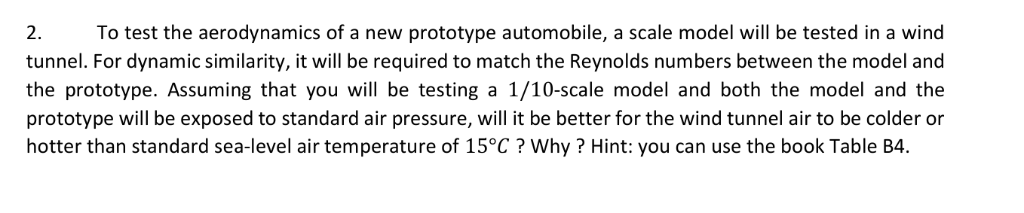 2. To test the aerodynamics of a new prototype automobile, a scale model will be tested in a wind
tunnel. For dynamic similarity, it will be required to match the Reynolds numbers between the model and
the prototype. Assuming that you will be testing a 1/10-scale model and both the model and the
prototype will be exposed to standard air pressure, will it be better for the wind tunnel air to be colder or
hotter than standard sea-level air temperature of 15°C ? Why ? Hint: you can use the book Table B4.
This is AI generated Response.
Asked by: manish kumar
Created at: 2025-10-03 08:58:34
Asked by: manish kumar
Created at: 2025-10-03 08:58:34
Final Answer:
Rendered
Raw Text
Did you like this answer?
Let's break down the problem step by step:
---
## **Step 1: Understanding Reynolds Number**
The Reynolds number (\( Re \)) is given by:
\[
Re = \frac{\rho V L}{\mu}
\]
where:
- \( \rho \) = density of air
- \( V \) = velocity of air
- \( L \) = characteristic length (e.g., car length)
- \( \mu \) = dynamic viscosity of air
For **dynamic similarity**, the Reynolds numbers of the model (\( Re_m \)) and prototype (\( Re_p \)) must be equal.
\[
Re_m = Re_p
\]
---
## **Step 2: Setting Up the Ratio**
For a **1/10-scale model**:
\[
L_m = \frac{1}{10}L_p
\]
Assume both are tested at **standard air pressure**, but possibly different temperatures.
Let \( V_m \) and \( V_p \) be the velocities for the model and prototype, respectively.
\[
\frac{\rho_m V_m L_m}{\mu_m} = \frac{\rho_p V_p L_p}{\mu_p}
\]
Assuming both use **air at standard pressure**, but possibly different temperatures, so \( \rho \) and \( \mu \) can change due to temperature.
---
## **Step 3: Rearranging for Model Testing**
\[
\Rightarrow \frac{\rho_m V_m L_m / \mu_m}{\rho_p V_p L_p / \mu_p} = 1
\]
\[
\Rightarrow \frac{\rho_m}{\rho_p} \cdot \frac{V_m}{V_p} \cdot \frac{L_m}{L_p} \cdot \frac{\mu_p}{\mu_m} = 1
\]
We know:
- \( L_m/L_p = 1/10 \)
To make test practical, you want \( V_m \) not to be excessively high.
---
## **Step 4: Effect of Temperature on Air Properties**
At **lower air temperatures**:
- **Density \( \rho \)** increases (air is denser).
- **Viscosity \( \mu \)** decreases (air is less viscous).
At **higher air temperatures**:
- **Density \( \rho \)** decreases.
- **Viscosity \( \mu \)** increases.
---
## **Step 5: What Temperature Is Better?**
We want to **match Reynolds numbers**.
To do this with a smaller model (\( L_m < L_p \)), we need to compensate by increasing \( V_m \) or by changing fluid properties.
\[
\frac{V_m}{V_p} = \frac{L_p}{L_m} \cdot \frac{\rho_p}{\rho_m} \cdot \frac{\mu_m}{\mu_p}
\]
If we **lower the temperature**:
- \( \rho_m \) increases, \( \mu_m \) decreases.
- Both effects **increase** the Reynolds number for the same velocity.
Thus, for the **model** at **lower temperature**, we can **achieve the required Reynolds number at a lower velocity** (which is more practical and safer for wind tunnel operation).
---
## **Step 6: Final Answer**
### **Should the wind tunnel air be colder or hotter?**
- **It should be colder than standard sea-level air temperature of 15°C.**
### **Why?**
- **Colder air** has **higher density** and **lower viscosity**, which increases the Reynolds number for the same velocity and length.
- This helps you **match the prototype Reynolds number with a lower wind tunnel speed**, making the test more practical.
---
## **Summary Table**
| Temperature | Density (\( \rho \)) | Viscosity (\( \mu \)) | Reynolds Number (\( Re \)) |
|-------------|----------------------|-----------------------|----------------------------|
| Lower | Higher | Lower | Higher |
| Higher | Lower | Higher | Lower |
---
## **Final Statement**
> **It is better for the wind tunnel air to be colder than standard sea-level air temperature of 15°C, because lower temperature increases air density and decreases viscosity, allowing you to more easily achieve the required Reynolds number for dynamic similarity at a lower, more manageable wind tunnel speed.**
---
If you have access to Table B4, you can verify the actual values of air properties at different temperatures to see this effect numerically!
📢 Instructions:
- Ask anything relatd to above question only.
- For new Question goto :