VIPSolutions logo ✨ VIPSolutions

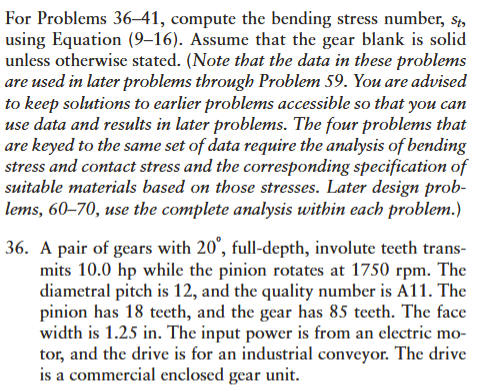
Act like a helpful tutor and exlain me : Give step-by-step solution with explanation and final answer:For Problems 36-41, compute the bending stress number, s;, using Equation (9-16). Assume that the gear blank is solid unless otherwise stated. (Note that the data in these problems are used in later problems through Problem 59. You are advised to keep solutions to earlier problems accessible so that you can use data and results in later problems. The four problems that are keyed to the same set of data require the analysis of bending stress and contact stress and the corresponding specification of suitable materials based on those stresses. Later design prob- lems, 60-70, use the complete analysis within each problem.) 36. A pair of gears with 20°, full-depth, involute teeth trans- mits 10.0 hp while the pinion rotates at 1750 rpm. The diametral pitch is 12, and the quality number is A11. The pinion has 18 teeth, and the gear has 85 teeth. The face width is 1.25 in. The input power is from an clectric mo- tor, and the drive is for an industrial conveyor. The drive is a commercial enclosed gear unit.
Question:

Act like a helpful tutor and exlain me : Give step-by-step solution with explanation and final answer:Uploaded ImageFor Problems 36-41, compute the bending stress number, s;, using Equation (9-16). Assume that the gear blank is solid unless otherwise stated. (Note that the data in these problems are used in later problems through Problem 59. You are advised to keep solutions to earlier problems accessible so that you can use data and results in later problems. The four problems that are keyed to the same set of data require the analysis of bending stress and contact stress and the corresponding specification of suitable materials based on those stresses. Later design prob- lems, 60-70, use the complete analysis within each problem.) 36. A pair of gears with 20°, full-depth, involute teeth trans- mits 10.0 hp while the pinion rotates at 1750 rpm. The diametral pitch is 12, and the quality number is A11. The pinion has 18 teeth, and the gear has 85 teeth. The face width is 1.25 in. The input power is from an clectric mo- tor, and the drive is for an industrial conveyor. The drive is a commercial enclosed gear unit.

This is AI generated Response.
Asked by: manish kumar
Created at: 2025-10-02 12:12:03

Final Answer:

Rendered Raw Text
Did you like this answer?
# Step-by-Step Solution to Problem 36 Let's solve for the **bending stress number, \( S_t \)** for the given gear problem using Equation (9–16) from the referenced text. ## **Given Data** - **Transmitted Power, \( P \)**: 10. hp - **Pinion Speed, \( n_p \)**: 175 rpm - **Diametral Pitch, \( P_d \)**: 12 - **Gear Quality Number, \( Q_v \)**: 11 - **Pinion Teeth, \( N_p \)**: 18 - **Gear Teeth, \( N_g \)**: 85 - **Face Width, \( F \)**: 1.25 in - **Pressure Angle**: \( 20^\circ \) (full-depth) - **Application**: Commercial enclosed gear unit (for service factor, etc.) --- ## **Step 1: Find Pitch Line Velocity (\( V \))** Pitch line velocity (in ft/min): \[ V = \pi d_p n_p / 12 \] Where: - \( d_p \) = pitch diameter of the pinion First, find pitch diameter (\( d_p \)): \[ d_p = \frac{N_p}{P_d} = \frac{18}{12} = 1.5 \text{ in} \] Now, plug into the velocity formula: \[ V = \frac{\pi \times 1.5 \times 175}{12} = \frac{3.1416 \times 1.5 \times 175}{12} \] \[ V \approx \frac{3.1416 \times 2625}{12} \approx \frac{8236.8}{12} \approx 686.4 \text{ ft/min} \] --- ## **Step 2: Find Transmitted Load (\( W_t \))** \[ \text{Horsepower} = \frac{W_t \times V}{33,000} \Rightarrow W_t = \frac{\text{Horsepower} \times 33,000}{V} \] \[ W_t = \frac{10 \times 33,000}{686.4} \approx \frac{330,000}{686.4} \approx 481 \text{ lbf} \] --- ## **Step 3: Lewis Bending Stress Equation (Equation 9-16)** \[ S_t = \frac{W_t \cdot P_d}{F \cdot Y} \] Where: - \( W_t \) = tangential load (lbf) - \( P_d \) = diametral pitch - \( F \) = face width (in) - \( Y \) = Lewis form factor (depends on number of teeth and tooth form) --- ## **Step 4: Find Lewis Form Factor (\( Y \))** For 20° full-depth involute, Lewis Y-factor for 18 teeth (from tables): - For 18 teeth: \( Y \approx .30 \) --- ## **Step 5: Calculate Bending Stress Number (\( S_t \))** Now substitute all values: \[ S_t = \frac{481 \times 12}{1.25 \times .30} \] \[ S_t = \frac{5772}{.375} \] \[ S_t \approx 15,392 \text{ psi} \] --- ## **Final Answer** \[ \boxed{S_t \approx 15,\!400~\text{psi}} \] --- ### **Summary of Steps** 1. Found pitch diameter and pitch line velocity. 2. Calculated transmitted load using horsepower and velocity. 3. Used Lewis equation with the Lewis form factor for 18 teeth. 4. Solved for the bending stress number, \( S_t \). If you need further steps (like dynamic factor, overload factor, or material selection), let me know!

📢 Instructions:

  • Ask anything relatd to above question only.
  • For new Question goto :

Study Help, Fast Answers

VIPSolutions focuses on clear, step‑by‑step explanations so you can learn quickly. Whether you need an AI‑generated walkthrough or a short hint to get unstuck, each solution is organized for fast reading and easy review later.

Search similar questions, compare approaches, and bookmark the best answers for revision. Our goal is simple: quick, reliable study help that feels natural—not noisy.