 VIPSolutions
Act like a helpful tutor and exlain me : Give step-by-step solution with explanation and final answer:3. A piston/eylinder initially contains 0.4 m* of air at 100 kPa and 80 °C. The air is then compressed such that the temperature inside the cylinder remains constant. a) Draw the piston/cylinder combination and write the initial properties next to it. b) Determine the work done using the ideal gas assumption. ©) Determine the final pressure (state 2). d) Draw a P-V graph, indicating the two volumes, the initial and final pressures, and an estimate of the pressure curve from the initial state (state 1) to the final state (state 2).
Question:
Act like a helpful tutor and exlain me :
Give step-by-step solution with explanation and final answer: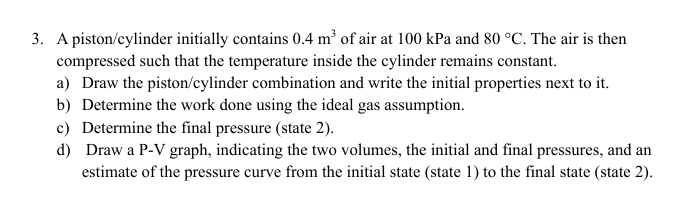 3. A piston/eylinder initially contains 0.4 m* of air at 100 kPa and 80 °C. The air is then
compressed such that the temperature inside the cylinder remains constant.
a) Draw the piston/cylinder combination and write the initial properties next to it.
b) Determine the work done using the ideal gas assumption.
©) Determine the final pressure (state 2).
d) Draw a P-V graph, indicating the two volumes, the initial and final pressures, and an
estimate of the pressure curve from the initial state (state 1) to the final state (state 2).
This is AI generated Response.
Asked by: manish kumar
Created at: 2025-10-02 11:45:12
Asked by: manish kumar
Created at: 2025-10-02 11:45:12
Final Answer:
Rendered
Raw Text
Did you like this answer?
Let's break down and solve each part step by step:
---
## Given Data
- **Initial Volume, \( V_1 \) = .4 m³**
- **Initial Pressure, \( P_1 \) = 100 kPa**
- **Initial Temperature, \( T_1 \) = 80°C = 353.15 K**
- **Process:** Isothermal compression (\( T_2 = T_1 \))
- **Final Volume, \( V_2 \):** Not given, but to be left as a variable for now.
We'll use the **ideal gas law** throughout.
---
a) Draw the Piston/Cylinder and Note Initial Properties
```
|---------------------|
| | <--- Movable piston
| Air |
| V1 = .4 m³ |
| P1 = 100 kPa |
| T1 = 80°C = 353.15K|
|---------------------|
```
*The piston/cylinder contains air at the specified initial state above.*
---
## b) Work Done During Isothermal Compression
**For an isothermal (constant temperature) process for an ideal gas:**
\[
W = nRT \ln\left(\frac{V_2}{V_1}\right)
\]
But since temperature is constant, and from the ideal gas law \( P_1 V_1 = P_2 V_2 \):
\[
n = \frac{P_1 V_1}{RT_1}
\]
So,
\[
W = nRT \ln\left(\frac{V_2}{V_1}\right) = P_1 V_1 \ln\left(\frac{V_2}{V_1}\right)
\]
Alternatively, since \( V_2 = \frac{P_1 V_1}{P_2} \):
\[
W = P_1 V_1 \ln\left(\frac{P_1}{P_2}\right)
\]
**Leave \( V_2 \) or \( P_2 \) as unknown for now; will be found in part (c).**
---
## c) Determine the Final Pressure (State 2)
Since the temperature is constant:
\[
P_1 V_1 = P_2 V_2
\]
So,
\[
P_2 = \frac{P_1 V_1}{V_2}
\]
If the final volume \( V_2 \) is not specified, you express \( P_2 \) in terms of \( V_2 \).
---
## d) Draw a P-V Diagram
- The **P-V graph** for an isothermal process is a **hyperbola** (since \( PV = \text{constant} \)).
- Mark **two points**:
- (V₁, P₁) = (.4 m³, 100 kPa)
- (V₂, P₂)
**Sketch:**
```
|
P | ● (V1,P1)
r | .
e | .
s | .
s | ● (V2, P2)
u | (curve: PV = const)
r |
e +-------------------------
V (Volume)
```
- The curve decreases as volume decreases and pressure increases for compression.
---
## **Summary Table**
| State | P (kPa) | V (m³) | T (K) |
|-------|---------|--------|----------|
| 1 | 100 | .4 | 353.15 |
| 2 | P₂ | V₂ | 353.15 |
---
## **Final Answers (in terms of V₂ or P₂):**
### **b) Work Done:**
\[
\boxed{W = P_1 V_1 \ln\left(\frac{V_2}{V_1}\right) = 100 \times .4 \times \ln\left(\frac{V_2}{.4}\right)~\text{kJ}}
\]
### **c) Final Pressure:**
\[
\boxed{P_2 = \frac{P_1 V_1}{V_2} = \frac{100 \times .4}{V_2}~\text{kPa}}
\]
### **d) P-V Diagram:**
- Isothermal curve from (.4 m³, 100 kPa) to (V₂, P₂), as drawn above.
---
**If you know the final volume (or pressure), you can substitute and get the numerical answers! If you have a specific final volume or pressure, let me know and I can plug in the numbers.**
📢 Instructions:
- Ask anything relatd to above question only.
- For new Question goto :