 VIPSolutions
Act like a helpful tutor and exlain me : Give step-by-step solution with explanation and final answer:! Required information A polyamide A-3 flat belt is used to transmit 15 hp under light shock conditions where K, = 1.25 , and a factor of safety equal to or greater than 11 is appropriate. The pulley rotational axes are parallel and in the horizontal plane. The shafts are 9.00 ft apart. The 5.00-in driving pulley rotates at 1,850 rev/min in such a way that the loose side is on top. The driven pulley is of 18-in diameter. With the tension from part a, find the belt width b that exhibits 77, = ny = 1.1. (Round the final answer to three decimal places) The belt width bwillbe[ in.
Question:
Act like a helpful tutor and exlain me :
Give step-by-step solution with explanation and final answer: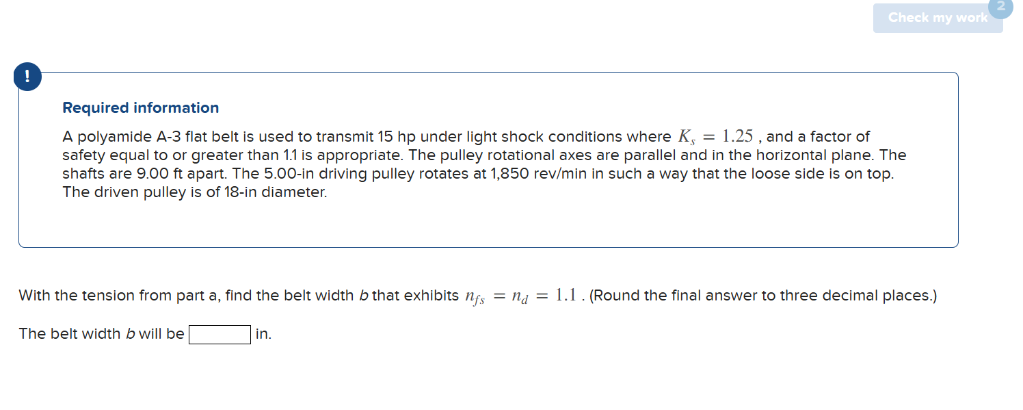 !
Required information
A polyamide A-3 flat belt is used to transmit 15 hp under light shock conditions where K, = 1.25 , and a factor of
safety equal to or greater than 11 is appropriate. The pulley rotational axes are parallel and in the horizontal plane. The
shafts are 9.00 ft apart. The 5.00-in driving pulley rotates at 1,850 rev/min in such a way that the loose side is on top.
The driven pulley is of 18-in diameter.
With the tension from part a, find the belt width b that exhibits 77, = ny = 1.1. (Round the final answer to three decimal places)
The belt width bwillbe[ in.
This is AI generated Response.
Asked by: manish kumar
Created at: 2025-10-02 09:45:27
Asked by: manish kumar
Created at: 2025-10-02 09:45:27
Final Answer:
Rendered
Raw Text
Did you like this answer?
Let's break down the problem step by step:
---
## **Step : Understand What's Given**
- **Power to transmit** (\(P\)): 15 hp
- **Shock factor** (\(K_s\)): 1.25
- **Minimum safety factor**: 1.1
- **Center distance between shafts**: 9.00 ft
- **Driving pulley diameter**: 5.00 in
- **Driven pulley diameter**: 18.00 in
- **Driving pulley speed** (\(N_1\)): 185 rpm
- **Belt type**: Polyamide A-3 flat belt
- **Belt width to be found** (\(b\)), such that \( n_{fs} = n_d = 1.1 \)
---
## **Step 2: Convert Units Where Needed**
- **Power**: \(1~\text{hp} = 33,000~\text{ft} \cdot \text{lb}/\text{min}\)
- **Pulley diameters**: 5 in and 18 in (keep in inches for now).
---
## **Step 3: Find the Belt Velocity**
Belt velocity, \(v\), (in ft/min):
\[
v = \pi \times D_1 \times N_1
\]
Where \(D_1\) is in **feet**:
\[
D_1 = 5~\text{in} = \frac{5}{12}~\text{ft}
\]
\[
v = \pi \times \frac{5}{12} \times 185
\]
\[
v = 3.1416 \times .4167 \times 185 \approx 2421.2~\text{ft/min}
\]
---
## **Step 4: Calculate the Effective Tension Needed**
Power transmitted (\(P\)):
\[
P = (T_1 - T_2) \times v
\]
Where:
- \(T_1\): Tight side tension (lbf)
- \(T_2\): Slack side tension (lbf)
- \(v\): Velocity in ft/min
Convert power to ft-lb/min:
\[
P = 15~\text{hp} \times 33,000 = 495,000~\text{ft-lb/min}
\]
\[
T_1 - T_2 = \frac{P}{v} = \frac{495,000}{2421.2} \approx 204.4~\text{lbf}
\]
---
## **Step 5: Find the Tension Ratio**
The ratio is:
\[
\frac{T_1}{T_2} = e^{f \theta}
\]
Where:
- \(f\): coefficient of friction (from data tables, for Polyamide A-3 flat belt, typically \(f = .3\))
- \(\theta\): arc of contact in radians (to be calculated)
### **Find Arc of Contact (\(\theta\))**
\[
\theta = \pi - 2 \sin^{-1} \left( \frac{D_2 - D_1}{2C} \right)
\]
Where:
- \(D_2 = 18~\text{in}\)
- \(D_1 = 5~\text{in}\)
- \(C = 9.00~\text{ft} \times 12 = 108~\text{in}\)
\[
\sin^{-1} \left( \frac{18 - 5}{2 \times 108} \right) = \sin^{-1} \left( \frac{13}{216} \right) \approx \sin^{-1}(.0602) \approx .0602~\text{radians}
\]
\[
\theta = \pi - 2(.0602) = 3.1416 - .1204 = 3.0212~\text{radians}
\]
---
## **Step 6: Find Maximum Allowable Tension per Inch Width**
From standard tables (for polyamide A-3), the **allowable tension** (\(T_{allow}\)) is about **300 lbf/in width** under light shock and with safety factor applied.
But since a safety factor is specified, we must divide by it:
\[
T_{max} = \frac{T_{allow}}{n_{fs}}
\]
\[
T_{max} = \frac{300}{1.1} \approx 272.7~\text{lbf/in width}
\]
---
## **Step 7: Calculate Belt Width (\(b\))**
The total tension on the tight side is:
\[
T_1 = \text{maximum tension per inch} \times b
\]
But also, from the tension ratio and effective tension:
\[
T_1 - T_2 = 204.4~\text{lbf}
\]
\[
\frac{T_1}{T_2} = e^{f \theta} = e^{.3 \times 3.0212} = e^{.9064} \approx 2.475
\]
\[
T_1 = 2.475 T_2
\]
\[
T_1 - T_2 = 204.4
\]
\[
2.475 T_2 - T_2 = 204.4
\]
\[
1.475 T_2 = 204.4
\]
\[
T_2 = \frac{204.4}{1.475} \approx 138.6~\text{lbf}
\]
\[
T_1 = 2.475 \times 138.6 \approx 343.1~\text{lbf}
\]
Now, solve for belt width \(b\):
\[
T_1 = T_{max} \times b
\]
\[
343.1 = 272.7 \times b
\]
\[
b = \frac{343.1}{272.7} \approx 1.258~\text{in}
\]
---
## **Step 8: Report Final Answer**
\[
\boxed{1.258~\text{in}}
\]
---
### **Final Answer**
The belt width \(b\) should be **1.258 in** (rounded to three decimal places).
---
## **Summary Table**
| Quantity | Value |
|---------------------------|-------------|
| Power (\(P\)) | 15 hp |
| Velocity (\(v\)) | 2421.2 ft/min|
| Effective Tension | 204.4 lbf |
| Tension Ratio | 2.475 |
| Tight Side Tension (\(T_1\)) | 343.1 lbf |
| Allowable Tension (per in)| 272.7 lbf |
| **Belt Width (\(b\))** | **1.258 in** |
---
If you need the derivation for any particular step, let me know!
📢 Instructions:
- Ask anything relatd to above question only.
- For new Question goto :