 VIPSolutions
Act like a helpful tutor and exlain me : Give step-by-step solution with explanation and final answer:A CFD model of steady two-dimensional incompressible flow has printed out the values of stream function i (x, ), in m/s, at each of the four corners of a small 0.700-m-by-0.700-m cell, as shown in the figure below. Use these numbers to estimate the resultant velocity in the center of the cell and its angle a with respect to the x axis. 5 y =1.9552 ms 2.0206 Vv? Ja? 1.7308 m/s 1.7978
Question:
Act like a helpful tutor and exlain me :
Give step-by-step solution with explanation and final answer: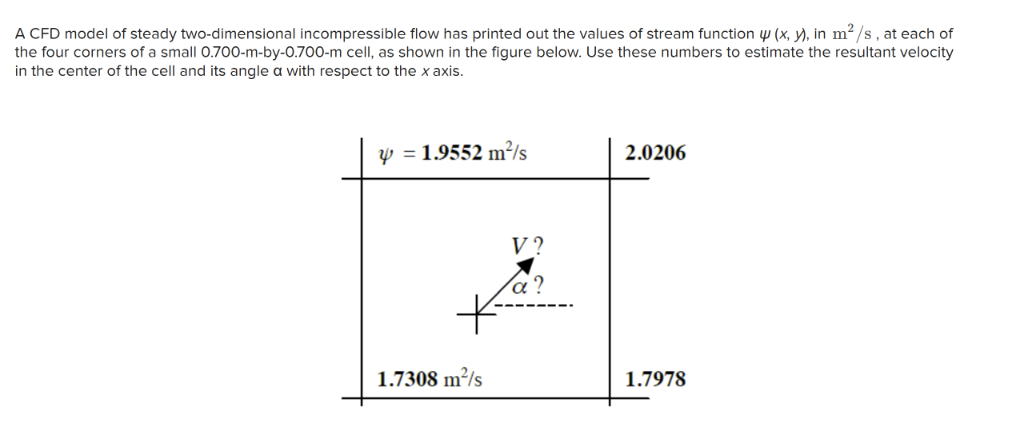 A CFD model of steady two-dimensional incompressible flow has printed out the values of stream function i (x, ), in m/s, at each of
the four corners of a small 0.700-m-by-0.700-m cell, as shown in the figure below. Use these numbers to estimate the resultant velocity
in the center of the cell and its angle a with respect to the x axis.
5
y =1.9552 ms 2.0206
Vv?
Ja?
1.7308 m/s 1.7978
This is AI generated Response.
Asked by: manish kumar
Created at: 2025-10-02 08:54:06
Asked by: manish kumar
Created at: 2025-10-02 08:54:06
Final Answer:
Rendered
Raw Text
Did you like this answer?
Let's break this down **step by step**!
---
## **Step 1: Understanding the Problem**
The stream function, \(\psi(x, y)\), is given at the four corners of a square cell (\(.7\, \text{m} \times .7\, \text{m}\)).
You need to estimate the **velocity magnitude** and **direction** at the cell center.
---
## **Step 2: Stream Function to Velocity**
For **2D incompressible flow**, the velocity components are:
\[
u = \frac{\partial \psi}{\partial y}
\]
\[
v = -\frac{\partial \psi}{\partial x}
\]
where:
- \(u\): velocity in \(x\) direction
- \(v\): velocity in \(y\) direction
---
## **Step 3: Assign the Values**
Let's assign the corners:
| Corner | Coordinates | \(\psi\) value \((\text{m}^2/\text{s})\) |
|------------------|-----------------|-------------------------------------------|
| Bottom left | (, ) | 1.7308 |
| Bottom right | (.7, ) | 1.7978 |
| Top left | (, .7) | 1.9552 |
| Top right | (.7, .7) | 2.0206 |
---
## **Step 4: Estimate Derivatives at Center**
Use **central differences** at the center \((.35, .35)\):
\[
u = \frac{\partial \psi}{\partial y} \approx \frac{\psi_{\text{top avg}} - \psi_{\text{bottom avg}}}{\Delta y}
\]
Where:
- \(\psi_{\text{top avg}} = \frac{1.9552 + 2.0206}{2}\)
- \(\psi_{\text{bottom avg}} = \frac{1.7308 + 1.7978}{2}\)
- \(\Delta y = .7\, \text{m}\)
Calculate:
\[
\psi_{\text{top avg}} = \frac{1.9552 + 2.0206}{2} = 1.9879
\]
\[
\psi_{\text{bottom avg}} = \frac{1.7308 + 1.7978}{2} = 1.7643
\]
\[
u = \frac{1.9879 - 1.7643}{.7} = \frac{.2236}{.7} = .3194\, \text{m/s}
\]
---
\[
v = -\frac{\partial \psi}{\partial x} \approx -\frac{\psi_{\text{right avg}} - \psi_{\text{left avg}}}{\Delta x}
\]
Where:
- \(\psi_{\text{right avg}} = \frac{1.7978 + 2.0206}{2} = 1.9092\)
- \(\psi_{\text{left avg}} = \frac{1.7308 + 1.9552}{2} = 1.843\)
- \(\Delta x = .7\, \text{m}\)
Calculate:
\[
v = -\frac{1.9092 - 1.843}{.7} = -\frac{.0662}{.7} = -.0946\, \text{m/s}
\]
---
## **Step 5: Resultant Velocity Magnitude**
\[
V = \sqrt{u^2 + v^2}
\]
\[
V = \sqrt{(.3194)^2 + (-.0946)^2}
\]
\[
V = \sqrt{.102 + .0089} = \sqrt{.1109} = .333\, \text{m/s}
\]
---
## **Step 6: Angle with Respect to x-axis**
\[
\alpha = \tan^{-1}\left(\frac{v}{u}\right)
\]
\[
\alpha = \tan^{-1}\left(\frac{-.0946}{.3194}\right) = \tan^{-1}(-.2962) = -16.5^\circ
\]
---
## **Final Answers**
### **Resultant Velocity at Center:**
- **Magnitude \(V\):** \(\boxed{.33\, \text{m/s}}\)
- **Angle \(\alpha\) (from x-axis):** \(\boxed{-16.5^\circ}\) (below the x-axis)
---
### **Summary Table**
| Quantity | Value |
|-------------------------|------------------|
| \(u\) | \(.32\, \text{m/s}\) |
| \(v\) | \(-.095\, \text{m/s}\) |
| \(V\) | \(.33\, \text{m/s}\) |
| \(\alpha\) | \(-16.5^\circ\) |
---
**Let me know if you'd like a diagram or further explanation of any step!**
📢 Instructions:
- Ask anything relatd to above question only.
- For new Question goto :