 VIPSolutions
Act like a helpful tutor and exlain me : Give step-by-step solution with explanation and final answer:1s kn i I Eg it HE do i ii JH Poof | Ee HEE I HH iil EE Pol | CCE 1 i ii i a. taal i Hl
Question:
Act like a helpful tutor and exlain me :
Give step-by-step solution with explanation and final answer: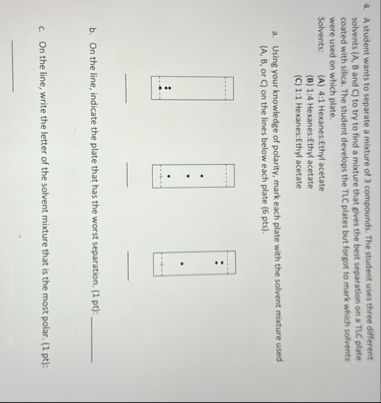 1s
kn i I
Eg it HE
do i ii JH
Poof | Ee HEE
I HH iil
EE
Pol | CCE
1 i ii
i a.
taal i Hl
This is AI generated Response.
Asked by: Edu
Created at: 2025-10-02 01:39:01
Asked by: Edu
Created at: 2025-10-02 01:39:01
Final Answer:
Rendered
Raw Text
Did you like this answer?
Let's go through your chromatography question step by step!
---
## **Step-by-Step Solution**
### **Step 1: Understanding the Problem**
- Three TLC plates (A, B, C) show the separation of a mixture of 3 compounds.
- Three different solvents were used:
- (A) 1:1 hexane:ethyl acetate (medium polarity)
- (B) 1:1 hexane:methanol (high polarity)
- (C) :1 hexane:ethyl ether (lower polarity than (B), but higher than (A))
- You need to match plates to solvents, indicate the **worst separation**, and the **most polar solvent**.
---
### **Step 2: Analyzing the Plates**
#### **What Do We Look For?**
- **Good separation:** Spots are spread out (not too close together).
- **Bad separation:** Spots are close together (hard to differentiate).
#### **Polarity and TLC**
- **More polar solvent:** Moves all compounds further (higher Rf values, less separation, sometimes all spots run together).
- **Less polar solvent:** Spots stay lower (better separation if compounds have different polarities).
---
### **Step 3: Matching Plates to Solvents**
Let's label the plates for clarity (top to bottom as shown in the image):
- Top Plate: 3 spots are close together near the top.
- Middle Plate: 3 spots are well-separated.
- Bottom Plate: 3 spots, but all closer to the baseline.
#### **Analysis:**
- **Most polar solvent (B: 1:1 hexane:methanol):** All spots move far up the plate, little separation (top plate).
- **Least polar solvent (A: 1:1 hexane:ethyl acetate):** Spots don't move far, might not separate well (bottom plate).
- **Medium polarity solvent (C: 1:1 hexane:ethyl ether):** Good separation (middle plate).
#### **Assignment:**
- **Top plate:** B (worst separation, most polar solvent)
- **Middle plate:** C (best separation, medium polarity)
- **Bottom plate:** A (least movement, less separation)
---
### **Step 4: Answer the Questions**
#### **a. Using your knowledge of polarity, match each plate with the solvent mixture used (A, B, or C)**
- **Top plate:** B (1:1 hexane:methanol)
- **Middle plate:** C (1:1 hexane:ethyl ether)
- **Bottom plate:** A (1:1 hexane:ethyl acetate)
#### **b. On the line, indicate the plate that has the worst separation.**
- **Answer:** Top plate (B)
#### **c. On the line, write the letter of the solvent mixture that is the most polar.**
- **Answer:** B (1:1 hexane:methanol)
---
## **Final Answers (copy to your worksheet):**
**a.**
- Top plate: B
- Middle plate: C
- Bottom plate: A
**b.**
- B
**c.**
- B
---
### **Summary Table**
| Plate Position | Plate Letter | Solvent Mixture | Polarity | Separation Quality |
|:--------------:|:------------:|:-----------------------|:--------------|:------------------|
| Top | B | 1:1 hexane:methanol | Most polar | Worst |
| Middle | C | 1:1 hexane:ethyl ether | Medium polar | Best |
| Bottom | A | 1:1 hexane:ethyl acetate| Least polar | Poor |
---
Let me know if you need more explanation on how TLC or polarity works!
📢 Instructions:
- Ask anything relatd to above question only.
- For new Question goto :