 VIPSolutions
Act like a helpful tutor and exlain me : Give step-by-step solution with explanation and final answer:CVEN5331: Biological Wastewater Treatment Homework 3 1-7: ‘The following data was obtained for a reactant for the reaction 4 — B + C. Determine the order of the reaction for the reactant and the value of the reaction rate constant k. Time, t Concentration Min mg/L 0 90 10 72 20 57 40 36 60 23
Question:
Act like a helpful tutor and exlain me :
Give step-by-step solution with explanation and final answer: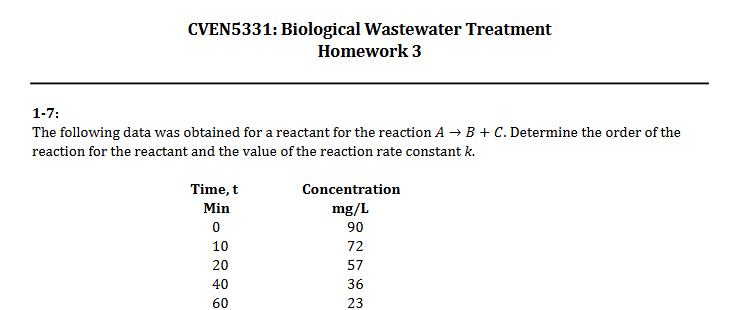 CVEN5331: Biological Wastewater Treatment
Homework 3
1-7:
‘The following data was obtained for a reactant for the reaction 4 — B + C. Determine the order of the
reaction for the reactant and the value of the reaction rate constant k.
Time, t Concentration
Min mg/L
0 90
10 72
20 57
40 36
60 23
This is AI generated Response.
Asked by: Edu
Created at: 2025-10-02 00:21:30
Asked by: Edu
Created at: 2025-10-02 00:21:30
Final Answer:
Rendered
Raw Text
Did you like this answer?
## Step-by-Step Solution
We are given concentration vs. time data for a reaction \( A \rightarrow B + C \). We need to determine:
1. **The order of the reaction** (with respect to \( A \)).
2. **The value of the rate constant \( k \)**.
### **Step 1: Organize the Data**
| Time, \( t \) (min) | Concentration, \( [A] \) (mg/L) |
|---------------------|----------------------------------|
| | 90 |
| 10 | 72 |
| 20 | 57 |
| 40 | 36 |
| 60 | 23 |
---
### **Step 2: Test Possible Reaction Orders**
#### **Zero-Order**
- **Equation:** \( [A] = [A]_ - kt \)
- Plot: \( [A] \) vs \( t \) should be a straight line if zero order.
#### **First-Order**
- **Equation:** \( \ln[A] = \ln[A]_ - kt \)
- Plot: \( \ln[A] \) vs \( t \) should be a straight line if first order.
#### **Second-Order**
- **Equation:** \( \frac{1}{[A]} = \frac{1}{[A]_} + kt \)
- Plot: \( 1/[A] \) vs \( t \) should be a straight line if second order.
Let's calculate values for each.
---
### **Step 3: Calculate Values for Each Order**
#### **First-Order Test: Compute \(\ln[A]\)**
| \( t \) (min) | \( [A] \) (mg/L) | \( \ln[A] \) |
|---------------|------------------|--------------|
| | 90 | 4.50 |
| 10 | 72 | 4.28 |
| 20 | 57 | 4.04 |
| 40 | 36 | 3.58 |
| 60 | 23 | 3.14 |
#### **Second-Order Test: Compute \(1/[A]\)**
| \( t \) (min) | \( [A] \) (mg/L) | \( 1/[A] \) (L/mg) |
|---------------|------------------|--------------------|
| | 90 | .0111 |
| 10 | 72 | .0139 |
| 20 | 57 | .0175 |
| 40 | 36 | .0278 |
| 60 | 23 | .0435 |
---
### **Step 4: Analyze Which is Linear**
Look for approximately constant differences (for zero order), or constant increments (for first or second order, based on the transformed values).
- **First-Order:** Differences of \( \ln[A] \) per 10 min:
- –10: 4.50 – 4.28 = .22
- 10–20: 4.28 – 4.04 = .24
- 20–40: 4.04 – 3.58 = .46 (over 20 min → .23 per 10 min)
- 40–60: 3.58 – 3.14 = .44 (over 20 min → .22 per 10 min)
This is quite consistent, indicating **first-order** kinetics.
---
### **Step 5: Calculate the Rate Constant \( k \)**
First-order: \( \ln[A] = \ln[A]_ - kt \)
Rearrange: \( k = \frac{\ln[A]_ - \ln[A]}{t} \)
Let's use the first and last data points:
- \( \ln[A]_ = \ln(90) = 4.50 \)
- \( \ln[A]_{t=60} = \ln(23) = 3.14 \)
- \( t = 60 \) min
\( k = \frac{4.50 - 3.14}{60} = \frac{1.36}{60} = .0227 \, \text{min}^{-1} \)
---
## **Final Answers**
### **1. Order of Reaction:**
**First Order**
### **2. Rate Constant:**
**\( k = .023 \, \text{min}^{-1} \) (rounded to 2 significant digits)**
---
### **Summary Table**
| Step | Result |
|---------------------|--------------------------|
| Reaction Order | First Order |
| Rate Constant, \(k\)| \(.023 \, \text{min}^{-1}\) |
---
**Let me know if you want to see the plots or need an explanation for another reaction order!**
📢 Instructions:
- Ask anything relatd to above question only.
- For new Question goto :