 VIPSolutions
Act like a helpful tutor and exlain me : Give step-by-step solution with explanation and final answer:CVEN5331: Biological Wastewater Treatment Homework 3 1-7: ‘The following data was obtained for a reactant for the reaction 4 — B + C. Determine the order of the reaction for the reactant and the value of the reaction rate constant k. Time, t Concentration Min mg/L 0 90 10 72 20 57 40 36 60 23
Question:
Act like a helpful tutor and exlain me :
Give step-by-step solution with explanation and final answer: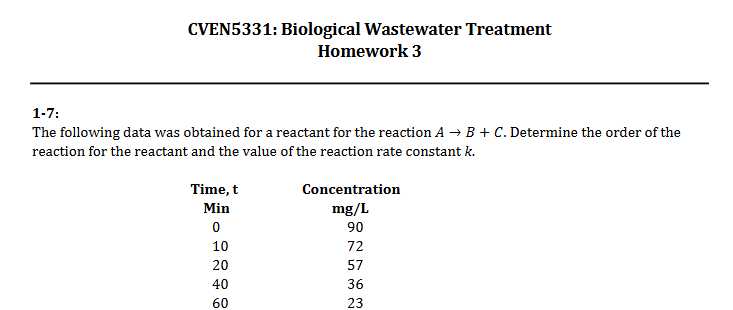 CVEN5331: Biological Wastewater Treatment
Homework 3
1-7:
‘The following data was obtained for a reactant for the reaction 4 — B + C. Determine the order of the
reaction for the reactant and the value of the reaction rate constant k.
Time, t Concentration
Min mg/L
0 90
10 72
20 57
40 36
60 23
This is AI generated Response.
Asked by: Edu
Created at: 2025-10-02 00:20:52
Asked by: Edu
Created at: 2025-10-02 00:20:52
Final Answer:
Rendered
Raw Text
Did you like this answer?
# Step-by-Step Solution
## **Given Data**
| Time, t (min) | Concentration, C (mg/L) |
|:-------------:|:-----------------------:|
| | 90 |
| 10 | 72 |
| 20 | 57 |
| 40 | 36 |
| 60 | 23 |
Reaction:
\[ A \rightarrow B + C \]
We are to **determine:**
1. The order of the reaction with respect to A.
2. The reaction rate constant, \( k \).
---
## **Step 1: Write Integrated Rate Laws**
Let's recall the integrated rate laws for different reaction orders:
### **Zero Order**
\[
C = C_ - kt
\]
### **First Order**
\[
\ln C = \ln C_ - kt
\]
### **Second Order**
\[
\frac{1}{C} = \frac{1}{C_} + kt
\]
---
## **Step 2: Test Reaction Order**
We'll check which integrated rate law gives a straight line with the data.
### **Prepare Data Table**
| t (min) | C (mg/L) | ln(C) | 1/C |
|---------|----------|--------|--------|
| | 90 | 4.4998 | .0111 |
| 10 | 72 | 4.2767 | .0139 |
| 20 | 57 | 4.0431 | .0175 |
| 40 | 36 | 3.5835 | .0278 |
| 60 | 23 | 3.1355 | .0435 |
---
### **Check First Order (Plot: \( \ln C \) vs \( t \))**
Calculate differences:
- \( \ln(90) = 4.4998 \)
- \( \ln(72) = 4.2767 \)
- \( \ln(57) = 4.0431 \)
- \( \ln(36) = 3.5835 \)
- \( \ln(23) = 3.1355 \)
Check if the decrease in \( \ln C \) is linear with time:
- From to 10 min: \( 4.4998 - 4.2767 = .2231 \)
- From 10 to 20 min: \( 4.2767 - 4.0431 = .2336 \)
- From 20 to 40 min: \( 4.0431 - 3.5835 = .4596 \) (for 20 min)
- From 40 to 60 min: \( 3.5835 - 3.1355 = .448 \) (for 20 min)
The changes are fairly consistent, suggesting **first-order kinetics**.
---
## **Step 3: Calculate the Rate Constant, \( k \)**
For first order:
\[
\ln C = \ln C_ - kt \implies k = \frac{\ln C_ - \ln C}{t}
\]
### Use two points ( and 60 min):
\[
k = \frac{4.4998 - 3.1355}{60}
= \frac{1.3643}{60}
= .0227\, \text{min}^{-1}
\]
### Check with other intervals for consistency:
- Between and 10 min:
\[
k = \frac{4.4998-4.2767}{10} = .0223
\]
- Between 10 and 20 min:
\[
k = \frac{4.2767-4.0431}{10} = .0234
\]
- Between 20 and 40 min:
\[
k = \frac{4.0431-3.5835}{20} = .02298
\]
Values are very close to each other! So, **first order** is correct and \( k \approx .023 \) min\(^{-1}\).
---
## **Final Answers**
### **1. Order of reaction:**
**First order** with respect to reactant A.
### **2. Value of rate constant \( k \):**
\[
k \approx .023 \ \text{min}^{-1}
\]
---
### **Summary Table**
| Order | Plot to Check | Linear? | Rate Constant (\( k \)) |
|-------|------------------|---------|--------------------------------------|
| | \( C \) vs \( t \) | No | — |
| 1 | \( \ln C \) vs \( t \) | Yes | \( k = .023 \ \text{min}^{-1} \) |
| 2 | \( 1/C \) vs \( t \) | No | — |
If you want, you can plot \( \ln C \) vs \( t \) as a straight line to visualize!
📢 Instructions:
- Ask anything relatd to above question only.
- For new Question goto :