 VIPSolutions
Act like a helpful tutor and exlain me : Give step-by-step solution with explanation and final answer:You are siphoning water at 20°C out of a tank with a 2-inch diameter hose as shown below. Calculate: a) the flowrate of water being siphoned out of the tank, and b) the gauge pressure at points (1-4). Note that point (2) is inside the hose. c) is the siphon experiencing cavitation problems? The attached Appendix 1 gives water properties as a function of temperature. (4) 240. dlomter mY = hose: l TFA P= af p ¥'s EX (5) | 3 .
Question:
Act like a helpful tutor and exlain me :
Give step-by-step solution with explanation and final answer: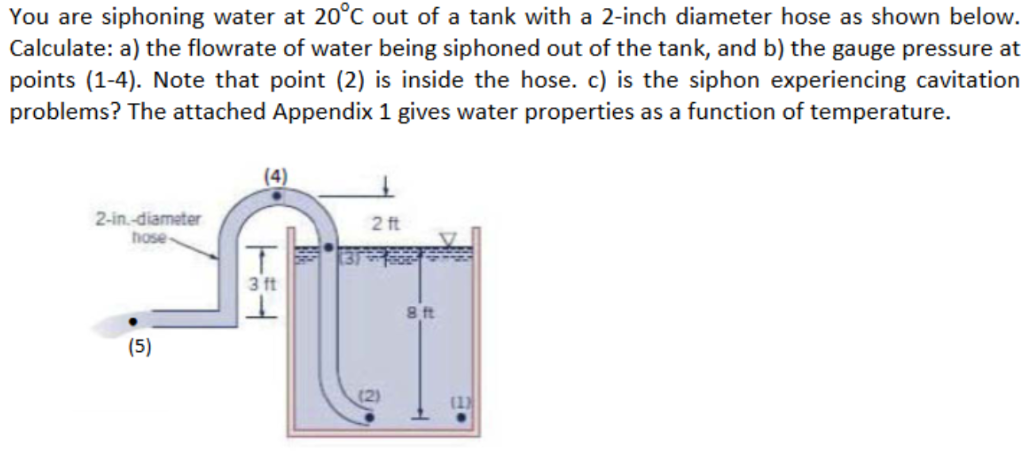 You are siphoning water at 20°C out of a tank with a 2-inch diameter hose as shown below.
Calculate: a) the flowrate of water being siphoned out of the tank, and b) the gauge pressure at
points (1-4). Note that point (2) is inside the hose. c) is the siphon experiencing cavitation
problems? The attached Appendix 1 gives water properties as a function of temperature.
(4)
240. dlomter mY =
hose: l
TFA P=
af
p ¥'s EX
(5) |
3 .
This is AI generated Response.
Asked by: manish kumar
Created at: 2025-10-01 12:15:29
Asked by: manish kumar
Created at: 2025-10-01 12:15:29
Final Answer:
Rendered
Raw Text
Did you like this answer?
Let's solve the problem step by step.
---
## **Given Data**
- **Water temperature:** \(20^\circ C\)
- **Hose diameter:** \(2\) in \(= .167\) ft (\(2 \times 1/12\))
- **Height from water surface to point 4:** \(3\) ft up, \(2\) ft over
- **Height from water surface to point 2 (bottom):** \(8\) ft down
- **Atmospheric pressure (\(P_{atm}\))** (assumed): \(101325\) Pa \(= 101.3\) kPa
- **Density of water at 20°C (\(\rho\)):** \(998\) kg/m³
- **Vapor pressure of water at 20°C (\(P_{vap}\))**: \(\approx 2.34\) kPa
Let’s use consistent SI units:
- **Diameter (D):** \(2\) in = \(.0508\) m,
- **Area (A):** \(\pi D^2/4 = \pi (.0508)^2/4 = .002026\) m²
- **Height difference (from tank surface to outlet):** \(8 + 3 = 11\) ft = \(3.353\) m
---
## **A) Calculate the Flowrate**
Assumptions:
- The siphon is running steadily.
- Velocity at the tank surface is negligible due to large area.
- Neglecting friction and minor losses for simplicity (unless asked).
Apply **Bernoulli’s Equation** between free surface (1) and outlet (5):
\[
P_1 + \frac{1}{2}\rho v_1^2 + \rho g z_1 = P_5 + \frac{1}{2}\rho v_5^2 + \rho g z_5
\]
Where:
- At (1): \(P_1 = P_{atm}\), \(v_1 \approx \), \(z_1 = \) (let’s choose tank surface as datum)
- At (5): \(P_5 = P_{atm}\), \(v_5 = v\), \(z_5 = -3.353\) m (down from the surface)
Plug in:
\[
P_{atm} + + = P_{atm} + \frac{1}{2}\rho v^2 - \rho g (3.353)
\]
\[
= \frac{1}{2}\rho v^2 - \rho g (3.353)
\]
\[
\frac{1}{2}\rho v^2 = \rho g (3.353)
\]
\[
v^2 = 2g(3.353)
\]
\[
v = \sqrt{2 \cdot 9.81 \cdot 3.353} = \sqrt{65.8} = 8.11 \text{ m/s}
\]
**Flowrate:**
\[
Q = v \cdot A = 8.11 \times .002026 = \boxed{.0164 \text{ m}^3/\text{s}}
\]
or
\[
Q = 16.4 \text{ L/s}
\]
---
## **B) Gauge Pressure at Points (1)-(4)**
Let’s calculate **gauge pressure** (\(P_{gauge} = P_{abs} - P_{atm}\)) at each point.
### **Point 1: Surface of Tank**
- At surface, open to atmosphere:
\[
P_{gauge,1} =
\]
### **Point 2: Bottom of Tank (8 ft below surface)**
\[
h = 8 \text{ ft} = 2.438 \text{ m}
\]
Hydrostatic pressure:
\[
P_2 = P_{atm} + \rho g h
\]
\[
P_{gauge,2} = \rho g h = 998 \times 9.81 \times 2.438 = 23,900 \text{ Pa} = 23.9 \text{ kPa}
\]
### **Point 3: Top of Siphon (3 ft above surface)**
\[
h = -3 \text{ ft} = -.914 \text{ m}
\]
We need to consider Bernoulli from (1) to (3):
- At (1): \(P_{atm}, v_1 \approx , z_1 = \)
- At (3): \(P_3, v_3 = v, z_3 = .914\) m
\[
P_{atm} + + = P_3 + \frac{1}{2}\rho v^2 + \rho g (.914)
\]
\[
P_3 = P_{atm} - \frac{1}{2}\rho v^2 - \rho g (.914)
\]
\[
P_{gauge,3} = P_3 - P_{atm} = - \frac{1}{2}\rho v^2 - \rho g (.914)
\]
Plug in values:
- \(v = 8.11\) m/s
- \(\frac{1}{2}\rho v^2 = .5 \times 998 \times (8.11)^2 = 32,860\) Pa
- \(\rho g z = 998 \times 9.81 \times .914 = 8,970\) Pa
\[
P_{gauge,3} = -32,860 - 8,970 = \boxed{-41,830 \text{ Pa}} = -41.8 \text{ kPa}
\]
### **Point 4: Outlet**
- At outlet, open to atmosphere:
\[
P_{gauge,4} =
\]
---
## **C) Cavitation Check**
Cavitation occurs if absolute pressure drops below vapor pressure.
\[
P_{abs,3} = P_{atm} + P_{gauge,3} = 101,300 - 41,830 = 59,470 \text{ Pa} = 59.5 \text{ kPa}
\]
Vapor pressure at 20°C = 2.34 kPa, which is much less than 59.5 kPa.
**Conclusion:**
**No cavitation will occur** since \(P_{abs,3} > P_{vap}\).
---
## **Final Answers (Summary Table)**
| Point | Gauge Pressure (kPa) |
|-------|----------------------|
| 1 | |
| 2 | +23.9 |
| 3 | -41.8 |
| 4 | |
- **Flowrate:** \(\boxed{.0164\ \text{m}^3/\text{s}}\) or \(16.4\) L/s
- **Cavitation:** **No cavitation occurs.**
---
If you need the same calculations with more detailed steps or with friction losses included, just ask!
📢 Instructions:
- Ask anything relatd to above question only.
- For new Question goto :