This is AI generated Response.
Asked by: manish kumar
Created at: 2025-10-01 10:17:05
Final Answer:
RenderedRaw Text
Did you like this answer?
# Step-by-Step Solution: Handle as a Fin
Let's break down the problem and solve it step-by-step:
---
## **1. Problem Restatement**
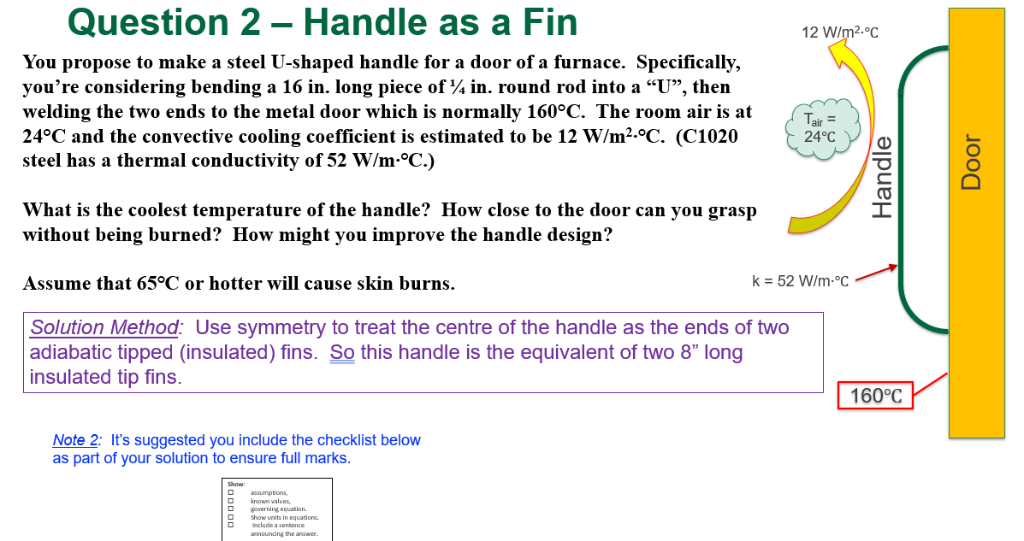
- **Handle:** 16 in. long steel rod, 1/4 in. diameter, bent into a "U" and welded to a furnace door.
- **Door temperature:** 160°C
- **Room air temperature:** 24°C
- **Convective cooling coefficient (h):** 12 W/m²·°C
- **Thermal conductivity of steel (k):** 52 W/m·°C
- **Assume:** 65°C or hotter will cause burns.
- **Model:** Treat as two 8-inch (.2032 m) insulated-tip fins due to symmetry.
---
## **2. Fin Equation Setup**
### **Fin Parameters**
- **Length of each fin (L):** 8 in = .2032 m
- **Diameter (d):** .25 in = .00635 m
- **Perimeter (P):** \( P = \pi d = \pi \times .00635 \)
- **Cross-sectional area (A):** \( A = \frac{\pi d^2}{4} \)
### **Fin Equation (Adiabatic Tip):**
For a straight fin with an insulated tip:
\[
\frac{T(x) - T_\infty}{T_b - T_\infty} = \frac{\cosh[m(L-x)]}{\cosh(mL)}
\]
Where:
- \( T_b \) = base temperature = 160°C
- \( T_\infty \) = air temperature = 24°C
---
## **3. Calculate Fin Parameter \( m \):**
\[
m = \sqrt{\frac{h P}{k A}}
\]
- \( h = 12 \) W/m²·°C
- \( P = \pi \times .00635 = .01995 \) m
- \( A = \frac{\pi}{4} \times (.00635)^2 = 3.17 \times 10^{-5} \) m²
- \( k = 52 \) W/m·°C
Plug in:
\[
m = \sqrt{\frac{12 \times .01995}{52 \times 3.17 \times 10^{-5}}}
\]
\[
m = \sqrt{\frac{.2394}{.0016484}}
\]
\[
m = \sqrt{145.3} \approx 12.05 \text{ m}^{-1}
\]
---
## **4. Find the Coolest Temperature of the Handle (at the tip):**
At the end (tip) of the fin, \( x = L \):
\[
\frac{T(L) - T_\infty}{T_b - T_\infty} = \frac{1}{\cosh(mL)}
\]
Calculate \( mL \):
\[
mL = 12.05 \times .2032 = 2.45
\]
Calculate \( \cosh(2.45) \):
\[
\cosh(2.45) \approx 5.78
\]
So,
\[
\frac{T_{tip} - 24}{160 - 24} = \frac{1}{5.78}
\]
\[
T_{tip} - 24 = \frac{136}{5.78}
\]
\[
T_{tip} - 24 = 23.5
\]
\[
T_{tip} = 47.5^\circ \text{C}
\]
---
## **5. How Close to the Door Can You Grasp Without Being Burned?**
We want \( T(x) = 65^\circ \)C.
\[
\frac{T(x) - 24}{136} = \frac{\cosh[m(L-x)]}{\cosh(mL)}
\]
Set \( T(x) = 65^\circ C \):
\[
\frac{65 - 24}{136} = \frac{\cosh[m(L-x)]}{5.78}
\]
\[
.301 = \frac{\cosh[m(L-x)]}{5.78}
\]
\[
\cosh[m(L-x)] = 1.74
\]
\[
m(L-x) = \cosh^{-1}(1.74) \approx 1.11
\]
\[
L-x = \frac{1.11}{m} = \frac{1.11}{12.05} = .092 \text{ m} = 9.2 \text{ cm}
\]
So, **you must grasp at least 9.2 cm (3.6 in) away from the door** to avoid burns.
---
## **6. How to Improve the Handle Design?**
- **Increase handle diameter:** Reduces temperature drop along handle.
- **Use lower thermal conductivity material:** Less heat travels to the end.
- **Add insulation to handle:** Reduces heat transfer.
- **Increase fin length:** Cooler at the tip, but may compromise usability.
---
## **Summary Table**
| **Parameter** | **Value** |
|-------------------------|----------------------|
| Coolest handle temp | **47.5°C** |
| Min safe distance | **9.2 cm (3.6 in)** |
| Max safe temp (grab) | 65°C |
---
## **Final Answers**
### **Coolest temperature of the handle:**
\[
\boxed{47.5^\circ \text{C}}
\]
### **Minimum distance from door to avoid burns:**
\[
\boxed{9.2\, \text{cm} \ (3.6\, \text{in})}
\]
### **How to improve:**
- Increase handle diameter,
- Use a material with lower thermal conductivity,
- Add insulation,
- Increase length if practical.
---
**Let me know if you need the calculations explained in more detail or help with another step!**
VIPSolutions focuses on clear, step‑by‑step explanations so you can learn quickly. Whether you need an AI‑generated walkthrough or a short hint to get unstuck, each solution is organized for fast reading and easy review later.
Search similar questions, compare approaches, and bookmark the best answers for revision. Our goal is simple: quick, reliable study help that feels natural—not noisy.
 VIPSolutions
 Question 2 — Handle as a Fin —
You propose to make a steel U-shaped handle for a door of a furnace. Specifically,
you're considering bending a 16 in. long piece of ¥ in. round rod into a “U”, then
welding the two ends to the metal door which is normally 160°C. The room air is at
24°C and the convective cooling coefficient is estimated to be 12 W/m2-°C. (C1020 I)
steel has a thermal conductivity of 52 W/m-°C.) oS
c
©
What is the coolest temperature of the handle? How close to the door can you grasp I
without being burned? How might you improve the handle design?
Assume that 65°C or hotter will cause skin burns. k = 52 W/m-C
Solution Method: Use symmetry to treat the centre of the handle as the ends of two
adiabatic tipped (insulated) fins. So this handle is the equivalent of two 8” long
insulated tip fins.
160°C
Note 2: It's suggested you include the checklist below
as part of your solution fo ensure full marks.