 VIPSolutions
Act like a helpful tutor and exlain me : Give step-by-step solution with explanation and final answer:Current Attempt in Progress Find the horizontal and vertical forces to hold stationary the nozzle shown in the figure below. The fluid flowing throught is 10°C liquid water; A; = 0.8 m?, A = 0.200 m?, V4 = 10 m/s, p2 = Pag and py = poem + 20 kPa. Neglect effects of gravity. As A21 P2 = Patm Fy y V1 ) > A F, Patm x 141 Fy= B kN f= B KN eTextbook and Media
Question:
Act like a helpful tutor and exlain me :
Give step-by-step solution with explanation and final answer: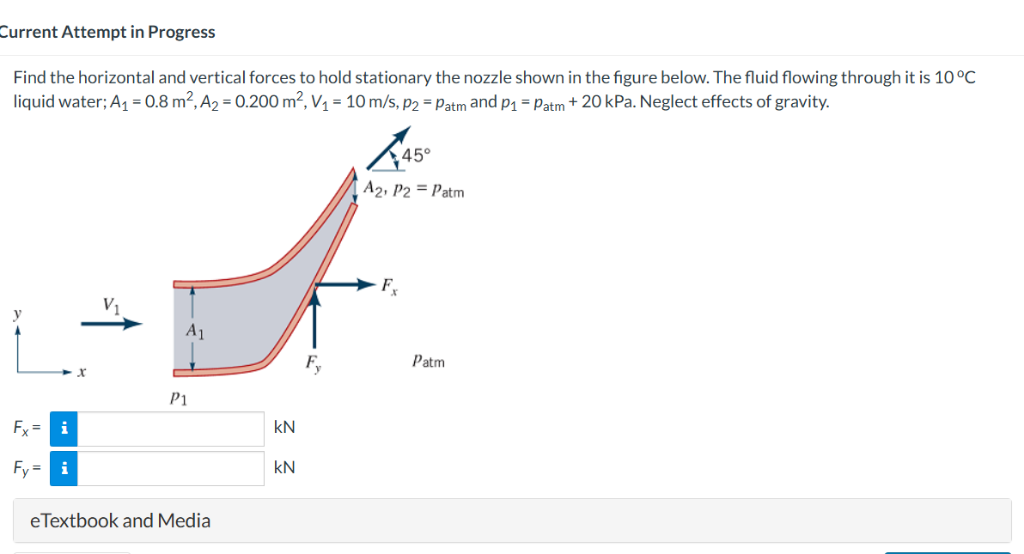 Current Attempt in Progress
Find the horizontal and vertical forces to hold stationary the nozzle shown in the figure below. The fluid flowing throught is 10°C
liquid water; A; = 0.8 m?, A = 0.200 m?, V4 = 10 m/s, p2 = Pag and py = poem + 20 kPa. Neglect effects of gravity.
As
A21 P2 = Patm
Fy
y V1
) > A
F, Patm
x
141
Fy= B kN
f= B KN
eTextbook and Media
This is AI generated Response.
Asked by: manish kumar
Created at: 2025-10-01 09:19:19
Asked by: manish kumar
Created at: 2025-10-01 09:19:19
Final Answer:
Rendered
Raw Text
Did you like this answer?
Let's break this problem down step by step:
---
## **Given Data**
- **Fluid:** 10°C liquid water (density, ρ ≈ 100 kg/m³)
- **A₁ =** .8 m² (Inlet area)
- **A₂ =** .2 m² (Outlet area)
- **V₁ =** 10 m/s (Inlet velocity)
- **p₁ =** p_atm + 20 kPa (Inlet pressure)
- **p₂ =** p_atm (Outlet pressure)
- **Outlet angle:** 45°
- **Neglect gravity**
---
## **Step 1: Find V₂ using Continuity Equation**
\[
Q = A_1 V_1 = A_2 V_2 \implies V_2 = \frac{A_1}{A_2} V_1
\]
\[
V_2 = \frac{.8}{.2} \times 10 = 4 \times 10 = 40\, \text{m/s}
\]
---
## **Step 2: Find Mass Flow Rate (\(\dot{m}\))**
\[
\dot{m} = \rho Q = \rho A_1 V_1 = 100 \times .8 \times 10 = 800\, \text{kg/s}
\]
---
## **Step 3: Apply Linear Momentum Equation**
The control volume is the nozzle. The forces needed to hold it stationary are:
\[
\vec{F} = \sum (\text{Momentum out}) - \sum (\text{Momentum in}) + \sum(\text{Pressure forces})
\]
### **Component Form:**
#### **X-direction:**
\[
F_x = (\dot{m} V_{2x}) - (\dot{m} V_{1x}) + (p_1 A_1 - p_2 A_2 \cos 45^\circ)
\]
#### **Y-direction:**
\[
F_y = (\dot{m} V_{2y}) - (\dot{m} V_{1y}) - (p_2 A_2 \sin 45^\circ)
\]
---
## **Step 4: Calculate Velocity Components**
- At inlet (1): \(V_{1x} = V_1 = 10\, \text{m/s}\), \(V_{1y} = \)
- At outlet (2): \(V_{2x} = V_2 \cos 45^\circ = 40 \times \frac{1}{\sqrt{2}} = 28.28\, \text{m/s}\)
- \(V_{2y} = V_2 \sin 45^\circ = 40 \times \frac{1}{\sqrt{2}} = 28.28\, \text{m/s}\)
---
## **Step 5: Pressure Forces**
- At inlet: \(p_1 A_1\)
- At outlet, only atmospheric acts, but since both outside and at outlet is \(p_{atm}\), the net force due to atmospheric cancels except for the extra \(20\, \text{kPa}\) at the inlet.
\[
p_1 - p_{atm} = 20,000\, \text{Pa}
\]
---
## **Step 6: Plug in the Numbers**
### **X-direction:**
\[
F_x = (\dot{m} V_{2x}) - (\dot{m} V_{1x}) + [p_1 A_1 - p_2 A_2 \cos 45^\circ]
\]
Since \(p_2 = p_{atm}\) and the outside is also at \(p_{atm}\), the \(p_2\) force cancels with the atmospheric pressure on the nozzle, so only the gauge pressure at inlet matters.
\[
F_x = (800 \times 28.28) - (800 \times 10) + [20,000 \times .8]
\]
\[
= (226,240) - (80,000) + 16,000
\]
\[
= 146,240 + 16,000 = 162,240\, \text{N}
\]
\[
F_x = 162.24\, \text{kN}
\]
---
### **Y-direction:**
\[
F_y = (\dot{m} V_{2y}) - (\dot{m} V_{1y}) - (p_2 A_2 \sin 45^\circ)
\]
But again, \(p_2 = p_{atm}\), and atmospheric cancels, so just use the momentum:
\[
F_y = 800 \times 28.28 -
\]
\[
= 226,240\, \text{N}
\]
\[
F_y = 226.24\, \text{kN}
\]
---
## **Final Answers**
\[
\boxed{
F_x = 162.24\, \text{kN} \\
F_y = 226.24\, \text{kN}
}
\]
---
### **Summary Table**
| Direction | Force (kN) |
|-----------|------------|
| \(F_x\) | 162.24 |
| \(F_y\) | 226.24 |
---
**Let me know if you want a breakdown of the pressure force terms or other clarifications!**
📢 Instructions:
- Ask anything relatd to above question only.
- For new Question goto :