Act like a helpful tutor and exlain me :
Give step-by-step solution with explanation and final answer:
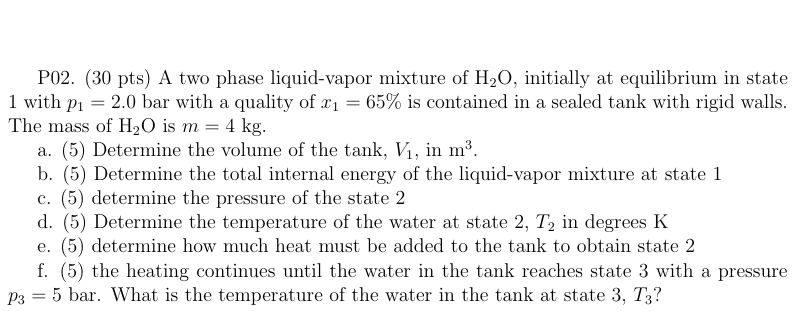
explain in detail and completely solve each sub part of the questionP02. (30 pts) A two phase liquid-vapor mixture of HO, initially at equilibrium in state
1 with p; = 2.0 bar with a quality of 21 = 65% is contained in a sealed tank with rigid walls.
The mass of HyO is m = 4 kg.
a. (5) Determine the volume of the tank, Vj, in m*
b. (5) Determine the total internal energy of the liquid-vapor mixture at state 1
c. (5) determine the pressure of the state 2
d. (5) Determine the temperature of the water at state 2, T} in degrees K
e. (5) determine how much heat must be added to the tank to obtain state 2
f. (5) the heating continues until the water in the tank reaches state 3 with a pressure
ps = 5 bar. What is the temperature of the water in the tank at state 3, T5?
Question:
Act like a helpful tutor and exlain me :
Give step-by-step solution with explanation and final answer:
explain in detail and completely solve each sub part of the questionP02. (30 pts) A two phase liquid-vapor mixture of HO, initially at equilibrium in state
1 with p; = 2.0 bar with a quality of 21 = 65% is contained in a sealed tank with rigid walls.
The mass of HyO is m = 4 kg.
a. (5) Determine the volume of the tank, Vj, in m*
b. (5) Determine the total internal energy of the liquid-vapor mixture at state 1
c. (5) determine the pressure of the state 2
d. (5) Determine the temperature of the water at state 2, T} in degrees K
e. (5) determine how much heat must be added to the tank to obtain state 2
f. (5) the heating continues until the water in the tank reaches state 3 with a pressure
ps = 5 bar. What is the temperature of the water in the tank at state 3, T5?
This is AI generated Response.
Asked by: manish kumar
Created at: 2025-10-01 08:58:16
Final Answer:
RenderedRaw Text
Did you like this answer?
Let's solve each subpart step by step.
---
# Given Data
- **Initial Pressure** (\( p_1 \)): 2. bar (200 kPa)
- **Quality** (\( x_1 \)): 65% = .65
- **Mass of H₂O** (\( m \)): 4 kg
- **Rigid tank:** Volume is constant
---
## a. **Determine the volume of the tank, \( V_1 \), in m³.**
### Step 1: Find Specific Volume at State 1
From steam tables at \( p_1 = 2. \) bar (200 kPa):
- \( v_f @ 200\, \text{kPa} \) (saturated liquid): ≈ .001061 m³/kg
- \( v_g @ 200\, \text{kPa} \) (saturated vapor): ≈ .8857 m³/kg
The mixture's specific volume:
\[
v_1 = v_f + x_1 (v_g - v_f)
\]
\[
v_1 = .001061 + .65 \times (.8857 - .001061)
\]
\[
v_1 = .001061 + .65 \times .884639
\]
\[
v_1 = .001061 + .574015
\]
\[
v_1 \approx .5751\, \text{m}^3/\text{kg}
\]
### Step 2: Calculate Total Volume
\[
V_1 = m \cdot v_1 = 4\, \text{kg} \times .5751\, \text{m}^3/\text{kg}
\]
\[
V_1 \approx 2.30\, \text{m}^3
\]
---
## b. **Determine the total internal energy of the liquid-vapor mixture at state 1**
From steam tables at \( p_1 = 2. \) bar:
- \( u_f @ 200\, \text{kPa} \) ≈ 504.43 kJ/kg
- \( u_g @ 200\, \text{kPa} \) ≈ 2506.5 kJ/kg
Mixture's specific internal energy:
\[
u_1 = u_f + x_1 (u_g - u_f)
\]
\[
u_1 = 504.43 + .65 \times (2506.5 - 504.43)
\]
\[
u_1 = 504.43 + .65 \times 2002.07
\]
\[
u_1 = 504.43 + 1301.35
\]
\[
u_1 \approx 1805.8\, \text{kJ/kg}
\]
Total internal energy:
\[
U_1 = m \cdot u_1 = 4 \times 1805.8 = 7223.2\, \text{kJ}
\]
---
## c. **Determine the pressure of state 2**
**Tank is rigid:** Volume and mass constant, so specific volume \( v_2 = v_1 = .5751\, \text{m}^3/\text{kg} \).
**When heat is added:** Water will eventually become all vapor (when \( x_2 = 1 \)), then superheated.
To find pressure at state 2, look for the pressure at which the specific volume of saturated vapor equals \( v_1 \):
From steam tables:
- At \( p \approx .6\, \text{bar} \) (60 kPa): \( v_g = 3.240\, \text{m}^3/\text{kg} \)
- At \( p \approx 2.\, \text{bar} \): \( v_g = .8857\, \text{m}^3/\text{kg} \)
- At \( p \approx 3.\, \text{bar} \): \( v_g = .6058\, \text{m}^3/\text{kg} \)
- At \( p \approx 3.5\, \text{bar} \): \( v_g = .5191\, \text{m}^3/\text{kg} \)
\( .5751\, \text{m}^3/\text{kg} \) is between \( v_g \) at 3. and 3.5 bar.
**Interpolate:**
\[
P_2 = 3. + \frac{.6058-.5751}{.6058-.5191} \times (3.5-3.)
\]
\[
= 3. + \frac{.0307}{.0867} \times .5
\]
\[
= 3. + .177 \approx 3.18\, \text{bar}
\]
---
## d. **Determine the temperature of the water at state 2, \( T_2 \) in K**
At state 2, all vapor (\( x_2 = 1 \)), at \( P_2 \approx 3.18 \) bar
From steam tables, saturated temperature at 3.18 bar:
- At 3. bar: \( T_{sat} = 133.6^\circ C \)
- At 3.5 bar: \( T_{sat} = 141.9^\circ C \)
Interpolate:
\[
T_2 = 133.6 + \frac{3.18-3.}{3.5-3.} \times (141.9-133.6)
\]
\[
= 133.6 + .36 \times 8.3 = 133.6 + 2.988 \approx 136.6^\circ C
\]
Convert to Kelvin:
\[
T_2 = 136.6 + 273.15 = 409.75\, \text{K}
\]
---
## e. **Determine how much heat must be added to the tank to obtain state 2**
Find internal energy at state 2 (\( x_2 = 1 \), \( P_2 = 3.18 \) bar):
From steam tables:
- At 3. bar: \( u_g = 2537.6\, \text{kJ/kg} \)
- At 3.5 bar: \( u_g = 2543.7\, \text{kJ/kg} \)
Interpolate:
\[
u_2 = 2537.6 + \frac{3.18-3.}{3.5-3.} \times (2543.7-2537.6)
\]
\[
= 2537.6 + .36 \times 6.1 = 2537.6 + 2.196 \approx 2539.8\, \text{kJ/kg}
\]
Total internal energy at state 2:
\[
U_2 = 4 \times 2539.8 = 10159.2\, \text{kJ}
\]
Heat added \( Q = U_2 - U_1 \):
\[
Q = 10159.2 - 7223.2 = 2936\, \text{kJ}
\]
---
## f. **The heating continues until the water in the tank reaches state 3 with a pressure \( p_3 = 5 \) bar. What is the temperature of the water in the tank at state 3, \( T_3 \)?**
Volume is still \( V_1 = 2.30\, \text{m}^3 \), mass = 4 kg, so \( v_3 = v_1 = .5751\, \text{m}^3/\text{kg} \).
At \( p_3 = 5 \) bar:
- \( v_g = .3744\, \text{m}^3/\text{kg} \) (saturated vapor)
- \( v_3 > v_g \), so the water is **superheated vapor**.
Look up superheated steam tables for \( p = 5 \) bar, \( v = .5751\, \text{m}^3/\text{kg} \):
- At \( T = 400^\circ C \), \( v = .5958\, \text{m}^3/\text{kg} \)
- At \( T = 300^\circ C \), \( v = .4804\, \text{m}^3/\text{kg} \)
Interpolate:
\[
T_3 = 300 + \frac{.5751-.4804}{.5958-.4804} \times (400-300)
\]
\[
= 300 + \frac{.0947}{.1154} \times 100
\]
\[
= 300 + .821 \times 100 = 300 + 82.1 \approx 382^\circ C
\]
Convert to Kelvin:
\[
T_3 = 382 + 273.15 = 655.15\, \text{K}
\]
---
# **Summary Table**
| Part | Quantity | Value |
|------|---------------------------------------|-------------------|
| a | Volume of tank, \( V_1 \) | \( 2.30\, \text{m}^3 \) |
| b | Total internal energy, \( U_1 \) | \( 7223.2\, \text{kJ} \) |
| c | Pressure at state 2, \( P_2 \) | \( 3.18\, \text{bar} \) |
| d | Temperature at state 2, \( T_2 \) | \( 409.8\, \text{K} \) |
| e | Heat added to reach state 2 | \( 2936\, \text{kJ} \) |
| f | Temperature at state 3, \( T_3 \) | \( 655.2\, \text{K} \) |
---
If you need a deeper explanation for any part or want to see the interpolation steps more explicitly, let me know!
VIPSolutions focuses on clear, step‑by‑step explanations so you can learn quickly. Whether you need an AI‑generated walkthrough or a short hint to get unstuck, each solution is organized for fast reading and easy review later.
Search similar questions, compare approaches, and bookmark the best answers for revision. Our goal is simple: quick, reliable study help that feels natural—not noisy.
 VIPSolutions
 P02. (30 pts) A two phase liquid-vapor mixture of HO, initially at equilibrium in state
1 with p; = 2.0 bar with a quality of 21 = 65% is contained in a sealed tank with rigid walls.
The mass of HyO is m = 4 kg.
a. (5) Determine the volume of the tank, Vj, in m*
b. (5) Determine the total internal energy of the liquid-vapor mixture at state 1
c. (5) determine the pressure of the state 2
d. (5) Determine the temperature of the water at state 2, T} in degrees K
e. (5) determine how much heat must be added to the tank to obtain state 2
f. (5) the heating continues until the water in the tank reaches state 3 with a pressure
ps = 5 bar. What is the temperature of the water in the tank at state 3, T5?