 VIPSolutions
Act like a helpful tutor and exlain me : Give step-by-step solution with explanation and final answer: rod AB is of brass and rod BC is of aluminium(25pt) The brass and aluminum rods (4B and BC, respectively), are joined by the collar at B and fixed at 4 and C. If there is no stress in the members when T, = 18°F, determine the average normal stress in each member when 7; = 145°F. Also, how far, and in what direction, will the collar be displaced? The cross-sectional area of both members, 4, is 1.6 in.2. Assume Eq = 10,000ksi, Ey, = 16,000ksi, ag = 12.2x10⁷%/°F, and a, = 10.4x10⁷°/°F. A B (e4 i | 4 3ft I —
Question:
Act like a helpful tutor and exlain me :
Give step-by-step solution with explanation and final answer: rod AB is of brass and rod BC is of aluminium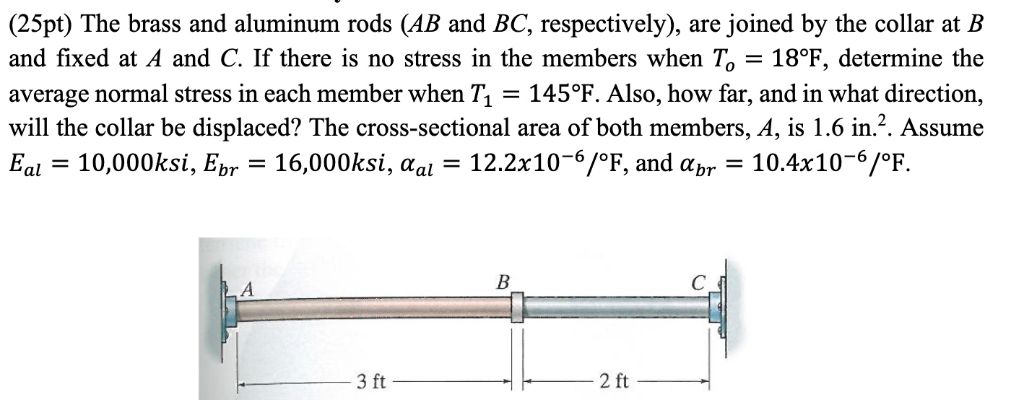 (25pt) The brass and aluminum rods (4B and BC, respectively), are joined by the collar at B
and fixed at 4 and C. If there is no stress in the members when T, = 18°F, determine the
average normal stress in each member when 7; = 145°F. Also, how far, and in what direction,
will the collar be displaced? The cross-sectional area of both members, 4, is 1.6 in.2. Assume
Eq = 10,000ksi, Ey, = 16,000ksi, ag = 12.2x10⁷%/°F, and a, = 10.4x10⁷°/°F.
A B (e4
i |
4 3ft I —
This is AI generated Response.
Asked by: manish kumar
Created at: 2025-09-30 23:01:38
Asked by: manish kumar
Created at: 2025-09-30 23:01:38
Final Answer:
Rendered
Raw Text
Did you like this answer?
Let's break down the problem **step by step**:
---
## **Given Data**
- **Rod AB:** Brass, Length = 3 ft = 36 in
- **Rod BC:** Aluminum, Length = 2 ft = 24 in
- **Cross-sectional area:** \(A = 1.6 \text{ in}^\)
-Modulus ofity:**
\(E_{} = 10,000 \text{ ksi} = 10,000,000 \text{ psi}\)
\(E_{br} = 16,000 \text{ ksi} = 16,000,000 \text{ psi}\)
- **Thermal Expansion Coefficient:**
\(\alpha_{al} = 12.2 \times 10^{-6}/^\circ F\)
\(\alpha_{br} = 10.4 \times 10^{-6}/^\circ F\)
- **Temperature change:**
\(T_ = 18^\circ F\)
\(T_1 = 145^\circ F\)
\(\Delta T = T_1 - T_ = 127^\circ F\)
- **Fixed at A and C; joined by collar at B. No stress at \(T_\).**
---
## **Step 1: Free Thermal Expansion**
If the rods were **free to expand**, their length would increase by:
\[
\Delta L = \alpha \cdot L \cdot \Delta T
\]
### **Brass Rod (AB):**
\[
\Delta L_{br,free} = \alpha_{br} \cdot L_{br} \cdot \Delta T \\
= (10.4 \times 10^{-6}) \times 36 \times 127 \\
= .0475 \text{ in}
\]
### **Aluminum Rod (BC):**
\[
\Delta L_{al,free} = \alpha_{al} \cdot L_{al} \cdot \Delta T \\
= (12.2 \times 10^{-6}) \times 24 \times 127 \\
= .0372 \text{ in}
\]
---
## **Step 2: Compatibility (Displacement)**
Since **A and C are fixed**, the total expansion must be **zero** (the system can't move as a whole).
But the collar at B can move, so let's **let the collar displacement be \(\delta\)** (positive to the right).
- Brass rod AB will be compressed (since it wants to expand more)
- Aluminum rod BC will stretched (since it wants to expand less)
**Compatibility equation:**
\[
(\text{Free expansion of AB}) - \delta = (\text{Actual expansion of AB})
\]
\[
(\text{Free expansion of BC}) + \delta = (\text{Actual expansion of BC})
\]
But the sum of actual expansions must be zero (because ends are fixed):
\[
(\text{Actual expansion of AB}) + (\text{Actual expansion of BC}) =
\]
So,
\[
(\Delta L_{br,free} - \delta) + (\Delta L_{al,free} + \delta) =
\]
\[
\Delta L_{br,free} + \Delta L_{al,free} =
\]
Wait, this would be true only if the collar could not move, but since the collar is free to move, we have to account for the **internal forces**.
---
## **Step 3: Force Equilibrium**
Let the **force in AB = F_{br}** (compression), **force in BC = F_{al}** (tension), and by Newton's third law, they are equal in magnitude:
\[
F_{br} = F_{al} = F
\]
The **actual deformation** due to force (ignoring temperature):
\[
\delta_{br,force} = -\frac{F L_{br}}{A E_{br}}
\]
\[
\delta_{al,force} = +\frac{F L_{al}}{A E_{al}}
\]
**Net collar displacement:**
\[
\delta = (\Delta L_{br,free} + \delta_{br,force}) = -(\Delta L_{al,free} + \delta_{al,force})
\]
But since all the expansion must be taken up by the internal forces (since ends are fixed):
\[
(\Delta L_{br,free} + \delta_{br,force}) + (\Delta L_{al,free} + \delta_{al,force}) =
\]
Plug in the values:
\[
(\Delta L_{br,free} + \delta_{br,force}) + (\Delta L_{al,free} + \delta_{al,force}) =
\]
\[
(\alpha_{br} L_{br} \Delta T - \frac{F L_{br}}{A E_{br}})
+ (\alpha_{al} L_{al} \Delta T + \frac{F L_{al}}{A E_{al}})
=
\]
---
## **Step 4: Solve for Internal Force \(F\)**
\[
\alpha_{br} L_{br} \Delta T + \alpha_{al} L_{al} \Delta T
- \frac{F L_{br}}{A E_{br}} + \frac{F L_{al}}{A E_{al}} =
\]
\[
(\alpha_{br} L_{br} \Delta T + \alpha_{al} L_{al} \Delta T)
= \frac{F L_{br}}{A E_{br}} - \frac{F L_{al}}{A E_{al}}
\]
\[
(\alpha_{br} L_{br} + \alpha_{al} L_{al}) \Delta T
= F \left( \frac{L_{br}}{A E_{br}} + \frac{L_{al}}{A E_{al}} \right)
\]
\[
F = \frac{(\alpha_{br} L_{br} + \alpha_{al} L_{al}) \Delta T}
{\frac{L_{br}}{A E_{br}} + \frac{L_{al}}{A E_{al}}}
\]
---
## **Step 5: Plug in Values**
- \(\alpha_{br} = 10.4 \times 10^{-6}/^\circ F\)
- \(L_{br} = 36 \text{ in}\)
- \(\alpha_{al} = 12.2 \times 10^{-6}/^\circ F\)
- \(L_{al} = 24 \text{ in}\)
- \(\Delta T = 127^\circ F\)
- \(A = 1.6 \text{ in}^2\)
- \(E_{br} = 16,000,000 \text{ psi}\)
- \(E_{al} = 10,000,000 \text{ psi}\)
### **Numerator:**
\[
(\alpha_{br} L_{br} + \alpha_{al} L_{al}) \Delta T =
[(10.4 \times 10^{-6}) \times 36 + (12.2 \times 10^{-6}) \times 24] \times 127
\]
Calculate each term:
- \(10.4 \times 10^{-6} \times 36 = .0003744\)
- \(12.2 \times 10^{-6} \times 24 = .0002928\)
- Sum: \(.0003744 + .0002928 = .0006672\)
Now multiply by \(\Delta T = 127\):
- \(.0006672 \times 127 = .0847344\)
### **Denominator:**
\[
\frac{L_{br}}{A E_{br}} + \frac{L_{al}}{A E_{al}}
\]
- \(\frac{36}{1.6 \times 16,000,000} = \frac{36}{25,600,000} = 1.40625 \times 10^{-6}\)
- \(\frac{24}{1.6 \times 10,000,000} = \frac{24}{16,000,000} = 1.5 \times 10^{-6}\)
- Sum: \(1.40625 \times 10^{-6} + 1.5 \times 10^{-6} = 2.90625 \times 10^{-6}\)
### **Now, Calculate Force \(F\):**
\[
F = \frac{.0847344}{2.90625 \times 10^{-6}} = 29,156 \text{ lbs}
\]
---
## **Step 6: Find Average Normal Stress**
\[
\sigma = \frac{F}{A}
\]
- For both rods, since force is same by Newton's 3rd law:
\[
\sigma = \frac{29,156}{1.6} = 18,222 \text{ psi}
\]
- **AB (Brass) is in compression.**
- **BC (Aluminum) is in tension.**
---
## **Step 7: Collar Displacement**
\[
\delta = \text{Expansion of AB (with stress)} = \Delta L_{br,free} - \frac{F L_{br}}{A E_{br}}
\]
\[
\Delta L_{br,free} = .0475 \text{ in}
\]
\[
\frac{F L_{br}}{A E_{br}} = \frac{29,156 \times 36}{1.6 \times 16,000,000} \\
= \frac{1,049,616}{25,600,000} = .041 \text{ in}
\]
\[
\delta_{AB} = .0475 - .041 = .0065 \text{ in (to the right)}
\]
---
## **Final Answers**
### **1. Average Normal Stress in Each Member:**
- **AB (Brass):** \( \boxed{18,200 \text{ psi (compression)}} \)
- **BC (Aluminum):** \( \boxed{18,200 \text{ psi (tension)}} \)
### **2. Collar Displacement and Direction:**
- **Displacement:** \( \boxed{.0065 \text{ in}} \)
- **Direction:** **To the right** (since brass wants to expand more)
---
### **Summary Table**
| Rod | Stress (psi) | Nature |
|-----------|--------------|-------------|
| AB (Brass)| 18,200 | Compression |
| BC (Alum) | 18,200 | Tension |
- **Collar moves right by .0065 in.**
---
**Let me know if you need any clarifications or further breakdown!**
📢 Instructions:
- Ask anything relatd to above question only.
- For new Question goto :